Physical Address
304 North Cardinal St.
Dorchester Center, MA 02124
Physical Address
304 North Cardinal St.
Dorchester Center, MA 02124



Bitcoin slid under $60,000 this week, and the usual chorus arrived right on schedule. Half the market calls it a generational entry point. The other half calls it the first crack in a structure that was never sound to begin with. Both camps are talking their book, and neither is looking very hard at the numbers. So let us look at the numbers, because the data tells a less dramatic and far more useful story than either side wants to admit.

For three years the loudest voices declaring an AI bubble were the ones nobody had to take seriously: permabears who have been wrong about everything since 2009, and retail sceptics shouting into the void while the index ground higher. That is precisely why the market ignored them. A bubble call only matters when it comes from someone with capital on the line and a record of being early in exactly the right way. This week, that person showed up. Several of them did, on three continents, and the market is finally listening.

For most of the last eighty years, the single most reliable business model on the planet was conflict. Wars created demand for weapons, justified ever-larger defence budgets, and turned every flattened city into a reconstruction contract. The product was instability itself, and it never ran short of customers. That model is now showing...

Everyone knows the AI boom is real. The argument worth having now is not whether it continues but where the most durable returns are hiding inside it. And right now, the data points somewhere most retail portfolios are systematically underweight: the semiconductor supply chain below the headline GPU names.

The consensus has already moved on. With an interim US-Iran accord signed and the first stranded tankers slipping out of the Persian Gulf, the market has decided the great supply shock of 2026 is finished. Brent has bled back to roughly $80 a barrel, down about 36 percent from its conflict peak above $120, and the smart-money narrative has pivoted seamlessly from scarcity to glut. The International Energy Agency is now warning of a supply overhang in 2027. Goldman Sachs expects Gulf exports back at pre-war levels by end-July. The story writes itself: war ends, barrels return, prices fall.

Ask a chatbot to build you a portfolio and it will hand you something that looks sophisticated, confident, and quietly dangerous. It will tilt hard into a handful of names you already recognize, weight them far above their place in the broader market, and present the whole thing as reasoned analysis. What it will not tell you is the mechanism underneath: it is not picking the best companies. It is picking the most talked-about ones. And in markets, those are rarely the same thing.
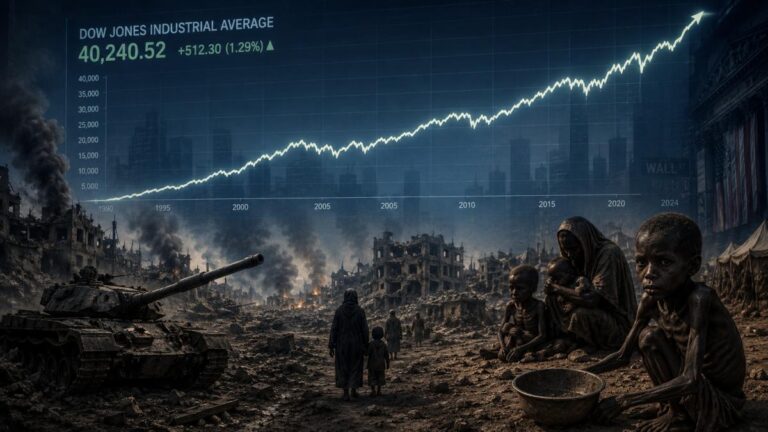
War headlines. Oil shocks. Rent that swallows a paycheck. And somehow, against all of it, the index prints another record. The instinct is to call the whole thing a casino, rigged and detached, a number that means nothing. That instinct is half right and far more dangerous than the casino theory, because the market is not detached at all. It is measuring something real. It is just measuring something most people were never told to look at.

Oil markets do not deal in nuance. They deal in headlines, and the headline this week was unambiguous: the war is over, the Strait of Hormuz reopens, sell the premium. Brent crude has obliged, sliding toward $78 per barrel and erasing roughly 38 percent of its value since the April peak, with the steepest legs of that decline landing in the two sessions following the announcement that Washington and Tehran had signed a memorandum of understanding to end hostilities and lift the naval blockade.

Eighteen months ago, the business case for replacing a human team with software fit on a single slide. Salary, benefits, and overhead on one side; a per-token API rate on the other. The API rate was a rounding error, and it was getting cheaper every quarter. The decision looked obvious, which is exactly the kind of decision that should make a contrarian nervous.

Every cycle hands contrarians the same temptation: wait for the miners to break, then back up the truck. The logic is seductive because it has worked before. When the people who literally manufacture the asset can no longer afford to keep the machines running, the marginal seller is exhausted, the float tightens, and price tends to find a floor. The problem with treating that as a mechanical buy signal in 2026 is that the conditions which made it reliable have quietly eroded, and the data this month says the squeeze is genuine but unfinished.