Physical Address
304 North Cardinal St.
Dorchester Center, MA 02124
Physical Address
304 North Cardinal St.
Dorchester Center, MA 02124


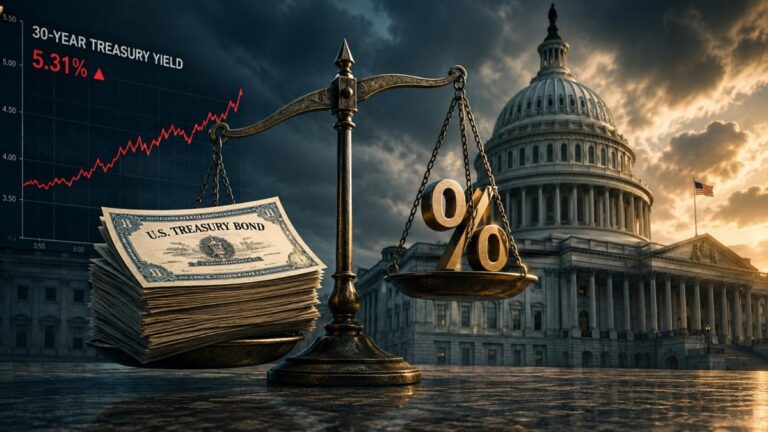
There is a genre of financial content that has learned exactly how to hold your attention. It opens with a real number, layers three plausible-sounding causal steps on top of it, and lands on the collapse of the global monetary order. The current specimen making the rounds combines the $40 trillion debt milestone, the long-bond selloff, and AI capital spending into a single narrative in which the United States is one auction away from insolvency.
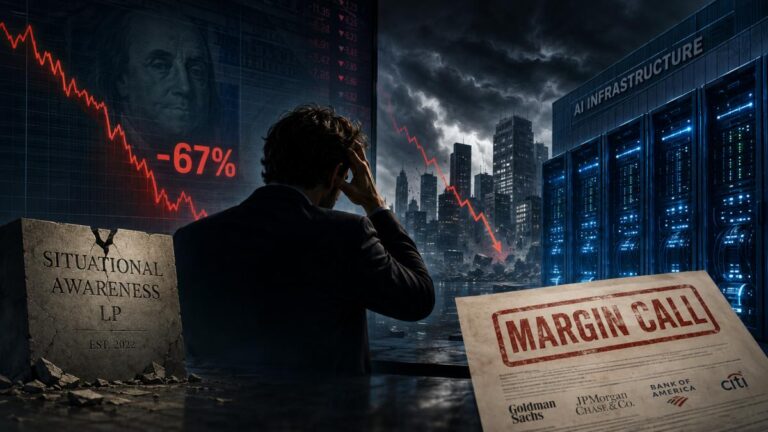
For about eighteen months, Leopold Aschenbrenner looked like the man who had worked out the AI trade before anyone else. His hedge fund, Situational Awareness, was built on a thesis that was easy to state and hard to argue with: artificial intelligence would demand an extraordinary quantity of compute, memory, data centre capacity and electricity. If that was right, the companies supplying the physical backbone of the boom stood to be among the decade's biggest winners.
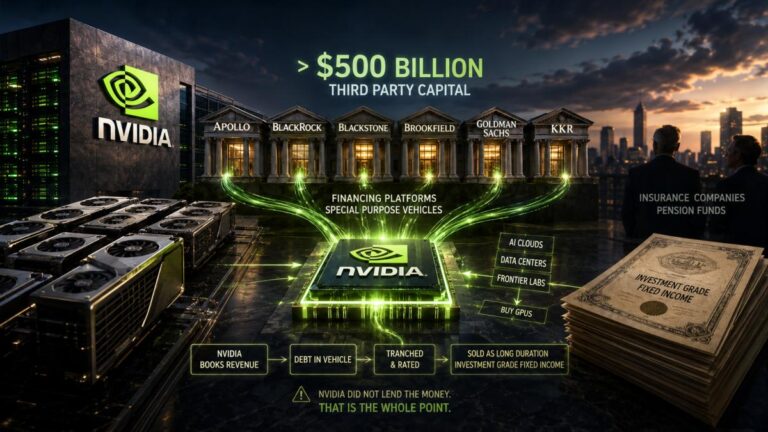
There is a version of the AI financing story that gets told as vendor financing, with Lucent and Nortel as the cautionary tale. Supplier lends to customer, customer buys supplier's product, revenue looks spectacular until the loans go bad and the whole edifice reverses. It is a good story and it is roughly the right shape, but it misses the most important structural feature of what was announced this month, which is that the supplier has arranged for someone else to hold the paper.
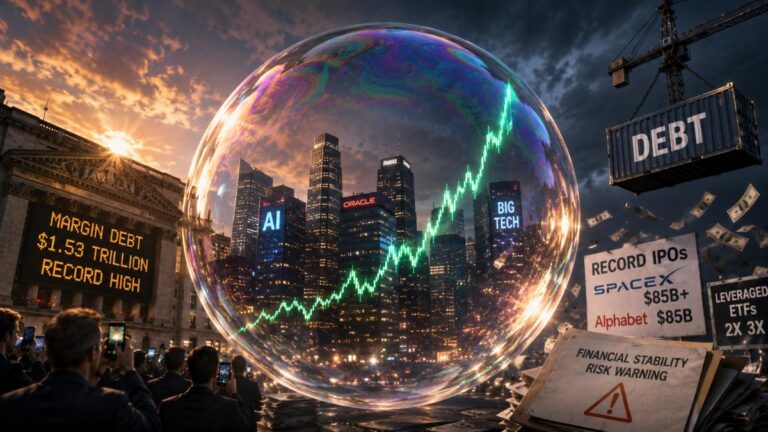
Bubbles do not announce themselves. They leave residue. Debt piles up somewhere it did not used to live, the people closest to the assets quietly sell, regulators publish careful documents nobody reads, and the price of risk drifts to a level that only makes sense if nothing can go wrong. None of it tells you the date. All of it tells you the terrain.

Every condition the safe-haven thesis asked for has now arrived. Bitcoin is still trading at half its peak. Start with the tape, because the tape is the argument. Bitcoin sits near $63,000. Its record high was $126,080, which means the asset is down roughly fifty percent from the top and has been grinding lower beneath every major daily moving average — not a crash, a slow bleed. Over the same stretch, the S&P 500 printed a record high and closed out its third consecutive weekly gain. Gold is hovering around $4,400 an ounce after a year that most institutions still describe as structurally supported.

The most popular argument in Western politics right now is a slogan: tax wealth, not work. Its most effective salesman is Gary Stevenson, a former Citibank trader turned YouTube economist with more than 1.6 million subscribers, a Channel 4 documentary, and a speaking tour that has taken the pitch to Australia.

Every market cycle produces the same seductive argument. A sector is reshaping the economy, its revenue lines are bending upward at improbable angles, and the conclusion writes itself: buy the fastest growers and let compounding do the rest. Right now that argument is being made about artificial intelligence infrastructure, where hyperscaler capital spending is running at roughly two billion dollars a day and analysts are openly debating whether the entire sector is priced for perfection. The logic feels obvious. It is also incomplete, and the missing piece is the one that has separated wealth-building investors from cautionary tales for a century.

On 4 August, Vladimir Putin signed the Law on Digital Currencies and Digital Rights. The headlines wrote themselves: Russia legalises crypto. It is a tidy line, and it is wrong in a way that matters, because it collapses two separate pieces of legislation into one story and then draws the opposite conclusion from the one the architecture supports.

There is a line doing the rounds at every energy conference from Paris to Cape Town this year: everything favours Africa now. Underexplored basins. Fiscal reform. Europe structurally short of gas. A Gulf chokepoint that has spent six months reminding the world what concentration risk feels like.

In April, Uber's chief technology officer told The Information that the company had spent its entire 2026 artificial intelligence budget. It was four months into the year. Nobody had misused anything. Engineers had used Claude Code for precisely the work it was built to do: parallel agent execution, large scale refactoring, automated test generation. Praveen Neppalli Naga reported burning $1,200 in a single two hour session during a personal demo of the tool.