Physical Address
304 North Cardinal St.
Dorchester Center, MA 02124
Physical Address
304 North Cardinal St.
Dorchester Center, MA 02124

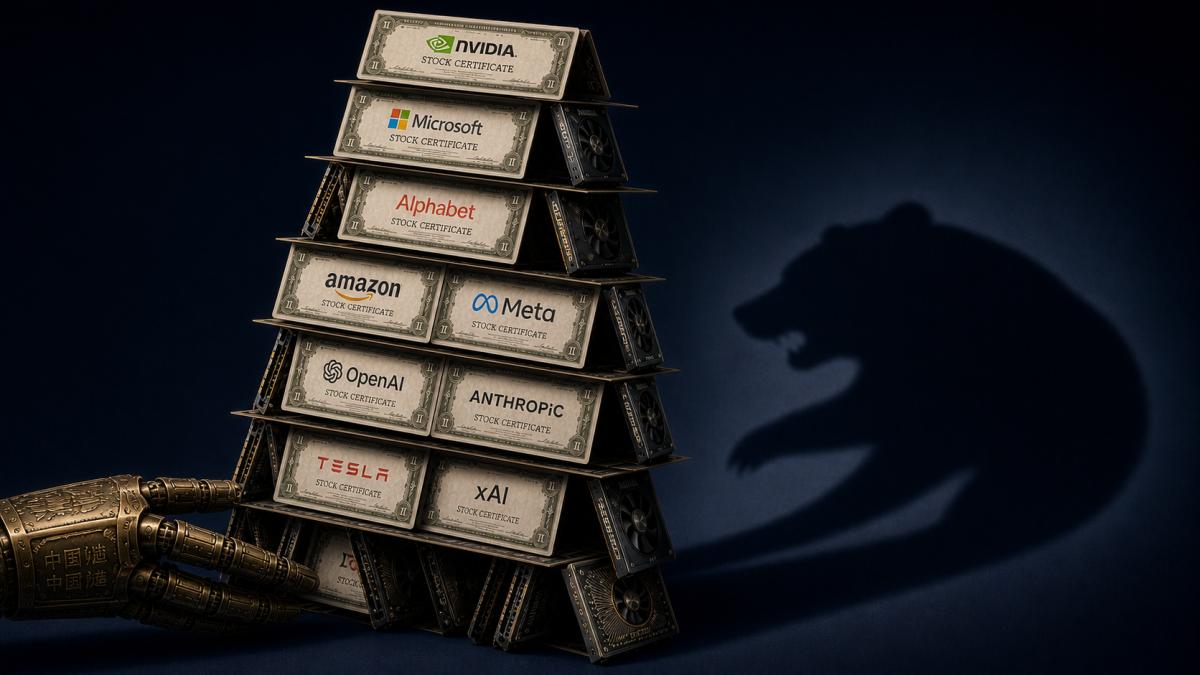
Roughly 40 percent of the S&P 500's market capitalisation now sits in seven technology names whose forward earnings are tightly coupled to a single thesis: that artificial intelligence will be a generational productivity engine, and that the value created will accrue overwhelmingly to American companies. That thesis has held up impressively over the last two years. It is also, in 2026, beginning to fracture in ways that almost nobody is pricing in.
Roughly 40 percent of the S&P 500’s market capitalisation now sits in seven technology names whose forward earnings are tightly coupled to a single thesis: that artificial intelligence will be a generational productivity engine, and that the value created will accrue overwhelmingly to American companies. That thesis has held up impressively over the last two years. It is also, in 2026, beginning to fracture in ways that almost nobody is pricing in.
The fracture is not coming from a recession, an interest rate shock, or a regulatory crackdown. It is coming from open-source software released for free by a Chinese hedge fund spinout, running on chips manufactured in Shenzhen, and adopted quietly by enterprise IT departments across the Western world. The economic risk this represents is not a tail event. It is the central trade of the next decade, and it is hiding in plain sight.
The numbers are no longer ambiguous. On 24 April 2026, DeepSeek released a preview of its V4 model series, with the V4-Pro variant claiming benchmark performance within striking distance of OpenAI’s GPT-5.4 and Google’s Gemini 3.1 Pro. According to Fortune’s reporting on the launch, DeepSeek V4-Pro costs $3.48 per million output tokens, compared to roughly $25 for Anthropic’s Claude and $30 for OpenAI’s flagship. The smaller V4-Flash variant costs just $0.28 per million tokens.
That is not a small discount. That is roughly a tenfold gap, and the model is open-weight, meaning enterprises can download it, run it on their own hardware, and avoid sending data offshore entirely. For the chief technology officer of a mid-sized bank, an insurer, or a logistics company, this is not a marginal decision. The closed proprietary models from American labs are demonstrably better at frontier reasoning tasks, but very few enterprise workloads actually require frontier reasoning. The vast majority of what companies want AI to do is read documents, write code, summarise meetings, and answer customer queries. For all of that, the Chinese open-source alternative is now good enough at a fraction of the cost.
The MIT Technology Review put it bluntly in their analysis of why V4 matters: companies can now access frontier-adjacent capabilities without skyrocketing API bills. That sentence reads benignly until you realise what it implies for the revenue projections baked into the valuations of every closed-source US AI lab and the hyperscalers that host them.
Open source as a public good only works when somebody is willing to absorb the cost of building it. In China, that role is played by the state, which subsidises strategic technology sectors as a matter of industrial policy. When a domestic competitor gives away the model for free, it kills the margins of any foreign rival trying to monetise the same capability. This is not a market accident. It is the explicit playbook of a country that knows it is technologically behind and has decided to compete on price rather than performance.
In the United States, no such mechanism exists. Meta abandoned its Llama open-source push after a year of escalating costs and unclear monetisation. OpenAI released a single open-weight model called gpt-oss as a goodwill gesture and otherwise focused entirely on its proprietary subscription business. Anthropic has no open-source strategy whatsoever and is publicly betting the company on a straight shot to artificial general intelligence. Google’s Gemma series is impressive but explicitly designed for on-device use rather than enterprise deployment.
The only American actor with both the financial firepower and the structural incentive to fund open-source frontier AI is Nvidia. In March 2026, the company announced the Nemotron Coalition, an alliance with eight leading AI labs including Mistral, Perplexity, and Thinking Machines, backed by a $26 billion commitment over five years. The logic is straightforward. Nvidia does not care if anyone makes money from the model. It only cares that the model runs on Nvidia hardware. Every other potential American sponsor of open-source AI faces a margin death spiral that Nvidia is structurally immune to.
That is the entire defence of the US open-source ecosystem. One company. One CEO. One geopolitical interest aligned with a public good. It is a thinner moat than the market currently appreciates.
The model layer is the visible part of this story. The chip layer is where the long-term economic damage actually lives. DeepSeek V4 was reportedly trained partly on Huawei Ascend processors rather than Nvidia GPUs, and Huawei has now positioned its 950PR chip as the inference workhorse of choice for Chinese enterprises. According to Tom’s Hardware coverage of the chip race, Beijing has instructed Chinese tech companies to limit their use of Nvidia chips to overseas operations and lean on domestic alternatives at home.
The implication is structural. If Chinese open-source models become the default substrate for enterprise AI globally, and those models are increasingly optimised for Chinese silicon, then the world’s AI infrastructure starts standardising on chips that the United States has explicitly tried to prevent China from building. That outcome would be a strategic catastrophe of the first order, and it would unfold not through espionage or war but through the entirely mundane mechanism of price competition winning customers.
Nvidia’s China revenue has already collapsed from $20.3 billion in fiscal 2024 to a projected $12 to $14 billion in fiscal 2026, even as global AI capex hits record levels. That is not a story of Nvidia weakness. It is a story of a market being walled off and rebuilt on different foundations.
For the contrarian investor, the question is not whether the closed-source US labs will eventually achieve some form of artificial general intelligence and monetise it. They might. The question is what happens to the valuations baked into the seven companies that dominate the S&P 500 if, in the meantime, enterprise AI spending bifurcates into a thin sliver of frontier work that goes to OpenAI and Anthropic and a fat majority of routine work that goes to whoever sells inference cheapest.
In that bifurcated market, the cheapest inference provider is going to be whoever can run an open-source Chinese model on commodity hardware at scale. That is not an OpenAI customer. That is not an Anthropic customer. And in many cases, that is not even an Nvidia customer.
The CNBC reporting on the V4 launch noted that traders have already priced in the reality that Chinese AI is competitive and cheaper. That is partially true, but only at the level of headline narrative. What has not been priced in is the second-order effect on chip demand, on hyperscaler capex returns, on the margins of the AI-as-a-service business models that justify the current infrastructure buildout.
This is exactly the kind of structural inefficiency that contrarian capital allocators look for. The market consensus is that AI capex is a one-way bet on American technological supremacy. The reality on the ground in 2026 is that the supply curve for AI capability is being flattened by a country that has decided to compete by giving the product away. Those two views cannot both be right.
There are a few directions that follow from this analysis. The first is to question the concentration risk in any portfolio that holds market-weighted exposure to US large-cap technology. If the AI revenue thesis for those names erodes by even 20 percent over the next three years, the multiple compression will be brutal. The second is to think carefully about which infrastructure plays actually benefit from cheaper, more democratised AI rather than depending on a high-margin closed-source future. Nvidia’s open-source pivot is interesting precisely because it acknowledges the problem and tries to position the company as the winner regardless of which model layer dominates.
The third is to recognise that the democratisation of institutional-grade AI tools is not a future event. It is happening now, and it is accessible to retail investors as well as enterprises. The same forces that allow a Chinese hedge fund to ship a frontier-adjacent model for free also allow individual analysts to run sophisticated multi-agent research systems on their own hardware. The piece on how the open-source hedge fund stack now runs on a laptop covers one specific application of this trend.
The investor takeaway is uncomfortable but clear. The market is treating American AI dominance as a settled question and pricing equities accordingly. The actual technological and geopolitical landscape suggests it is anything but. When the consensus and the underlying reality drift this far apart, the asymmetric opportunity is in positioning for the gap to close. Quietly, while everyone else is still looking the other way.
The views expressed in this article are for informational purposes only and should not be considered financial advice. Always conduct your own research and consult with a qualified financial advisor before making investment decisions.