Physical Address
304 North Cardinal St.
Dorchester Center, MA 02124
Physical Address
304 North Cardinal St.
Dorchester Center, MA 02124

In the closing months of the last great bull cycle, the dominant narrative was simple: innovation would outrun instability. Investors piled into long-duration growth assets, trusting that central banks could fine-tune the economy and that technological acceleration, especially around artificial intelligence, would justify almost any valuation multiple.
In the closing months of the last great bull cycle, the dominant narrative was simple: innovation would outrun instability. Investors piled into long-duration growth assets, trusting that central banks could fine-tune the economy and that technological acceleration, especially around artificial intelligence, would justify almost any valuation multiple.
That confidence is fading fast.
A different conversation is now taking over on X (formerly Twitter), and it is not subtle. Threads about gold are going viral again. Commodity charts are being reframed not as cyclical trades but as strategic hedges. Energy infrastructure, once considered the dullest corner of any portfolio, is being recast as a cornerstone of long-term resilience. And running through all of it is a single, unifying idea: the anti-fiat hedge is back.
This is not a fringe narrative. It is a shift in how capital is positioning itself for a world that feels structurally less stable, less predictable, and more politically entangled than at any point since the early 2000s. Understanding why this is happening, and how to respond, is one of the more important investment questions of this decade.
For years, gold was dismissed in certain circles as a relic, an asset that “just sits there” while equities compound and technology reshapes the world. That dismissal relied on a crucial assumption: that the monetary system itself was fundamentally stable, and that policymakers could be trusted to maintain it indefinitely.
That assumption is now under serious pressure.
Across financial media and social platforms, the tone has shifted from curiosity to conviction. Influential macro accounts are no longer asking if gold deserves a place in portfolios. They are debating how much. The catalyst is not just price momentum. It is what is happening beneath the surface at the institutional and sovereign level.
Central banks around the world are aggressively accumulating gold at a pace not seen in decades. According to the World Gold Council, central bank gold buying has remained at historically elevated levels, with emerging market institutions leading the charge. This is not retail speculation. It is sovereign positioning. Countries are actively diversifying away from overexposure to any single currency system, particularly the US dollar, and gold remains the most neutral and universally recognised reserve asset available.
The implications are profound. When central banks buy gold, they are not chasing returns. They are hedging systemic risk. And when large institutional investors begin to mirror that behaviour, it signals a deeper shift in market psychology: from maximising upside to protecting against downside scenarios that are no longer considered improbable.
One of the most active debates in macro investing right now is not whether to hedge. It is how.
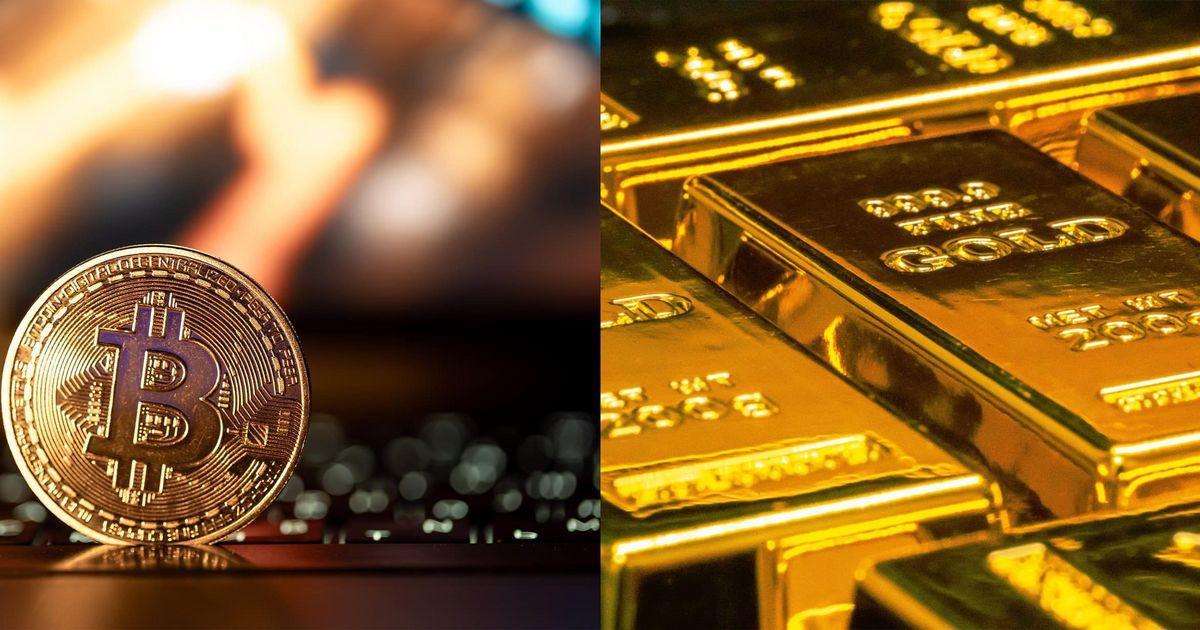
On one side, you have gold: tangible, time-tested, and universally recognised across cultures and political systems. On the other, you have Bitcoin: digital, decentralised, and increasingly seen as a modern alternative to fiat monetary systems.
What is striking is how this debate has evolved. It has moved well beyond rivalry. The dominant view emerging among serious investors is increasingly: own both.
Gold offers stability and a multi-thousand-year track record. It has survived wars, currency collapses, hyperinflation, and regime changes. It does not depend on networks, software protocols, or adoption curves. It exists as a store of value entirely outside the reach of any single government or institution.
Bitcoin, by contrast, offers asymmetry. It is more volatile, but also more responsive to global liquidity cycles and capital flows. It represents a bet not just against fiat currency erosion, but on a parallel financial architecture emerging alongside the traditional one. Research from Fidelity Digital Assets has argued that Bitcoin occupies a fundamentally different category to other digital assets, functioning more like digital gold than a speculative technology play.
For defensive investors, this combination carries genuine strategic logic. Gold anchors the portfolio in times of stress. Bitcoin introduces optionality and exposure to monetary system disruption. Together, they form a dual-layer hedge against both currency debasement and the broader transformation of global finance.
This is not theoretical anymore. Portfolio construction frameworks being shared across institutional and retail circles increasingly include both assets, not as speculative plays, but as core components of a modern defensive allocation.
If gold is the monetary hedge, commodities are the geopolitical hedge.
The world is fragmenting along political and economic fault lines. Supply chains are being reshaped by alliance structures, sanctions regimes, and strategic competition. Energy markets are no longer purely economic instruments. They are tools of statecraft. Food security, resource nationalism, and targeted trade restrictions are all firmly back in play.
This is why commodities are being reframed across financial media, not as cyclical growth trades, but as insurance against disruption.
Oil is no longer just about global demand forecasts. It is about chokepoints, conflict zones, and strategic reserve policies. Agricultural commodities reflect not just seasonal weather patterns, but export controls and domestic political decisions in major producing nations. Industrial metals are increasingly tied to infrastructure buildouts, electrification programmes, and national security manufacturing priorities.
In this environment, commodities take on a new and important role. They become assets that perform not when everything goes right, but when things go wrong. That is the essence of genuine defensive investing, and it is a quality that has been underpriced for most of the past decade.
While gold and commodities dominate the macro headlines, energy infrastructure is emerging as a quieter but equally important long-term theme.
The core idea gaining traction is straightforward: energy demand is becoming structurally non-optional.
The explosive growth of AI, data centres, and large-scale electrification is driving unprecedented demand for reliable baseload power. At the same time, geopolitical tensions are forcing governments to secure and localise their energy supply chains rather than depend on potentially hostile trading partners. The result is a sustained surge in capital investment into grids, pipelines, storage systems, and generation capacity across both developed and emerging markets.
Unlike many sectors, energy infrastructure benefits from structural tailwinds that are largely independent of short-term economic cycles. The International Energy Agency projects that global clean energy investment will exceed USD 2 trillion in 2024, a figure that underscores just how non-discretionary this capital spending has become.
Governments need it. Corporations cannot function without it. Consumers have no substitute for it. This creates a rare and valuable dynamic: highly predictable demand in an unpredictable world. For defensive investors building portfolios designed to weather volatility, that kind of structural resilience is difficult to replicate elsewhere.
At the heart of the hard asset revival is a concern that rarely makes front-page headlines in plain terms: currency debasement.
When governments run persistent fiscal deficits and central banks expand their balance sheets to finance them, the value of money does not collapse overnight. It erodes gradually. Purchasing power declines year after year. Asset prices rise, not necessarily because the underlying assets have become more productive, but because the currency used to measure them is worth progressively less.
This is the silent tax of inflation, and it is one that disproportionately punishes savers and those holding cash or nominal bonds over long time horizons.
Hard assets offer a meaningful counterbalance. They are not liabilities of any government or central bank. They cannot be printed or diluted at the stroke of a policy decision. Their supply is constrained either physically, as with gold and oil, or structurally, as with infrastructure assets that take years and billions of capital to build.
A long-term study published by the Bank for International Settlements examining historical inflation episodes found that real assets have consistently outperformed paper assets during periods of sustained monetary expansion. This pattern is not coincidence. It reflects the fundamental difference between assets with a fixed or constrained supply and those whose value depends entirely on institutional credibility.
Perhaps the most underappreciated aspect of the current hard asset trend is who is actually driving it.
It is not retail investors seeking excitement. It is not hedge funds looking for a short-term momentum play.
It is central banks.
By systematically increasing gold reserves, central banks are signalling a desire to reduce concentrated exposure to any single currency or jurisdiction. This is not a short-term trade. It is a multi-year strategic realignment with consequences that will ripple through global asset markets for decades.
When institutions with the longest time horizons, the deepest access to macro intelligence, and the least tolerance for short-term noise begin reallocating in this way, it carries a weight that no individual investor narrative can match.
This theme intersects directly with the broader de-dollarisation trend that is reshaping global reserve management. For a deeper look at how BRICS-driven monetary shifts are accelerating this process, our analysis of the de-dollarisation trade unpacks the investment implications in detail.
The resurgence of hard assets reflects a broader psychological shift that is quietly reordering investment priorities.
For most of the past decade, the overriding goal was to maximise returns. Risk was something to be managed algorithmically, not genuinely feared. Liquidity was always available. Drawdowns were temporary disruptions on a long upward trajectory.
That environment is changing in ways that feel less like a cycle and more like a structural transition. Research from JPMorgan’s long-term capital market assumptions consistently highlights that expected returns from traditional 60/40 portfolios are materially lower over the coming decade than they were in the one just passed. In a lower-return environment, protecting what you have becomes as important as growing it.
Hard assets fit naturally into this new framework. They may not always lead during bull markets driven by liquidity and sentiment. But they provide genuine resilience when conditions deteriorate, when confidence in institutions erodes, and when the assumptions that underpinned the previous cycle are revealed to have been less solid than they appeared.
Increasingly, that trade-off is being viewed not as a compromise on returns, but as a rational response to a riskier world.
It is important to be clear about what this trend represents, and what it does not.
This is not a wholesale rejection of the financial system. Equities, bonds, and fiat currencies will continue to play central roles in global capital markets. The institutions that manage them are not disappearing. But the unquestioned assumption of systemic stability that once underpinned them is being seriously and legitimately questioned by the most sophisticated investors on the planet.
Hard assets are not replacing the system. They are hedging it.
They represent a parallel layer of financial security, a way to store value that is less dependent on policy decisions, political continuity, or the sustained credibility of financial engineering. That is why this shift matters beyond the price action in any single commodity or asset class.
It is not about chasing performance. It is about acknowledging uncertainty.
And in a world where that uncertainty is becoming structural rather than cyclical, the return of the anti-fiat hedge is not just a trend.
It is a signal worth taking seriously.
Disclaimer: This article is for informational purposes only and does not constitute financial advice. Always conduct your own research before making investment decisions.