Physical Address
304 North Cardinal St.
Dorchester Center, MA 02124
Physical Address
304 North Cardinal St.
Dorchester Center, MA 02124

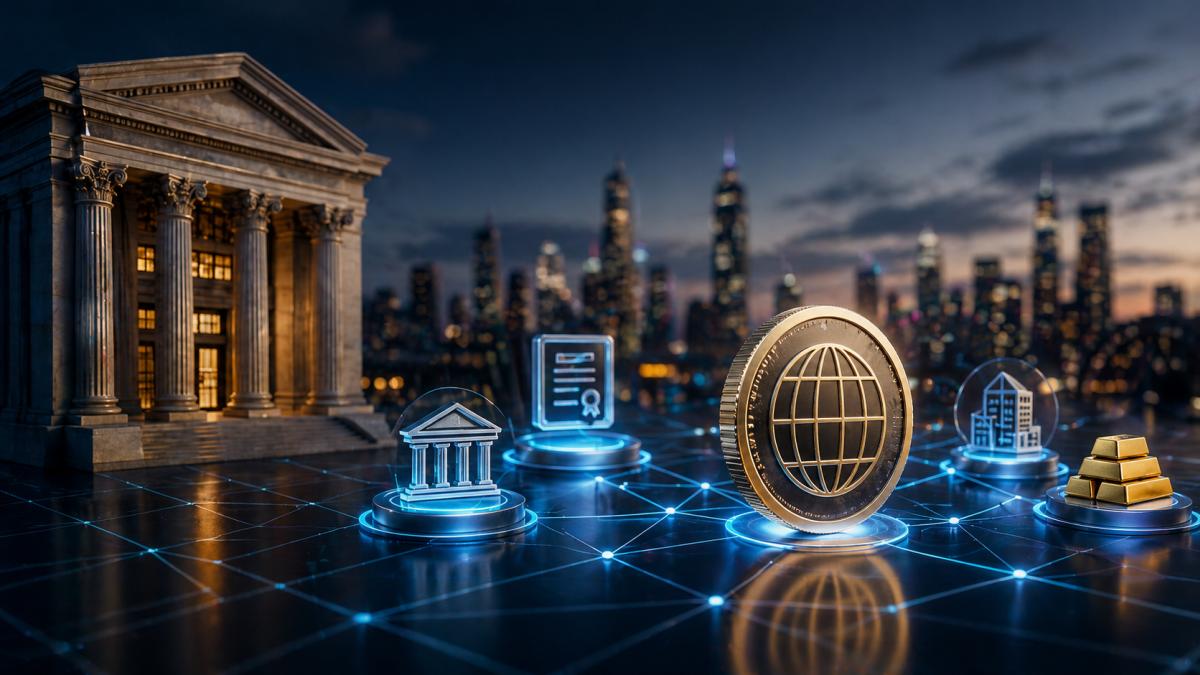
The narrative around crypto is evolving again. For years, the space was dominated by speculation, innovation cycles, and volatile retail-driven markets. Today, a quieter but far more significant transformation is underway. Real-world assets, often referred to as RWAs, are moving on-chain at an accelerating pace.
This is not just another trend. It represents a structural shift in how capital is issued, managed, and traded. Treasuries, private credit, and even equities are being tokenized and integrated into blockchain ecosystems. Estimates suggest that tens of billions of dollars in real-world value are already represented on-chain, and that number continues to grow.
The narrative around crypto is evolving again. For years, the space was dominated by speculation, innovation cycles, and volatile retail-driven markets. Today, a quieter but far more significant transformation is underway. Real-world assets, often referred to as RWAs, are moving on-chain at an accelerating pace.
This is not just another trend. It represents a structural shift in how capital is issued, managed, and traded. Treasuries, private credit, and even equities are being tokenized and integrated into blockchain ecosystems. Estimates suggest that tens of billions of dollars in real-world value are already represented on-chain, and that number continues to grow.
The implication is clear. Wall Street is no longer watching crypto from the sidelines. It is actively building within it.
What Real-World Asset Tokenization Actually Means
At its core, tokenization is the process of representing ownership of a real-world asset on a blockchain. This could be a government bond, a corporate loan, a piece of real estate, or a share in a company. Instead of holding these assets through traditional intermediaries, investors hold digital tokens that correspond to them.
These tokens can be transferred, traded, or used as collateral within decentralized systems. This creates a bridge between traditional finance and crypto infrastructure.
The appeal is straightforward. Blockchain technology offers faster settlement, greater transparency, and potentially lower costs. It also enables fractional ownership, opening access to assets that were previously restricted to large institutions.
For a broader overview of how tokenization works, BlackRock’s tokenization explainer is a useful starting point.
Why Institutions Are Moving In
The involvement of institutional players is one of the most important aspects of this shift. Large asset managers, banks, and financial firms are increasingly exploring or deploying tokenized products.
The motivation is not ideological. It is practical.
Tokenization allows institutions to improve efficiency in areas such as settlement and collateral management. It also creates new distribution channels. Products that were once limited to specific markets can now be accessed globally through blockchain networks.
In addition, the demand for yield has pushed institutions to explore alternative structures. Tokenized treasuries, for example, allow investors to earn stable returns while remaining within crypto ecosystems.
This is particularly attractive in environments where traditional yields are competitive with or exceed speculative crypto returns.
To understand how institutional adoption is accelerating, this Reuters report on BlackRock’s tokenized fund launch covers the watershed moment in detail.
Tokenized Treasuries and the Yield Narrative
One of the most discussed segments within RWA tokenization is tokenized treasuries. These products provide exposure to government bonds through blockchain-based tokens. Investors can earn yield while maintaining the flexibility of on-chain assets.
This has created a new narrative within crypto. Instead of chasing volatile gains, some participants are focusing on stable, predictable income streams.
On X, threads explaining how to earn yield from tokenized treasuries have gained significant traction. Influencers break down the mechanics, compare returns, and highlight the relative safety of these instruments compared to traditional DeFi yields.
The appeal is obvious. In a market that has experienced repeated cycles of boom and bust, the idea of earning consistent returns backed by government debt is compelling.
However, this also introduces new considerations. These assets are only as secure as the structures that support them. Custodianship, legal frameworks, and counterparty risk all play a role.
Ondo Finance and Franklin Templeton’s FOBXX fund are two of the most prominent live examples of this structure in action.
The Role of Credit and Private Markets
Beyond treasuries, private credit is emerging as another major category within RWA tokenization. Loans that were once confined to traditional financial systems are now being issued and managed on-chain.
This creates opportunities for investors to access yields that were previously difficult to reach. It also introduces new risks.
Private credit markets are inherently less transparent than public markets. When these assets are tokenized, the complexity does not disappear. It is simply wrapped in a digital format.
Investors must still assess the underlying creditworthiness of borrowers, the structure of the deals, and the reliability of intermediaries.
This is where due diligence becomes critical. The ease of access provided by tokenization can create a false sense of simplicity. In reality, these instruments require careful evaluation.
Maple Finance and Centrifuge are two platforms at the forefront of on-chain private credit, and studying how they structure deals offers useful insight into how this market is evolving.
X as the Narrative Engine
While the infrastructure for tokenization is being built by institutions, the narrative around it is being shaped on X. This is where sentiment forms, spreads, and influences market behavior.
Currently, the tone is largely bullish. Many influential voices describe RWA tokenization as the next major phase of crypto adoption. The involvement of established financial players adds credibility to this view.
Threads discussing yield strategies, risk comparisons, and portfolio allocation are widely shared. These discussions help to educate participants and drive interest.
At the same time, there is an ongoing debate. Some argue that the integration of traditional assets into crypto undermines the original vision of decentralization. Others see it as a necessary evolution that brings stability and legitimacy.
This tension reflects a broader question. Is crypto becoming an extension of traditional finance, or is it transforming it?
Is This Just TradFi 2.0
One of the most common critiques of RWA tokenization is that it simply replicates existing financial systems on a new technological layer. If the same institutions control the assets, and the same regulatory frameworks apply, what has really changed?
This is a valid concern.
In many cases, tokenized assets rely on centralized entities for custody, compliance, and legal enforcement. The blockchain component improves efficiency, but it does not eliminate traditional dependencies.
However, there are also meaningful differences.
Tokenization introduces programmability. Assets can be integrated into smart contracts, enabling new forms of financial interaction. It also allows for greater interoperability between systems.
These features create possibilities that do not exist in traditional finance. Whether they will be fully realized remains to be seen.
For now, the reality is a hybrid model. Elements of decentralization coexist with institutional control.
How This Changes Crypto’s Risk Profile
Perhaps the most important aspect of the RWA shift is how it alters the risk profile of crypto investing. This is where the implications become particularly significant.
Historically, crypto markets have been driven by speculative assets with high volatility. Risk was concentrated in price swings, technological uncertainty, and regulatory developments.
With the introduction of RWAs, new forms of risk enter the system.
First, there is counterparty risk. Tokenized assets often depend on custodians, issuers, and legal structures. If any of these fail, the value of the token can be affected.
Second, there is regulatory risk. As traditional assets move on-chain, they attract greater scrutiny from regulators. Changes in policy can impact how these products are issued and traded.
Third, there is liquidity risk. While tokenization can improve access, it does not guarantee deep markets. In times of stress, liquidity can dry up quickly.
At the same time, some risks are reduced.
Exposure to stable assets such as treasuries can lower overall portfolio volatility. Predictable yields provide a buffer against market downturns. The integration of real-world value can also enhance the credibility of the ecosystem.
The result is a more complex risk landscape. Investors must balance the benefits of stability with the introduction of new dependencies.
For those looking to understand broader crypto market dynamics, Market Mind Investor’s crypto analysis offers a contrarian perspective on where these trends are heading.
The Convergence of Two Financial Worlds
What we are witnessing is not the replacement of one system by another. It is the convergence of two distinct financial worlds.
Traditional finance brings scale, regulation, and established asset classes. Crypto brings innovation, accessibility, and new technological capabilities.
Tokenization sits at the intersection of these forces.
This convergence is likely to accelerate. As infrastructure improves and regulatory clarity increases, more assets will move on-chain. New products will emerge, blending features from both systems.
The pace of change will depend on multiple factors, including technological development, market demand, and institutional participation.
What Investors Should Watch Next
For investors, the key is to stay informed and adaptable. The RWA trend is still in its early stages, and its full impact has yet to be realized.
Several indicators are worth watching.
The growth of tokenized treasury products will provide insight into demand for stable yield. The expansion of private credit markets will reveal how risk is being managed. Institutional announcements will signal the level of commitment from major players.
Equally important is the evolution of narrative on X. Sentiment can influence adoption, and shifts in perception can drive market behavior.
Understanding both the technical and social dimensions of this trend will be essential.
Conclusion: A New Foundation for Crypto Markets
The rise of real-world asset tokenization marks a turning point for the crypto industry. What began as a niche experiment is evolving into a foundational layer for global finance.
Wall Street is not just participating. It is helping to shape this new landscape.
For investors, this creates both opportunity and complexity. The integration of traditional assets introduces stability, but also new forms of risk. Navigating this environment requires a broader perspective and a deeper understanding of how these systems interact.
The $30B tokenization shift is only the beginning. As more capital moves on-chain, the lines between crypto and traditional finance will continue to blur.
The future of markets may not belong to one system or the other. It may belong to the space where they meet.