Physical Address
304 North Cardinal St.
Dorchester Center, MA 02124
Physical Address
304 North Cardinal St.
Dorchester Center, MA 02124


For two decades, the largest technology companies were the closest thing markets had to a sure bet. They generated cash faster than they could spend it, returned billions to shareholders through buybacks, and carried balance sheets pristine enough to make sovereign treasuries look leveraged. That model just cracked, and the crack is worth understanding before deciding what it means for a portfolio.
For two decades, the largest technology companies were the closest thing markets had to a sure bet. They generated cash faster than they could spend it, returned billions to shareholders through buybacks, and carried balance sheets pristine enough to make sovereign treasuries look leveraged. That model just cracked, and the crack is worth understanding before deciding what it means for a portfolio.
In its most recent quarter, Alphabet reported negative free cash flow for the first time since it went public in 2004. The deficit came in at roughly $5.9 billion, even though the underlying business still generated $39.1 billion in operating cash flow. The reason is not that the business stopped working. It is that capital expenditure doubled year over year to $44.9 billion in a single quarter, overwhelming everything the core operation produced. Management then raised full-year capex guidance to a range of $195 billion to $205 billion, the second increase in three months, and told analysts that spending in the following year would rise “significantly.” Buybacks went to zero for the second consecutive quarter.
This is the detail that matters more than any single earnings line. The market is not reacting to a bad business. It is reacting to a good business voluntarily converting itself into a different kind of business, and doing so at a scale that removes the margin of safety investors had priced in for twenty years.
The old profile was simple to underwrite. Search advertising and cloud services threw off enormous margins, capital requirements were modest relative to revenue, and the excess flowed back to owners. An investor could treat these names as bond-like: dependable, defensive, and lightly cyclical. That is precisely why they anchored so many retirement portfolios.
The new profile is the opposite. Capital expenditure now consumes an historically unprecedented share of revenue, the highest in the company’s public life. The spend is concentrated in physical assets: servers, custom silicon, data-center shells, power contracts, and networking gear. Roughly sixty percent goes to compute hardware and forty percent to the buildings and grids that house it. These are not software margins. They are infrastructure economics, closer to a utility or a heavy-industry build-out than to the asset-light advertising machine of the past decade.
The financing tells the same story. Rather than fund the build purely from operating cash, Alphabet raised close to $50 billion through equity and preferred issuance and another $20 billion in senior notes, while long-term debt more than doubled from the prior year. When a company that could self-fund almost anything starts issuing stock and bonds to keep pace, the constraint is no longer ambition. It is physics and supply.
None of this is unique to one company. Independent analysis suggests the firm spending the most on capex in 2026 was simply the first to cross into negative territory, and that others may follow before year-end if operating cash growth decelerates while spending accelerates. Combined hyperscaler capital spending is on track to approach three-quarters of a trillion dollars in a single year.
The reported balance sheets are only half the picture, and arguably the less important half. A recent Nikkei investigation into five hyperscalers — Alphabet, Microsoft, Amazon, Meta, and Oracle — estimated their combined off-balance-sheet obligations at roughly $1.65 trillion. That figure now exceeds the approximately $1.35 trillion in debt these companies report outright. The hidden pile has grown roughly eightfold in four years.
These obligations are not fraudulent. They are data-center leases that have not yet commenced, GPU and server supply commitments, and joint ventures with private-credit funds, all of which sit in financial-statement footnotes rather than on the balance sheet itself until the underlying facilities go live. Meta is the starkest case, carrying an estimated $420 billion in such commitments, close to three times its visible debt. Oracle’s off-book obligations have grown more than thirtyfold in four years, much of it tied to a single enormous counterparty relationship.
The Bank for International Settlements has a name for this pattern: shadow borrowing. The concern is not that the accounting is illegal. It is that a firm can commit to paying for enormous capacity before that capacity earns a dollar, and standard leverage ratios will not reflect it in real time. Moody’s has flagged the related danger that many of these leases are pre-operational, meaning the obligation exists well before the revenue does. Morgan Stanley’s broader industry estimate puts total off-balance-sheet exposure closer to $1.8 trillion once purchase commitments and accounts-payable financing are included.
Layered on top is a timing mismatch in how the visible assets are treated. Hardware is depreciated over five to six years, so current-period earnings look robust precisely because a large share of the true economic cost has not yet hit the income statement. When one operator extended the assumed useful life of its servers, the accounting change alone added billions to reported earnings without a single additional unit sold. The problem is that AI accelerators may not age gracefully over a comfortable five-year schedule. Replacement cycles for cutting-edge compute can run far shorter than the bond durations financing them, which is the kind of mismatch that credit models tend to miss until it matters.
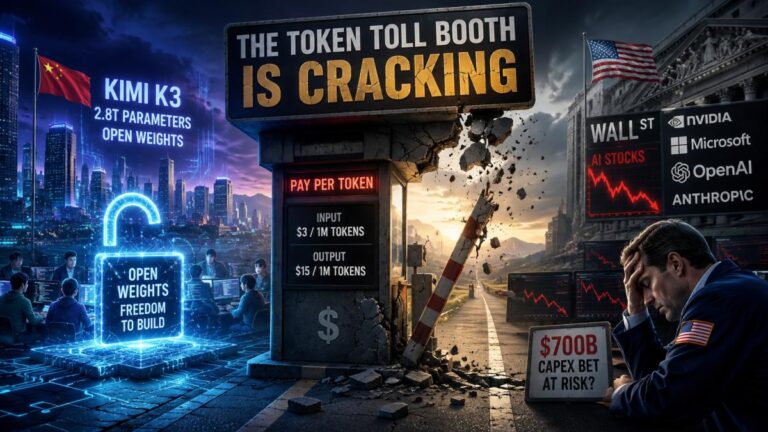
Underneath the capital story is a strategic fight that determines whether any of this spending earns a durable return. The immediate flashpoint is an accusation from a senior White House official that the Chinese lab Moonshot AI conducted large-scale distillation of Anthropic’s Fable model to build its Kimi K3 system, alongside allegations that it accessed restricted Nvidia GB300 hardware through Thailand. The Treasury Secretary followed with a warning that sanctions and export-list designations remain on the table.
It is worth being precise here, because the popular framing overstates the case. Distillation, in which a smaller model is trained on the outputs of a larger one, is a routine and widely used optimization technique, not inherently theft. And several independent researchers have publicly disputed the claim that distillation alone could account for Kimi K3’s capabilities, noting that the teacher model in question became publicly accessible only weeks before the Chinese model launched. There is, as one researcher put it, barely enough time for the story to be true.
The more revealing development is who lined up on each side. A coalition of twenty-five companies, led by Nvidia, Microsoft, and Meta and including Palantir, IBM, Dell, Hugging Face, and Mistral, published an open letter defending open-weight models and warning against sweeping restrictions on distillation. Nvidia’s chief executive used his first-ever post on the platform to promote it. Notably absent were the frontier-lab leaders whose models are the ones being copied, along with the two hyperscalers with the most to lose from a fully commoditized model layer.
That split is the real signal for investors. The coalition’s position, stripped of the patriotic framing, is that a cheap and commoditized frontier is good for their businesses, because most of them sell the infrastructure, tooling, or downstream applications rather than the frontier model itself. The letter is more measured than the “back off” caricature suggests, conceding that unlawful extraction of value from closed models is a legitimate concern best handled through targeted legal frameworks. But the underlying commercial logic is unmistakable.
Here is the uncomfortable synthesis. The bear case for these stocks is not that artificial intelligence disappoints. It is that it succeeds, gets cheaper, and gets commoditized, such that the firms spending most aggressively to build the frontier watch the economic value of that frontier compress toward zero even as usage explodes.
Consider the incentives. The frontier labs need the moat protected, because they spent the capital to build it and intend to charge for access. The infrastructure and application layer wants the moat gone, because commoditization drives volume through their businesses. Twenty-five of the largest names in the industry have now publicly aligned with the second camp. When the companies best positioned to know argue that the frontier should not be defensible, that is a statement about where they expect the returns to accrue, and it is not to the model itself.
This does not mean the build-out is irrational. Demand appears to be real, and for a company whose core franchise is directly threatened by AI-native competitors, spending to stay in the race may be genuinely existential rather than optional. The problem is that “we must spend or lose the business” and “this spending will earn an attractive return” are two very different investment theses, and the market spent two decades pricing these names on the second while they have quietly shifted to the first.
The practical takeaway is not a prediction of collapse. It is a reclassification. These are no longer the low-capital, cash-returning, bond-like holdings that justified their weight in conservative portfolios. They are high-capital, cash-consuming, strategically cornered bets on an uncertain and fast-commoditizing technology, funded increasingly with debt and equity issuance, and carrying obligations that standard leverage screens do not fully capture.
The dot-com era offers a rough template, not a forecast. The internet did transform the economy, exactly as promised. It also bankrupted a large share of the companies that spent most aggressively to build the early infrastructure, while value accrued later and elsewhere. A rational response to that kind of setup is not to short the technology or to abandon the sector wholesale. It is to insist on a margin of safety that the current prices, in many cases, no longer offer, to hold meaningful liquidity and high-quality defensive assets, and to watch the financing conditions closely, because in a capital-intensive arms race the constraint that eventually bites is almost always the cost and availability of money rather than the technology itself.
The pursuit of intelligence may well be endless. Capital is not. The gap between those two facts is where the risk now lives.
This article is general market commentary and does not constitute investment advice. Positions and prices referenced reflect reporting available at the time of writing and can change quickly.