Physical Address
304 North Cardinal St.
Dorchester Center, MA 02124
Physical Address
304 North Cardinal St.
Dorchester Center, MA 02124

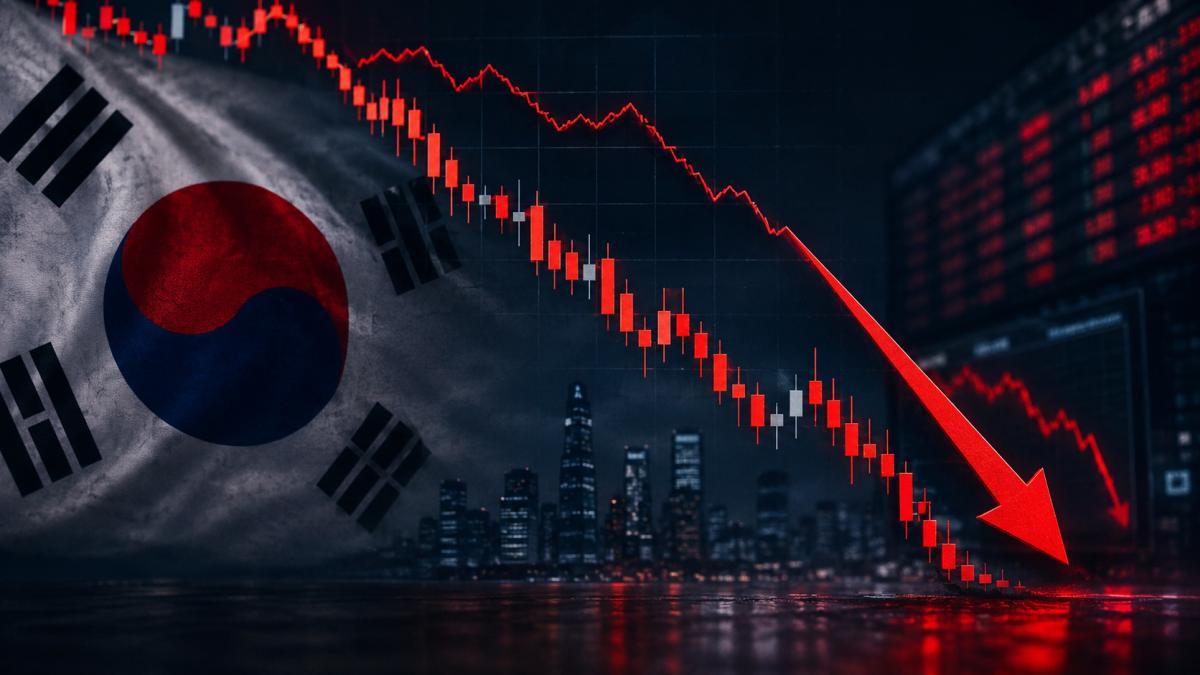
Three weeks ago, South Korea had the best performing major stock market on the planet. Today it is a live demonstration of what happens when a leveraged retail bubble meets a forced-selling doom loop, and the mechanics on display in Seoul should worry anyone holding US equities on borrowed money.
The numbers are brutal. The KOSPI has collapsed roughly 27% from the record high it set in June, erasing around $1 trillion in market value and pushing the index deep into bear market territory. On July 13, a day Korean traders are already calling Black Tuesday, the index closed down 8.95% at 6,806.93, surrendering the 7,000 level barely two months after first breaching it. SK Hynix fell 15.37%, the largest single-day decline in the company’s history. Samsung Electronics dropped 10.7%. The session triggered both the sell-side sidecar mechanism and the year’s seventh circuit breaker.
But the crash itself is not the story. The story is what the crash revealed about how modern leveraged markets unwind, because the United States is running the same experiment at a larger scale and a slower speed.
The KOSPI technically contains hundreds of companies. In practice, it had become a leveraged bet on two of them. Samsung and SK Hynix now account for around half of the index’s total weight, up from roughly a quarter at the end of last year, according to analysis from eToro. Both companies dominate the memory chip market that feeds AI data centers, which means the entire Korean equity market had effectively become a derivative of American hyperscaler capital expenditure.
Roughly 14 million Korean retail investors, about one in four citizens, piled into this trade. The scale of the mania is best captured by its velocity: the number of Koreans who own stocks surged from about 6 million in 2019 to more than 14.5 million by the end of 2025, according to the Korea Securities Depository. Many borrowed to do it, through margin accounts, personal loans, and leveraged ETFs that multiply daily index moves by two or three times. Priced out of a housing market that had made property ownership unrealistic for an entire generation, young Koreans treated the stock market as the last available wealth escalator. When the escalator reversed, the leverage did what leverage always does.
What makes the Korean episode analytically valuable is how cleanly the deleveraging cascade played out. Data from the Korea Financial Investment Association shows cumulative forced liquidations reached 344.2 billion won in July, including 142.2 billion won in a single day on July 9. Because liquidation data lags by two trading days, the pressure from the July 13 collapse had not even registered in those figures yet.
In total, about 1.2 million brokerage accounts received margin calls, representing as much as 10% of all Korean trading accounts, according to Fundstrat’s Tom Lee. Of those, an estimated 320,000 to 360,000 accounts were forcibly liquidated, and forced liquidations from May through July 14 totaled 2.3 trillion won, roughly $1.55 billion, according to figures compiled by the Maeil Business Newspaper. Between the June 22 peak and July 14, sidecar mechanisms were triggered 57 times and circuit breakers seven times, breaking records set during the global financial crisis.
The mechanism is worth spelling out, because it explains why the selling did not stop when sentiment stabilized. When stocks bought on margin fall below maintenance thresholds, brokers liquidate automatically, at whatever price the market offers. That selling pushes prices lower, which triggers the next tranche of margin calls, which forces more selling. Leveraged ETFs then compound the spiral: to maintain their leverage ratios, these funds must rebalance daily, which means selling into a falling market at the close of every bad day. Retail investors were being liquidated while the funds they held were force-selling on top of them.
Nobody needed to panic for prices to keep falling. The market structure did the panicking on their behalf.
The popular narrative pins the crash on nervousness ahead of Micron earnings in the US. The reality is a convergence of pressures. Profit-taking followed SK Hynix’s Nasdaq ADR listing. Brokerages began cutting estimates: Korea Investment & Securities forecast SK Hynix’s second-quarter operating profit at 60.4 trillion won against a market consensus of 65 trillion, and lowered its 2026 and 2027 operating profit estimates by 9% and 11%. Peak-out concerns, the fear that the semiconductor cycle has already topped, spread through the market. US strikes on Iran added a geopolitical risk premium. And into the middle of the crash, the Bank of Korea raised its benchmark rate 25 basis points to 2.75%, marking the start of a new tightening cycle.
Notably, one of the KOSPI’s worst daily plunges came after SK Hynix itself signaled plans to slow its AI memory business. The thesis that markets would crack the moment AI capex growth showed signs of moderating did not remain hypothetical. It got a live test, from the supply side, and the answer was violent.
The aftermath has been whipsaw rather than recovery. A 6.24% rally on July 15 was fully erased by a 6.37% plunge the following session, with SK Hynix down 11.58% and Samsung down 8.94%. When trading resumed after a national holiday on July 20, both chipmakers fell again. The leverage that fueled the boom has not been fully flushed.
Here is where the Korean episode stops being a regional curiosity. The United States is carrying the most leveraged retail investor base in its history, concentrated in the same AI trade, with the same structural amplifiers.
FINRA margin debt reached $1.42 trillion as of May 2026, at or near all-time highs. For perspective, the 2021 meme-stock cycle, itself considered an extreme, peaked at $935 billion. Relative to GDP, margin debt hit a record 4.44% in May 2026, against a historical median of 2.37%, with year-over-year growth of 44.6%. Every prior extreme in this ratio, 2000, 2007, 2021, preceded a major drawdown.
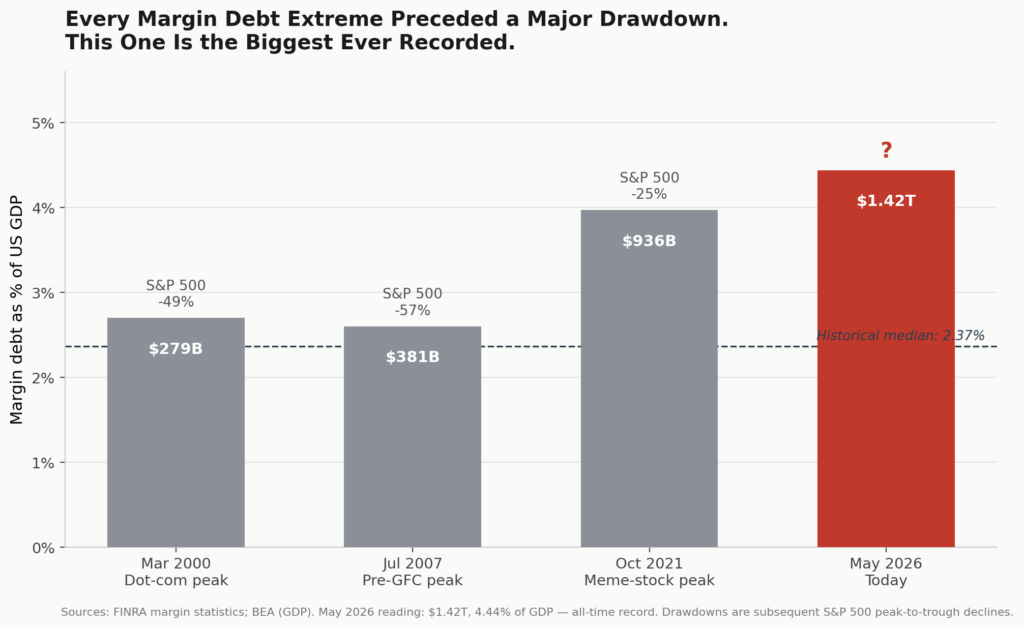
The detail most commentary misses is the investor credit balance. Advisor Perspectives calculates that net investor credit sits at negative $991.7 billion, a new record low, meaning American investors collectively owe nearly a trillion dollars more than they hold in free cash. There is no cushion. And the official figures capture only traditional brokerage margin. Leveraged single-stock ETFs, zero-day options, portfolio margin, and private credit channels sit outside the reported data entirely, which makes the record 4.44% a floor, not a ceiling.
Concentration tells the same story at lower intensity. The top ten stocks represent about 36% of the S&P 500, historically extreme for the US, though nowhere near Korea’s two-stock absurdity. Nearly all of them are expressions of a single bet: that hyperscaler AI spending, running at roughly three quarters of a trillion dollars annually across Microsoft, Google, Amazon, and Meta, continues indefinitely.
The bull case deserves a fair hearing. Tom Lee argues the Korean unwind was a liquidity event rather than a fundamental one, and expects battered AI names to rebound now that forced selling has cleared weak hands. Deleveraging events do often mark local bottoms, precisely because the selling is mechanical rather than informed. If hyperscaler earnings later this month reaffirm capex guidance, the KOSPI could stage exactly the kind of face-ripping rally that leveraged markets produce in both directions.
But the structural lesson stands regardless of the near-term bounce. Korea demonstrated that in a heavily margined market, the distance between all-time high and systemic margin call crisis is about three weeks, and that the trigger does not need to be a real deterioration in fundamentals. A downgrade, a listing event, a rate hike, and a geopolitical scare were sufficient. The selling that followed was not a decision anyone made. It was an automatic consequence of market structure.
The single variable that matters from here is hyperscaler capital expenditure. One earnings call in which a major cloud provider guides AI spending lower, and is rewarded by the market for doing so, changes the incentive structure for every other CEO in the complex. When restraint starts getting rewarded, the capex arms race ends, and the earnings that justify current chip valuations end with it. Korea just previewed what the unwind mechanics look like when that repricing arrives in a leveraged market.
The prudent position is not prediction. It is recognizing that at 4.44% margin debt to GDP, the US market has pre-committed to selling on the way down, whether anyone wants to or not. Korean investors had absolute confidence three weeks before the margin calls arrived. Confidence is not collateral.