Physical Address
304 North Cardinal St.
Dorchester Center, MA 02124
Physical Address
304 North Cardinal St.
Dorchester Center, MA 02124

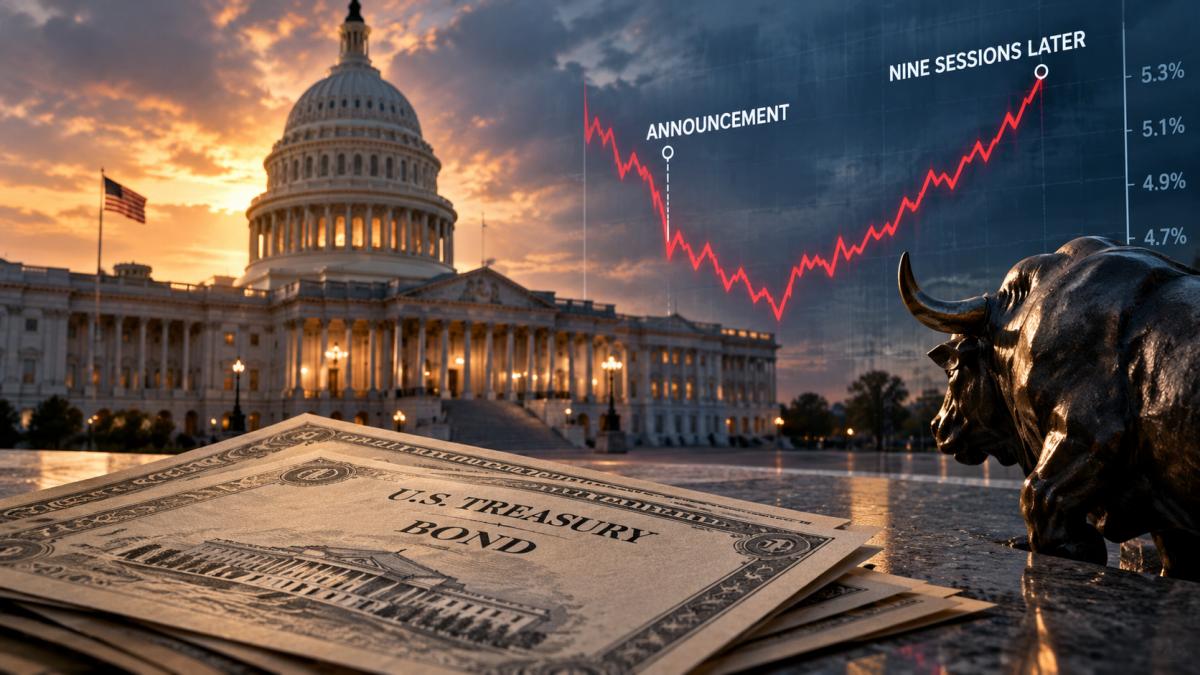
On 19 August the US Treasury announced it would at least double the size of its long end buyback operations. Yields dropped within minutes. By 1 September the entire move had been surrendered, and the first enlarged operation had still not taken place. Nothing had been bought. Nothing had been repurchased. The policy had not fired a single round, and the market had already finished pricing it out.
On 19 August the US Treasury announced it would at least double the size of its long end buyback operations. Yields dropped within minutes. By 1 September the entire move had been surrendered, and the first enlarged operation had still not taken place. Nothing had been bought. Nothing had been repurchased. The policy had not fired a single round, and the market had already finished pricing it out.
That sequence, rather than the policy itself, is where the information sits. A tool that gets discounted to zero before deployment is telling you something the announcement was designed to obscure.
The Treasury statement was narrow and technical. The department said it was increasing, by at least double, the size of liquidity support buyback operations for longer dated nominal coupon securities, specifically the 10 to 20 year and 20 to 30 year sectors. The per operation ceiling rises from $2 billion to at least $4 billion. The change takes effect on 9 September and runs through 4 November, with any further decision deferred to the Quarterly Refunding scheduled for that date.
The stated justification was market plumbing. Treasury said it consistently receives more high quality offers in long dated operations than it chooses to accept, and that this excess supply of willing sellers justifies a larger footprint. That is a perfectly respectable argument on its own terms. It is also not the sort of argument that normally requires an unscheduled announcement issued two weeks after the quarterly buyback calendar has already been published. Axios noted that the window happens to run through the final stretch of the midterm campaign.
Buybacks are not an invention of this Treasury. The authority sits in section 3111 of title 31, and the operational record on Fiscal Data runs back to 2000. Treasury buys off the run nominal coupons and inflation protected securities, and does not buy bills, floating rate notes or STRIPS. The instrument was taken out of the drawer, not designed from scratch. What changed was the size, the timing, and the fact that everybody understood it as a price operation rather than a liquidity one.
The immediate reaction was textbook. The ten year closed down roughly six basis points at 4.647 percent and the thirty year fell nine basis points to 5.196 percent, having traded above 5.3 percent the previous day at its highest level in nineteen years. Equity futures rose. The dollar fell close to eight tenths of a percent against a basket of currencies.
Then it unwound. By 1 September the thirty year was back at 5.27 percent, which is precisely where it sat in the moments before the announcement crossed. The ten year did worse, finishing more than ten basis points above its pre announcement level at roughly 4.8 percent. The retracement was not partial. It was total on the long bond and negative on the belly.
Nine trading sessions. No operation conducted. Full round trip.
This was the expected outcome rather than a surprise. When the announcement landed, the argument here was that the long end was repricing term premium rather than credit risk, that $4 billion against the outstanding stock was a rounding error, and that the tell would be yields falling on the news and then resuming their climb. That is precisely what happened, and then some. The climb did not merely resume. It retraced the whole move.
The sell side had flagged the risk almost immediately. ING wrote that the intervention suggested discomfort with the level of long term borrowing costs and was unlikely on its own to alter the trajectory of long end yields, though it would mute the move and remind the market that the size could be doubled again. That reasoning was correct on the mechanics and, as it turned out, generous on the timeline.
One correction to the earlier argument is owed here. That piece described the buybacks as retiring illiquid off the run paper funded by issuing liquid on the run paper, with net debt outstanding barely moving. That was the standard description at the time and it remains the most likely mechanism. It was also stated with more confidence than the facts supported, because the funding source is not settled, and the reporting that surfaced afterwards makes the ambiguity material rather than academic.
Here is where the analysis in circulation splits, and where most readers have been handed one half of a contradiction without being told the other half exists.
One account says the buybacks are funded with bills. On this reading, Treasury expects to borrow roughly $739 billion in privately held marketable debt this quarter. Every $4 billion retired at the long end raises that borrowing requirement by $4 billion, and with coupon auction sizes frozen, the marginal financing instrument is the bill. A thirty year bond leaves the market and a short dated bill takes its place. No money is created. The debt simply gets shorter.
The other account says the money can come from the cash pile. Senior officials indicated to CNBC that the Treasury General Account, built up to around $950 billion, could be tapped to fund the purchases. Bessent himself described the exercise on television as a Treasury Twist, and said the size could exceed the announced $4 billion per issue depending on conditions.
These are not two descriptions of the same trade. They are two different trades with opposite liquidity consequences, and the distinction has been almost entirely lost in the coverage.
Bill funded buybacks are a maturity swap and nothing more. The stock of debt held by the public is unchanged. Bank reserves are unchanged. Duration is pulled out of private hands and replaced with front end paper, which lowers the weighted average maturity of the national debt and pushes a larger share of the rollover problem into the part of the curve most sensitive to policy rates. It is a mild bull flattener in intent and a large increase in refinancing risk in practice.
TGA funded buybacks are a different animal. Drawing down the general account moves cash out of the Treasury’s balance at the Fed and into the banking system as reserves. That is reserve adding. It is not quantitative easing, because no central bank balance sheet expands, but it does loosen financial conditions in a way the bill funded version does not. It is also finite in a way the bill funded version is not, which is exactly why the market was sceptical about the firepower behind the announcement.
An investor who cannot tell you which of these is happening cannot tell you what the operation does to the curve, to reserves, or to the front end. Watch the TGA balance and the weekly bill auction sizes through September. Those two series will settle the question faster than any official statement.
The framing that Treasury is usurping monetary policy is not new. Stephen Miran and Nouriel Roubini made the argument in their 2024 Hudson Bay Capital paper on activist Treasury issuance, estimating that a deliberate tilt toward bills had lowered ten year yields by around a quarter of a percentage point, roughly comparable to a full point of Fed easing. Janet Yellen rejected the characterisation flatly at the time and denied any such strategy existed.
The irony is worth sitting with. The critique developed against the previous Treasury describes the current one more accurately, and one of its authors has since served on the Federal Reserve Board and returned to the private sector. The practice survived the change of administration. Only the instrument changed, from issuance mix to repurchase.
The buyback does not address any of the reasons the long end sold off. Fixed income desks attribute the move that began in late June to a deficit tracking above the prior year, inflation that has not returned to target, and a heavy corporate issuance calendar competing directly with government paper for the same pool of duration buyers. The thirty year was near 4.63 percent before the Iran conflict. It is above 5.2 percent now.
None of that is a demand failure, which is the distinction that keeps getting lost. The August auction tape showed indirect bidder participation essentially at its twelve month average, so the quarter century record was a price event rather than an absence of buyers. Buyers turned up. They turned up at 5.216 percent. The binding constraint is the average coupon on outstanding debt sitting at 3.442 percent against what new thirty year money costs today, a gap of roughly 177 basis points that widens the interest bill with every maturity that rolls. No repurchase operation touches that.
Against that, $4 billion per operation against a stock of roughly $32.2 trillion in debt held by the public is a rounding error. The Council on Foreign Relations put the point plainly enough: interventions by advanced economies to cap rising government bond yields tend not to hold without either genuine policy change or a material slowdown, and the first is politically difficult while the second is unwanted.
The constructive counterargument, made by Invesco, is that the feared fiscal reckoning keeps failing to arrive because the government has both the capacity and every incentive to prevent it. That is true, and it is also the point. The capacity to prevent a reckoning is not the same as the capacity to set the price of thirty year money. The first is about solvency. The second is about who is willing to hold duration for three decades at 5 percent, and that question is answered by buyers, not by the issuer.
The first enlarged operation is the real test, and the tell is not the yield print on the day. It is the offer to cover. Treasury has repeatedly accepted only a fraction of what dealers offer, which is what allowed it to claim spare capacity in the first place. If dealers flood the operation and Treasury accepts a small share, the liquidity story holds. If Treasury takes close to everything offered, or lifts the size beyond $4 billion as Bessent has suggested it might, the liquidity framing is finished and this is a price defence being run in public.
The second tell is the 4 November refunding. Deferring the size decision to that date was a choice. It leaves the option open to escalate, and escalation is the only path by which this becomes large enough to matter.
For anyone positioning around it, the useful conclusion is narrow. The long end selloff has a fiscal and inflation cause that a $4 billion repurchase cannot touch. The announcement effect has already decayed to nothing, which means the next announcement of the same kind will decay faster. And the front end is quietly absorbing duration risk that used to sit thirty years out. Whatever else the buyback does, it makes the debt shorter, and shorter debt is more sensitive to exactly the rate path nobody in this story controls.