Physical Address
304 North Cardinal St.
Dorchester Center, MA 02124
Physical Address
304 North Cardinal St.
Dorchester Center, MA 02124

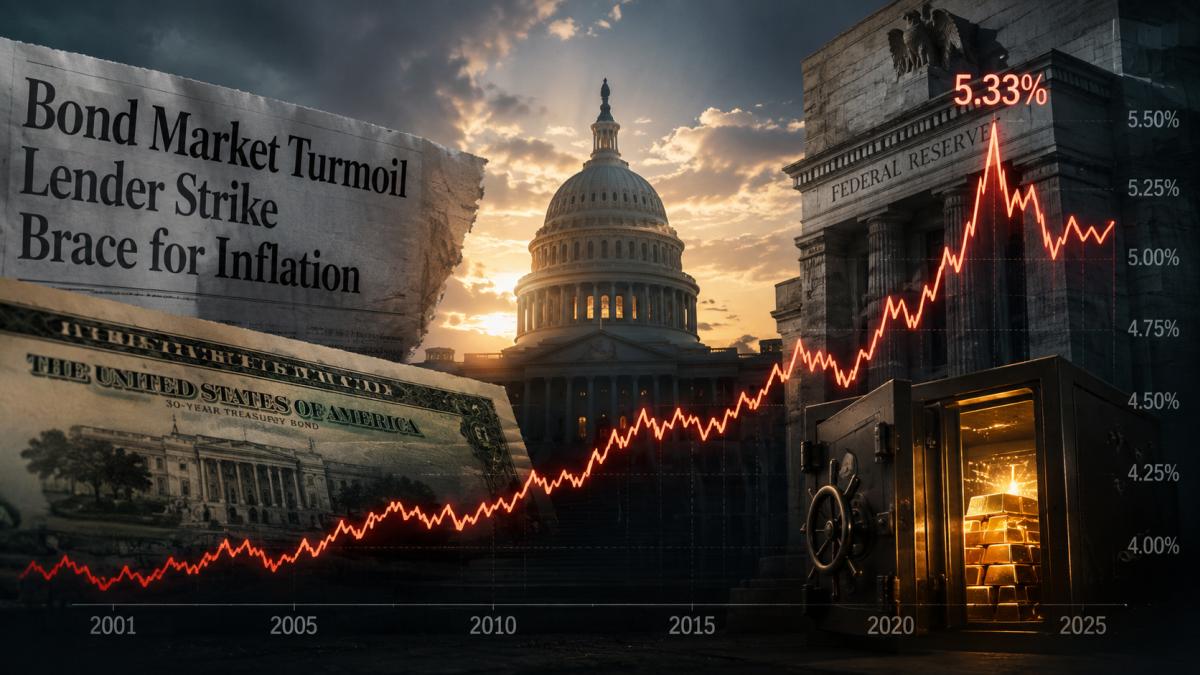
There is a story circulating about what happened to government bond markets this August, and it is a good story. It goes like this: the developed world has borrowed more than lenders are willing to fund, buyers have gone on strike, and governments will now respond the way governments always respond, by capping their own borrowing costs and inflating the difference away. Sell your bonds. Buy things instead of promises.
There is a story circulating about what happened to government bond markets this August, and it is a good story. It goes like this: the developed world has borrowed more than lenders are willing to fund, buyers have gone on strike, and governments will now respond the way governments always respond, by capping their own borrowing costs and inflating the difference away. Sell your bonds. Buy things instead of promises.
The facts underneath that story are almost entirely correct. The conclusion drawn from them is almost entirely backwards, and the difference matters more than the story does.
On 18 August the yield on the 30-year US Treasury touched 5.33 percent, its highest since 2007. Five days earlier, Treasury had sold twenty-five billion dollars of new 30-year paper at 5.216 percent, the costliest long-bond auction since 2001. Total public debt outstanding crossed forty trillion dollars on 19 August. The same week, long yields in Japan, Germany, France, Canada and the United Kingdom pushed to multi-year highs of their own.
Then on 19 August the Treasury did something unusual. It announced mid-quarter that it would at least double the size of its liquidity support buyback operations in the ten-year to thirty-year sector, taking the maximum per operation from two billion dollars to at least four billion, effective 9 September through 4 November. Yields fell hard on the announcement and gave the entire move back within a day. As of 27 August the 30-year sat at 5.19 percent, roughly where it started.
All of that is accurate. Now here is where the popular reading goes wrong.
The hook in the doom version is that inflation cooled while borrowing costs rose, which supposedly proves something structural has broken. Headline CPI came in at 3.4 percent for July with core at 2.5 percent, but that is an energy shock unwinding rather than disinflation. Inflation bottomed near 2.4 percent in January, spiked to 4.2 percent in May as the conflict with Iran disrupted shipping, and has retreated for two months since. Gasoline remains roughly 24.6 percent above year-ago levels.
What changed this past week is the rate path. When the July print landed, futures leaned toward the Fed simply holding through September. After Kevin Warsh’s Jackson Hole appearance on 28 August, markets moved to roughly even odds of a September hike, with the probability of a hike by December above seventy percent. Long yields rising while headline inflation falls is not an anomaly when the front end has started pricing tightening risk. That is a curve doing arithmetic.
The phrase “lender strike” is doing enormous work in the popular version, and the auction data does not support it. At the 13 August thirty-year sale, indirect bidders, the standard proxy for foreign demand, took 66.8 percent of competitive awards against a twelve-month average of 67.0 percent. Bid-to-cover came in at 2.39 against an average of 2.43. Dealers absorbed 11.6 percent against an average of 10.6 percent. The tail was 0.4 basis points.
That is a soft auction. It is not a buyers’ strike. Foreign participation was effectively at trend. What repriced was the level, not the willingness. Allspring’s Michal Stanczyk put the distinction well when he noted that a successful auction should not be confused with strong structural demand for long duration, and that is the honest reading: buyers showed up, they showed up at 5.216 percent, and they will show up again at whatever number clears. There is a real problem here. It is a price problem, not an absence problem, and the two lead to very different portfolios.
This is the part that should stop anyone repeating the yield curve control thesis, and it is the part the doom version gets flatly wrong.
The claim is that the Fed has restarted asset purchases as the first step toward capping long rates. What actually happened is the reverse. The New York Fed announced that from 14 August through 14 September it would conduct no Treasury purchases at all under the Reserve Management Purchases programme, the first pause since the programme restarted eight months and 338.4 billion dollars ago. RMPs went to zero.
Kevin Warsh is the wrong chair for this thesis. He resigned from the Board of Governors in 2011 in opposition to the second round of quantitative easing. He has spent the years since arguing the balance sheet is bloated. At his first meeting as chair he had the FOMC’s implementation note softened from an instruction to increase SOMA holdings to a conditional one, and he has since appointed a task force to review the six point seven trillion dollar balance sheet with an eye to shrinking it.
The single number the doom story tells you to watch, Fed holdings of notes and bonds, is currently pointing away from the conclusion it is supposed to confirm. That is not a small detail. It is the entire load-bearing wall.
Scale check. Treasury’s refunding schedule allows repurchases of up to sixty-nine billion dollars across all maturities between 6 August and 5 November, and the doubled long-end operations add roughly fourteen billion more. Against gross issuance running into the hundreds of billions in a single week, that is a rounding error deployed for signalling purposes. Evercore ISI’s Krishna Guha called it a weak form of Operation Twist and warned it could backfire if markets read it as an admission of funding anxiety. The Council on Foreign Relations reached the same conclusion, arguing that any durable suppression of yields would have to come from the central bank, which is precisely where the door has now closed.
We took the buyback-versus-yield-curve-control distinction apart in The Bond Market Is Not Crashing. It Is Charging You Rent For Duration., and the argument holds with more force now. A rate cap requires a central bank committing to an unlimited standing bid at a stated yield, the way the Fed did from 1942 until the Treasury-Fed Accord broke it in 1951. What exists instead is an eighty-three billion dollar liquidity facility run by the borrower, alongside a purchase programme that has gone to zero. Confusing the two is a category error, and category errors get expensive when they drive position sizing.
None of the above makes long duration attractive. It makes it unattractive for a different and more durable reason.
The fiscal arithmetic is as bad as advertised. Net interest on public debt reached 963 billion dollars in the first ten months of fiscal 2026, up 117 billion or fourteen percent year over year, running at roughly 3.18 billion dollars a day. The deficit over the same ten months came to 1.8 trillion dollars, 170 billion above the prior year, and the CBO lifted its full-year projection to 2.1 trillion.
The number that captures it best is a comparison almost nobody quotes. The average coupon across Treasury’s outstanding bonds is 3.442 percent. New thirty-year money now costs 5.216 percent. Every maturity that rolls repricies across a gap of roughly 177 basis points, and it will keep doing so for years regardless of what the Fed does next month. That is a compounding problem that does not require a crisis narrative to hurt.
Layer on the supply competition the doom version omits entirely. Corporate issuance tied to AI infrastructure is now a genuine rival for the same capital, and BMO strategists have flagged it alongside energy and foreign yield spillover as reasons the long end can push higher still. Japanese long yields dragging US yields up with them is a mechanical channel, not a metaphor.
If you accept the yield curve control thesis, the implied trade is to abandon nominal fixed income entirely and load up on hard assets in anticipation of deliberate currency debasement. That trade might eventually work. Right now it is being justified by a mechanism that is not operating, and a position held for a reason that is wrong tends to get abandoned at exactly the wrong moment.
The better-supported version is narrower and more useful. Long-dated government debt is unattractive not because a printing press is about to be aimed at it, but because of the opposite. There is a central bank that may still hike, a Treasury that cannot meaningfully reduce supply before the November refunding review, no institution willing to act as buyer of last resort, and a rollover gap that widens the fiscal hole with every auction. Duration is being repriced by a market that is functioning, not rescued by an authority that has gone missing.
That argues for the front end over the long end, for real assets as a hedge rather than a conviction bet, and for pricing power in equities as the thing that actually survives an environment where inflation settles above target rather than below it. It does not argue for treating a 5.2 percent thirty-year yield as a trap.
Watch three numbers instead of one. Watch the indirect bidder share at each long-end auction, because that is where a genuine funding strike would show up first. Watch the RMP schedule out of the New York Fed, because a reversal there would be the first real evidence for the suppression thesis. And watch whether core CPI stays anchored near 2.5 percent while headline unwinds, because the gap between those two is currently doing more to set the long end than anything Treasury announces.
The pressure in this system is real. The valve is working normally. That is a very different situation from one where somebody is welding it shut.