Physical Address
304 North Cardinal St.
Dorchester Center, MA 02124
Physical Address
304 North Cardinal St.
Dorchester Center, MA 02124

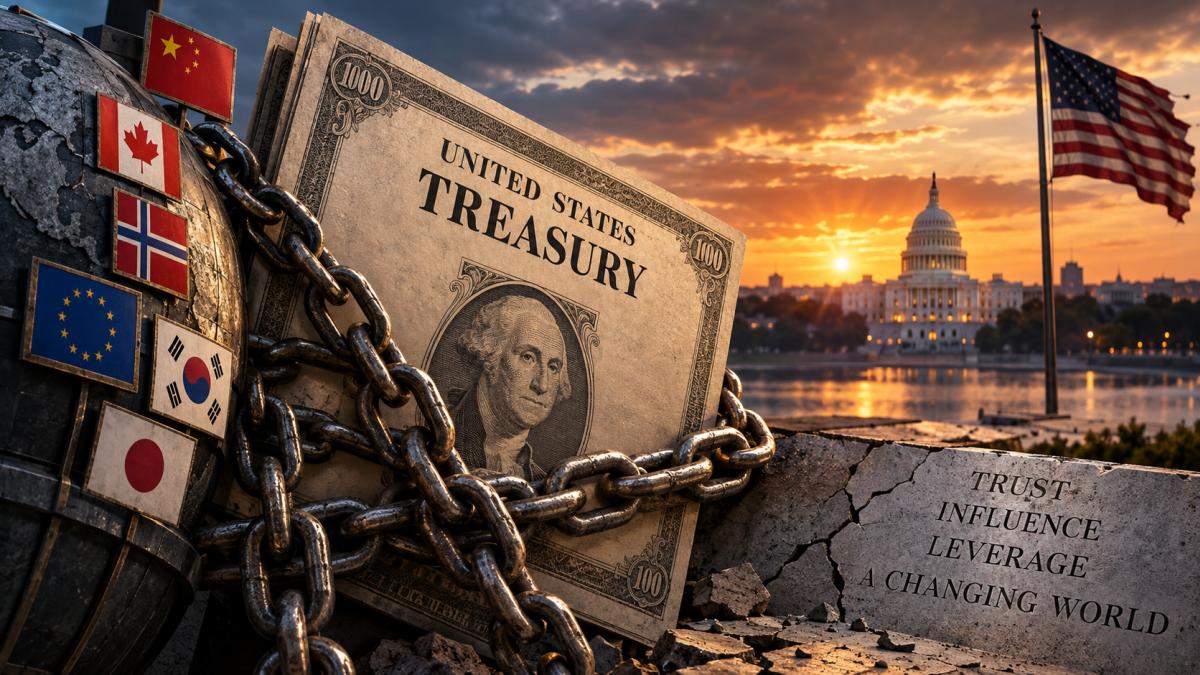
The idea that United States government debt is the one asset every country must hold no matter what is starting to look shakier than it has in decades. For most of the post war period, foreign governments piled into Treasuries because there was simply nowhere else to park reserves at that scale with that much liquidity.
That assumption is now being tested in real time, and the test is not coming from a rival superpower trying to force the issue. It is coming from allies quietly rebalancing their books because the math no longer works in Washington’s favour.
Foreign ownership of US government debt has become so large that it functions less like a simple investment and more like a form of hostage taking in both directions. Governments that hold hundreds of billions in Treasuries cannot easily dump them without damaging the value of their own remaining holdings, which gives Washington leverage over exactly the countries it depends on to keep funding its deficits. At the same time, a government that needs to keep selling new debt every quarter cannot afford to alienate its largest buyers too aggressively, which gives those buyers leverage right back.
This is the trap that is now visible in how European governments have lined up behind sanctions on Iran even where their own economic interests would argue for a different course, and it is part of why South Korea has signalled a willingness to expand military cooperation with Washington despite domestic reluctance. Deep financial entanglement with the dollar system narrows the room countries have to say no.
But entanglement is not the same as loyalty, and the data now emerging suggests the buyers are recalculating.
It is worth remembering how this dynamic actually played out the last time the US financial system was in real trouble. During the 2008 crisis, the Treasury Department leaned on Beijing to keep buying US government debt and to hold off dumping its existing position while the Federal Reserve fought to stabilise the banking sector. China cooperated. A decade later, that cooperation bought it a tariff war that began in 2018, tariff rates on some goods pushed toward 50 percent in the most recent escalation, and a widening set of restrictions on access to advanced semiconductors. The lesson Beijing drew from that episode is straightforward: being a reliable creditor to the United States does not buy immunity from being treated as a strategic rival when priorities shift.
Canada offers an even sharper illustration of the same point, precisely because it is not a rival at all. Treasury International Capital data places Canada among the five largest foreign holders of US government debt, with holdings that have moved between roughly $395 billion and $475 billion over the past year depending on the month. Canada has issued dollar denominated bonds nearly every year since 2019 and has generally been treated as one of the more dependable partners in the system, a point confirmed in independent fact checking of Canada’s reserve holdings.
None of that has stopped Washington from threatening tariffs as high as 50 percent on Canadian goods, or from repeatedly singling Canada out in public commentary as a difficult trading partner. If a close neighbour and long-time ally with hundreds of billions tied up in US debt can be treated this way, the message to every other creditor nation is unambiguous: financial exposure to the United States buys far less protection than it used to.
The most consequential move so far has come from Norway, whose sovereign wealth fund is the largest single pool of investment capital on the planet at roughly $2.3 trillion. Norges Bank Investment Management, which runs the fund, has formally proposed cutting the government bond share of its portfolio from 70 percent down to 50 percent, with the reduction falling hardest on US Treasuries. Under the plan detailed in a letter to Norway’s Ministry of Finance, the fund’s allocation to Treasuries would drop from 34.1 percent of its bond index to 21.9 percent, a shift that could remove close to $80 billion from the fund’s roughly $215 billion Treasury position.
The money is not simply leaving the dollar system. Much of it is being redirected into higher yielding US corporate debt, including mortgage backed securities, with that allocation set to rise from 16.2 percent to 27.6 percent, while Japanese government bond exposure would climb from 4.6 percent to 7.4 percent. The fund’s own leadership framed the move as a search for better risk adjusted returns rather than a political statement, but the timing matters. It arrives while Treasury yields remain elevated and while confidence in the stability of long duration US debt is under visible strain.
The mechanics behind that strain are not complicated. Bond prices move inversely to yields, and the sensitivity gets worse the longer the maturity. A one percentage point rise in yields can knock roughly nine percent off the market value of a ten year Treasury, so a sustained tightening cycle of several points can erode a tenth of a portfolio’s value in the assets meant to be its safest holdings. For a fund the size of Norway’s, that is not a rounding error.
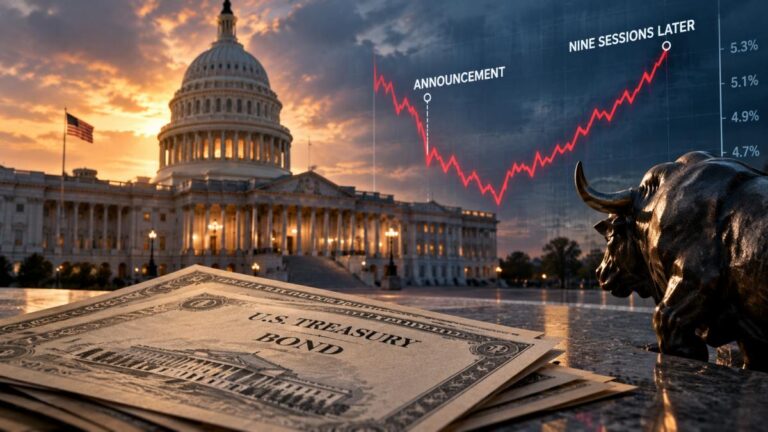
Perhaps the clearest sign that something has shifted in how markets read the US economy came with a recent jobs report that beat expectations by a wide margin, adding well over three times the number of positions analysts had forecast. Under the old playbook, that would have been unambiguously bullish. Instead, both stocks and bonds sold off, because traders immediately priced in a higher probability of further rate increases to contain inflation. Strong growth is no longer being read as good news for asset prices, it is being read as a signal that borrowing costs are going higher, and higher borrowing costs are exactly what erodes the value of existing bond holdings. That inversion of the usual relationship is a symptom of a market that no longer fully trusts the stability of the policy path ahead, and it is precisely the kind of environment that makes officials go out of their way in public appearances to talk yields down and project confidence about inflation cooling and oil prices falling back toward the 40 to 50 dollar range. Direct intervention has not fared much better. When Washington doubled its bond buybacks earlier this year, the market erased the effect within nine trading sessions, a reminder that liquidity support alone cannot fix a demand problem this size.
While confidence in US debt wavers, China’s onshore bond market has quietly become more attractive to international borrowers. UBS priced its first ever panda bond in China’s interbank market at a coupon of just 1.78 percent, a record low for a five year yuan denominated bond from a foreign financial institution, with the offering more than three times oversubscribed according to the bank’s own disclosure. Borrowing in yuan at under two percent compares starkly with the five to six percent a bank might pay to raise equivalent dollar debt in Western markets, and that gap has been widening as more international issuers follow the same path into China’s interbank bond market.
Currency appreciation adds a second layer to the appeal. The yuan has strengthened meaningfully against the dollar over the past year, meaning investors who bought yuan denominated debt have picked up a currency gain on top of the coupon. Meanwhile Beijing has kept its own fiscal position relatively conservative through the period of global turbulence, leaving room to keep issuing government debt even as it has used only a portion of its planned annual bond quota so far this year. That combination, a currency with room to keep appreciating, a central bank with tools to manage inflation without simply mirroring Federal Reserve rate hikes, and a bond market that has been trending toward lower yields since the early 2010s even as US yields have pushed higher, gives China’s debt market a diversification profile that looks increasingly attractive to global allocators looking to spread risk away from the dollar system.
Layered on top of all of this is the drag from the prolonged standoff with Iran, now running past the six month mark with no resolution in sight on terms either side can accept. Extended disruption to shipping through the Strait of Hormuz carries a global growth cost that independent estimates put above one and a half percent of world output, a figure in the trillions of dollars, and every month the conflict drags on adds to the inflationary pressure coming through higher oil, gas and diesel prices worldwide. That is precisely the kind of pressure that keeps upward force on the yields Norway and other large holders are trying to get ahead of.
None of this means the dollar’s dominant role is about to collapse overnight, and Treasuries remain by far the deepest and most liquid government bond market on earth. But the direction of travel matters more than the absolute numbers right now. When the world’s largest sovereign wealth fund proposes cutting its Treasury exposure by tens of billions of dollars, when a close US ally with a fifth-largest foreign holding of Treasuries still gets hit with punitive tariff threats, and when international banks are lining up to borrow more cheaply in yuan than in dollars, that is a pattern worth watching rather than dismissing. Investors who have treated US government debt as an automatic safe haven allocation may want to look more closely at duration risk, currency diversification and the kind of non-government dollar debt that funds like Norway’s are now rotating into, because the assumptions that underpinned decades of Treasury demand are visibly being reassessed by the very institutions that built that demand in the first place.