Physical Address
304 North Cardinal St.
Dorchester Center, MA 02124
Physical Address
304 North Cardinal St.
Dorchester Center, MA 02124

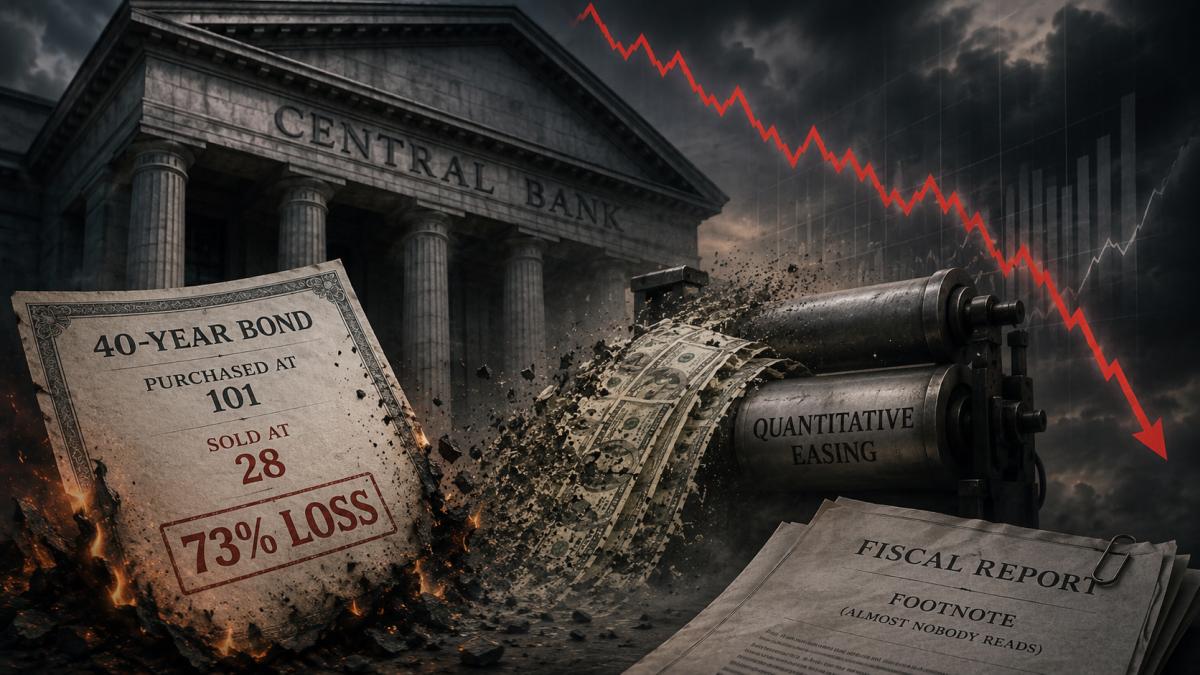
Imagine a fund manager who bought a 40-year bond at 101 and sold it at 28, locking in a 73% loss. Now imagine that manager did this not once but systematically, across a portfolio worth hundreds of billions, using money conjured from nothing — and then sent you the bill. You would expect a scandal. Instead, you get a footnote in a fiscal report that almost nobody reads.
Imagine a fund manager who bought a 40-year bond at 101 and sold it at 28, locking in a 73% loss. Now imagine that manager did this not once but systematically, across a portfolio worth hundreds of billions, using money conjured from nothing — and then sent you the bill. You would expect a scandal. Instead, you get a footnote in a fiscal report that almost nobody reads.
This is the quiet story of quantitative tightening, the reversal of the great money-printing experiment of 2009–2021. Every major central bank is now unwinding its crisis-era bond portfolio, and every major central bank is losing money doing it. The losses are enormous, they are landing on taxpayers, and they are reshaping sovereign bond markets in ways most equity investors have not yet priced in.
The mechanics are almost comically simple. During quantitative easing, central banks created reserves electronically and used them to buy government bonds — at scale, and often near the top of the market. The Bank of England accumulated £875 billion of gilts between 2009 and 2021, with its heaviest buying during the pandemic, when yields were at generational lows and prices at generational highs. The Federal Reserve and the European Central Bank did the same with Treasuries and euro-area sovereign debt.
Then inflation arrived, rates rose, and bond prices collapsed. The central banks were left holding vast portfolios of low-coupon paper bought at premium prices, funded by reserves on which they now had to pay 4–5% interest. Income from the assets stayed fixed and low; the cost of the liabilities exploded. The carry trade of the century flipped into the carry loss of the century.
The Bank of England compounded the problem by doing something no other major central bank does: actively selling its bonds into the market rather than simply letting them mature. That crystallises mark-to-market losses immediately. One long-dated gilt maturing in 2061, bought at around 101, was sold off at around 28 — a real transaction, not a hypothetical. Multiply that dynamic across a nine-hundred-billion-pound portfolio and you begin to understand the scale of the problem.
The numbers are no longer projections. They are showing up in audited accounts across the developed world.
In the United Kingdom, the Office for Budget Responsibility’s analysis of the Asset Purchase Facility traces how nearly £124 billion of QE-era cash profits handed to the Treasury before mid-2022 have flipped into losses that the Treasury must now reimburse under its indemnity. Lifetime loss estimates have climbed with each forecast revision and now sit in the £120–135 billion range, with some estimates that include running interest costs reaching as high as £240 billion. A UK parliamentary inquiry found that these losses feed directly into public debt and constrain the government’s ability to meet its own fiscal rules. In other words, monetary policy plumbing is now dictating fiscal policy headroom.
In the United States, the Federal Reserve stopped sending profits to the Treasury in September 2022 and began accumulating a so-called deferred asset — an accounting device that records losses as a claim on future earnings. That deferred asset has grown to roughly $243 billion, and you can watch it evolve in real time on the St. Louis Fed’s FRED database. For context, the Fed used to remit $80–100 billion a year to the Treasury. Those payments have vanished for years, a silent hole in the federal budget at precisely the moment deficits are running at wartime levels.
In the euro area, the ECB reported a €1.25 billion loss for 2025, its fourth consecutive year in the red, with no profit distributions to national central banks. The Bundesbank — historically the most profitable and conservative central bank in Europe — has accumulated losses of €27.8 billion, after posting its first annual loss since 1979. The Bank of Japan, meanwhile, sits on unrealised valuation losses of roughly ¥45 trillion on its bond portfolio, insulated only by accounting conventions that let it hold everything at amortised cost.
Same trade, same outcome, everywhere. The only differences are the accounting devices used to spread the pain over time.
Here is the part that deserves far more attention than it receives. Central bank losses are not money vanishing into a void. They are transfers. The interest paid on reserves flows directly to commercial banks holding those reserves. Analysis from the New Economics Foundation put it bluntly: the Bank of England’s bond sales were on track to cost the Treasury up to £96 billion over four years, with the losses functioning as gains for the private financial sector.
So the full circle looks like this: central banks printed money to buy bonds, inflating asset prices and enriching asset holders on the way up. Now, on the way down, they are paying banks handsome risk-free interest on the reserves created by that printing, while taxpayers cover the shortfall. Heads, the financial sector won. Tails, the financial sector also won.
The central banks know how this looks, and they are quietly adjusting course. In September 2025 the Bank of England slowed its annual balance-sheet runoff from £100 billion to £70 billion and deliberately skewed sales away from long-dated gilts — a decision taken weeks after 30-year gilt yields hit their highest level since 1998. The retreat is visible in the fine print: the Bank’s own market notices now detail a gentler sales schedule, taking holdings down to £488 billion by late 2026 with only a fraction coming from active sales.
Officially, this was always the plan. Unofficially, it is hard to read as anything other than an admission that the bond market could not absorb the supply. And in November 2025, Governor Andrew Bailey wrote to the Chancellor arguing that QE will ultimately cost taxpayers nothing once the savings from issuing government debt at rock-bottom rates are counted. Perhaps. But note the asymmetry: when QE was generating cash profits, those profits were banked and spent. Now that it is generating cash losses, we are told to focus on invisible offsetting benefits. Every losing trader in history has made the same argument.
For investors, the lesson is not that central banks are incompetent. It is that the single largest, most price-insensitive buyer of government bonds for fifteen years has become a seller — or at best, an absentee. The ECB alone has shed over €3 trillion from its balance sheet, a larger unwind than the Fed’s. That structural shift has consequences.
First, expect the long end of yield curves to stay under pressure. Without a printing press bidding for 30-year paper, duration must be absorbed by pension funds, insurers, and price-sensitive private investors who demand real compensation. The divergence between UK and US long yields after QE ended was an early preview of what happens when that bid disappears.
Second, expect fiscal and monetary policy to keep colliding. When central bank losses add tens of billions annually to government borrowing needs, treasuries lean on central banks to slow the unwind — and central banks, whatever their rhetoric about independence, comply. The line between monetary and fiscal policy, always blurrier than advertised, is now openly contested.
Third, understand that the risk-free rate is being repriced structurally, not cyclically. Higher term premiums flow through to mortgage rates, corporate borrowing costs, equity discount rates, and ultimately to the multiples investors are willing to pay for stocks. The great QE experiment suppressed the price of money for a decade and a half. The bill for that suppression is now being paid — partly through inflation already endured, and partly through hundreds of billions in trading losses socialised across taxpayers who never knew they were in the trade.
The next time someone tells you central banks can always print their way out of trouble, point them to a gilt bought at 101 and sold at 28. The magic money tree turned out to have a repayment schedule after all.