Physical Address
304 North Cardinal St.
Dorchester Center, MA 02124
Physical Address
304 North Cardinal St.
Dorchester Center, MA 02124

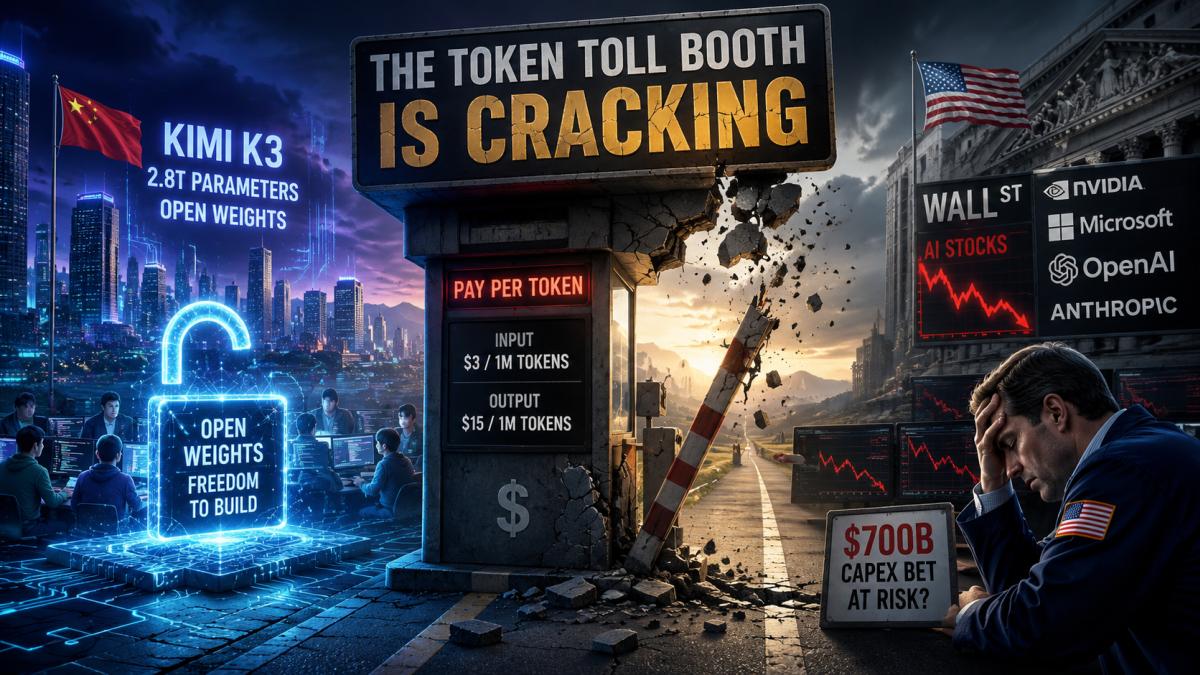
Wall Street has a short memory, but not that short. When Beijing-based Moonshot AI released its Kimi K3 model on July 16, traders didn't need the parallel explained to them. AI and semiconductor stocks sold off sharply as the phrase "DeepSeek moment" ricocheted across trading desks, recalling January 2025, when a then-obscure Chinese lab wiped out one of the largest single-day market-value losses in history by demonstrating that frontier AI could be built for a fraction of American budgets.
Wall Street has a short memory, but not that short. When Beijing-based Moonshot AI released its Kimi K3 model on July 16, traders didn’t need the parallel explained to them. AI and semiconductor stocks sold off sharply as the phrase “DeepSeek moment” ricocheted across trading desks, recalling January 2025, when a then-obscure Chinese lab wiped out one of the largest single-day market-value losses in history by demonstrating that frontier AI could be built for a fraction of American budgets.
The reflex is understandable. But the reflex is also wrong — or at least aimed at the wrong target. The real story of Kimi K3 isn’t that AI just got cheap. It’s that the entire business model underpinning trillions of dollars in US AI valuations — charging rent on every token that passes through a proprietary model — just took another structural hit. And the market, as usual, is panicking about the wrong thing while ignoring the thing that should actually worry it.
Strip away the hype and the specs are still remarkable. Kimi K3 is a 2.8-trillion-parameter open-weight model — the largest ever released with downloadable weights — featuring a million-token context window and two novel architectural tricks (a hybrid linear attention mechanism the company calls KDA, plus attention residuals) that squeeze more reasoning out of less compute.
By Moonshot’s own admission, K3 still trails the top American systems overall. But it consistently beat every other model it was tested against, including the second-tier flagships from both OpenAI and Anthropic, on coding and agentic benchmarks. Within a day of launch it topped a major frontend programming leaderboard. Bank of America analysts noted that despite restricted access to advanced chips, Moonshot demonstrated that algorithmic ingenuity can substitute for raw silicon — the same conclusion Forbes drew from the company’s disclosures.
That last point deserves more attention than it’s getting. Moonshot’s technical documentation points to export-grade, deliberately hobbled Nvidia hardware — the cut-down cards Washington permits for sale into China — alongside an unnamed domestic accelerator. Three years of escalating export controls, and the gap keeps narrowing anyway. Every restriction has functioned less as a wall and more as a forced innovation program for Chinese labs.
Friday’s selloff was genuinely ugly in places. Chip stocks extended a brutal week, the Philadelphia Semiconductor Index flirted with bear-market territory, and — in a detail that says everything about how commoditization cuts both ways — Moonshot’s own Chinese rivals got hammered hardest, with Zhipu and MiniMax plunging 28% and 16% respectively in Hong Kong trading.
But honest analysis requires admitting the selloff was multi-causal. As The Next Web pointed out, the market was already loaded with triggers: disappointing earnings from Netflix and TSMC, escalating conflict in the Persian Gulf pushing oil higher, and simmering rate anxiety. Kimi K3 was the match, not the fuel. Notably, most chip names clawed back their losses intraday, with Nvidia closing down just over 2% after a far scarier open — a pattern eerily similar to the original DeepSeek scare, which faded within weeks and turned into one of the great buying opportunities of 2025.
So is this just DeepSeek redux — a headline scare that mean-reverts? For the hardware trade, probably yes. For the model labs, probably no. Here’s the distinction the market keeps missing.
The American AI story rests on a specific economic bet: that intelligence can be metered and tolled. You build a frontier model at colossal expense, keep the weights locked in a vault, and charge for every million tokens in and out. The margin between what compute costs you and what you charge the customer is the entire investment thesis — the thing that’s supposed to eventually justify the roughly $700 billion in annual hyperscaler capital expenditure that Apollo’s chief economist has warned could drag the broader economy down if it fails to pay back.
Open weights attack that margin directly. Once K3’s full weights drop on July 27, any enterprise with sufficient GPUs can self-host a near-frontier model and pay nobody rent. The toll booth doesn’t get cheaper; it gets bypassed entirely.
And the pricing pressure is already visible in the tape. Here’s the twist most coverage missed: K3 is not a budget model. Moonshot priced it at $3 per million input tokens and $15 per million output — the most expensive API ever offered by a Chinese lab. That sounds like good news for American incumbents until you notice it’s still roughly half the per-task cost of Anthropic’s premium tier. Moonshot is deliberately price-anchoring just below the US frontier, while DeepSeek occupies the basement — its latest model serves output at under a dollar per million tokens after a 75% price cut. The Chinese labs have effectively built a pricing ladder underneath the entire American product stack, with a free self-hosted option waiting at the bottom.
Meanwhile, the adoption evidence keeps accumulating. Fortune reported that a leading US coding-assistant company quietly acknowledged its flagship agent runs on a Kimi model under the hood. When American AI products are themselves built on Chinese open weights, the “national champion charging global rents” narrative starts to look shaky.
The consensus take is binary: either K3 is overhyped (buy the dip in everything) or it’s a genuine DeepSeek 2.0 (sell American AI). Both miss the asymmetry. This release is bad for one specific business model and neutral-to-good for almost everything else.
Bearish: pure-play model labs. Companies whose valuation depends on proprietary token margins face a permanent, ratcheting price ceiling set by open-weight alternatives. Every capability they ship gets replicated in an open model within months, and the replication cycle is shortening. Their moat is now speed, not exclusivity — and speed moats are expensive to maintain.
Neutral-to-bullish: compute and infrastructure. Cheaper intelligence means more consumption of it, not less — the Jevons dynamic that played out after DeepSeek, when hyperscalers raised capex rather than cutting it. K3 itself reinforces the point: it burns tokens voraciously (independent testers clocked thousands of reasoning tokens for trivial tasks), and Moonshot recommends serving it on clusters of 64-plus accelerators. Free-to-download does not mean free-to-run. Morningstar’s analysts landed in a similar place, arguing the launch is a reason to buy cloud infrastructure names, since algorithmic progress expands the total market even as it reshuffles who captures the software margin.
Bullish: AI adopters. The clearest winners are the companies that consume intelligence rather than sell it. Every ratchet down in the price of capable models is a direct margin transfer from AI vendors to AI users. Businesses are already experimenting with cheaper Chinese models precisely because American APIs keep getting more expensive.
Beneath the market mechanics sits a policy failure nobody wants to name. Export controls were supposed to preserve an American compute monopoly long enough for US labs to build unassailable leads and monetize them globally. Instead, Chinese labs learned to do more with less, released their work openly, and are now setting the world’s price for intelligence. The July 27 weights release will hand every developer on Earth a near-frontier model that answers to no American terms of service and pays no American toll.
You can restrict chips. You cannot restrict arithmetic. And you certainly cannot charge monopoly rents on a product your competitor gives away.
The DeepSeek moment of 2025 taught investors that these scares pass. The Kimi moment of 2026 should teach them something subtler: the scares pass, but the pricing power doesn’t come back. Watch what happens to American API price sheets over the next two quarters. That — not Friday’s candle on the Nasdaq — is where this story will actually be told.