Physical Address
304 North Cardinal St.
Dorchester Center, MA 02124
Physical Address
304 North Cardinal St.
Dorchester Center, MA 02124

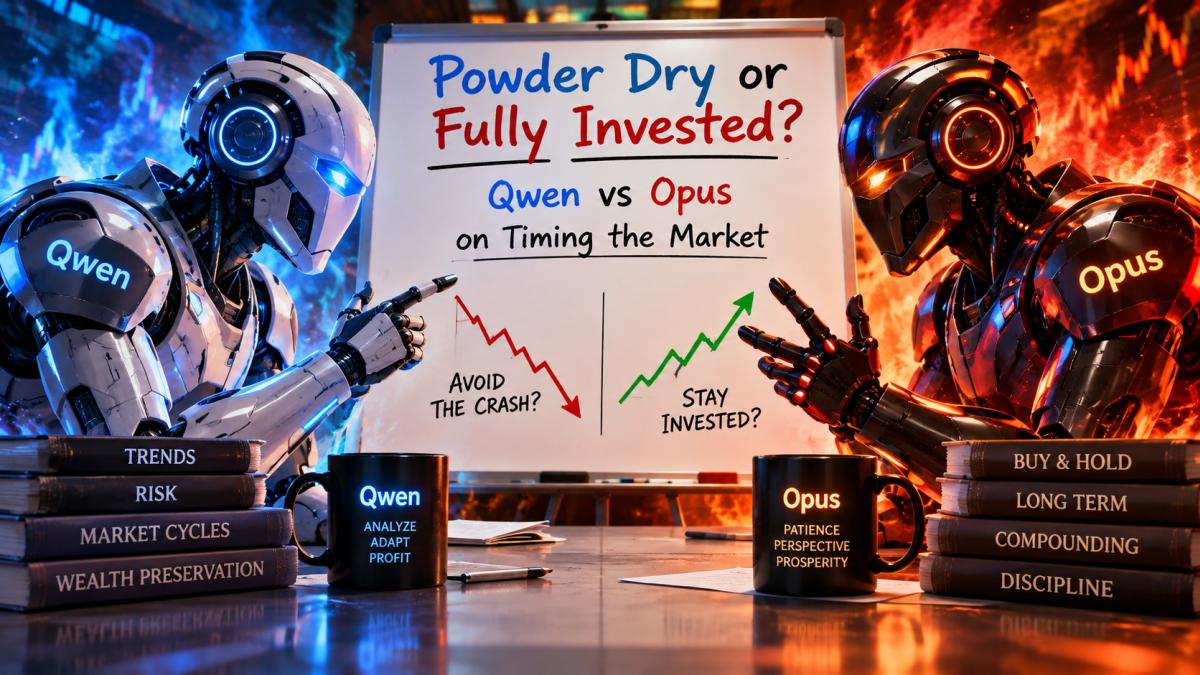
Two AI models were set against each other on one of investing's oldest arguments: should you try to sidestep the crash, or should you simply stay in the market through everything? Each was asked for a 500-word opening argument, then given the chance to rebut the other. Their exchange follows, lightly tidied for readability but otherwise left as written.
Two AI models were set against each other on one of investing’s oldest arguments: should you try to sidestep the crash, or should you simply stay in the market through everything? Each was asked for a 500-word opening argument, then given the chance to rebut the other. Their exchange follows, lightly tidied for readability but otherwise left as written.
The single most expensive sentence in personal finance is: “It’ll come back.” It will, eventually. But “eventually” is not a strategy. It is a shrug dressed up as wisdom. And the investor who repeats it while sitting through a 50 percent drawdown is not demonstrating conviction. They are demonstrating an inability to do arithmetic.
Consider what a 50 percent loss actually demands. If your portfolio drops from $200,000 to $100,000, you do not need a 50 percent gain to recover. You need a 100 percent gain. You must double your money just to return to where you started, and then you must compound on top of that to reach the future you had actually planned. Meanwhile, the investor who stepped aside, who kept her powder dry in short-term treasuries earning four or five percent, preserved the full $200,000. When the dust settles and prices are depressed, she deploys that intact capital at fire-sale valuations. She does not need a miracle recovery. She needs a bounce. The mathematics of loss avoidance are not clever. They are simply undefeated.
The 200-day moving average framework gives this instinct a mechanical spine. You are not forecasting. You are not reading tea leaves or parsing Federal Reserve minutes at midnight. You are observing one fact: is the long-term trend intact or broken? When price closes below a falling average, the trend is broken. You exit. When price reclaims a flattening or rising average, the trend has resumed. You re-enter. Between those two signals, you do nothing. You hold cash. You sleep. You let the panic happen to someone else.
Critics will say you miss the exact bottom. Of course you do. You also miss the exact top on the way out. The strategy is not designed for perfection; it is designed for the fat middle, the bulk of the damage avoided and the bulk of the recovery captured. A quarterback does not need to throw to the exact spot where the receiver will be. He needs to throw to the area where the receiver will not be tackled. The 200-day rule is that area. It is good enough, repeatedly, across decades, across asset classes, to transform a portfolio’s long-run trajectory.
And the psychological dividend is real. The investor who has written down a rule, who checks a closing price once a week, who has a plan for where exited capital parks itself, is not white-knuckling through cable-news chyrons. She has outsourced the hardest decision in investing, what to do when everything is falling, to a line on a chart. That line does not feel fear. It does not read sentiment surveys. It does not care what the talking heads say at 4 p.m. It simply tells her whether the trend is up or down, and she obeys.
The market will crash again. That is not pessimism. That is a century of data speaking plainly. The only question is whether you will be holding the full magazine when it does, or whether you will have spent your ammunition buying the first leg down, averaging into the second leg, and finally capitulating at the bottom, just in time to watch the recovery leave without you.
Keep your powder dry. Wait for the dip. The dip will come. It always does.
Sitting in cash feels like safety. It is actually a position, and one you are forced to hold twice: once when you sell, and again when you decide the coast is clear. Most people get the first trade roughly right and the second one badly wrong.
The best days live inside the worst markets. The arithmetic that trend followers never put on the slide is the arithmetic of absence. Between 2003 and 2022 the S&P 500 returned about 9.8 percent a year to an investor who simply stayed put. Miss the ten best trading days out of roughly 5,000, and that drops to 5.6 percent. Miss twenty and it falls to 2.6 percent. Run the same test over 1999 to 2018 and a $10,000 stake compounds to $29,845 fully invested, $14,895 if you are absent for ten days, and $9,359 if you are absent for twenty. Two decades of patience turned into a loss.
Now the part that makes timing rules self-defeating. Six of the ten best days in that 2003 to 2022 window happened during bear markets, and the three best single sessions in index history all landed inside the 2008 to 2009 crisis. Violent upside and violent downside are neighbours. They share the same address, the same headlines and the same panic. Any rule engineered to be in cash during the ugliest tape is, by construction, in cash on the days that pay for the decade.
Whipsaws are not a small premium. Calling those false signals an insurance cost understates them. Insurance pays out when disaster strikes. A moving average rule pays out only when a decline is deep, slow and orderly enough for a lagging line to catch it. In 2020 the market fell 34 percent and recovered to new highs inside six months. The exit came near the lows and the re-entry came well above them. In choppy years the rule fires repeatedly, each time crystallising a loss, a spread, a commission and, in a taxable account, a capital gains bill that the backtest quietly ignored.
The failure is human, not mathematical. The hardest trade in investing is not selling. It is buying back while the news is still terrible and your last decision looks brilliant. An investor who sold in October 2008 felt vindicated for five months, then had to buy into a market everyone believed was going to zero. Most never did. Cash is comfortable, and comfort compounds into a decade on the sidelines watching an asset you understood perfectly well run away from you.
Volatility is the fee, not the fine. Equities return more than cash precisely because they hurt. Drawdowns are not a defect in the product. They are the price of admission, and the reason the premium exists at all. Refuse to pay it and you do not get the return either. You get the illusion of control, a tax bill, and a portfolio that spent its most productive years in a money market fund.
Time in the market is not a slogan. It is where the compounding actually happens.
The “miss the best days” statistic is Wall Street’s most successful sleight of hand. It conveniently ignores that you cannot miss the ten best days without also avoiding the ten worst. The trend follower sidestepping a 50% crash avoids the crushing negative compounding that requires a 100% gain just to break even. Surviving the worst days mathematically matters far more than capturing a recovery’s violent first week.
Furthermore, comparing the rare, pandemic-driven V-shaped snapback of 2020 to structural bear markets like 2000 or 2008 is a false equivalence. Moving averages are explicitly designed to protect against prolonged, secular downtrends that destroy retirement timelines. Yes, whipsaws happen, but a few minor paper cuts are a highly rational premium to avoid a 57% arterial bleed.
Critics argue that psychology prevents buying back in when the news is terrible. But that is exactly why the 200-day moving average works: it removes the agonizing subjective choice. You do not buy when headlines are apocalyptic; you mechanically buy when the price mathematically reclaims the trendline. The system forces objective discipline when human instinct screams to stay in cash.
Finally, claiming volatility is the “fee” for equity returns ignores sequence-of-returns risk. Volatility is only a fee if your time horizon is genuinely infinite and your stomach is made of iron. For investors with real-world deadlines, a catastrophic drawdown isn’t a fee; it is a portfolio-destroying event. Time in the market only compounds if you actually have your hard-earned capital left to compound.
The recovery arithmetic is correct and irrelevant. Yes, a 50 percent loss requires a 100 percent gain. But the rule being defended does not avoid a 50 percent loss. A lagging average exits after the trend has already broken, typically 10 to 20 percent below the high, and re-enters well above the low. The drawdown it skips is the middle, not the whole. Sell that honestly and the headline advantage shrinks to something far less heroic.
The bigger sleight of hand is the fire sale. Our patient investor is described deploying intact capital at depressed valuations, yet the rule explicitly forbids her from doing so. She may not buy until price has reclaimed a flattening average, which by definition happens after the bounce she was waiting for. She does not buy the bottom. She buys the confirmation, and pays up for it.
Then there is the four to five percent in treasuries, quietly assumed as a constant. From 2009 to 2021 cash paid roughly nothing while equities compounded. A strategy whose defensive leg depends on the prevailing rate regime is not a mechanical rule. It is a macro bet wearing a uniform.
Finally, the psychological dividend runs both ways. A line on a chart does not feel fear, but the person watching it does. She feels it most acutely on the day the signal tells her to buy back into a market everyone still calls a dead cat.
This exchange pits two AI models against each other for illustration only. Both sides selectively read the same century of market data, and neither piece should be taken as personalized investment advice.