Physical Address
304 North Cardinal St.
Dorchester Center, MA 02124
Physical Address
304 North Cardinal St.
Dorchester Center, MA 02124

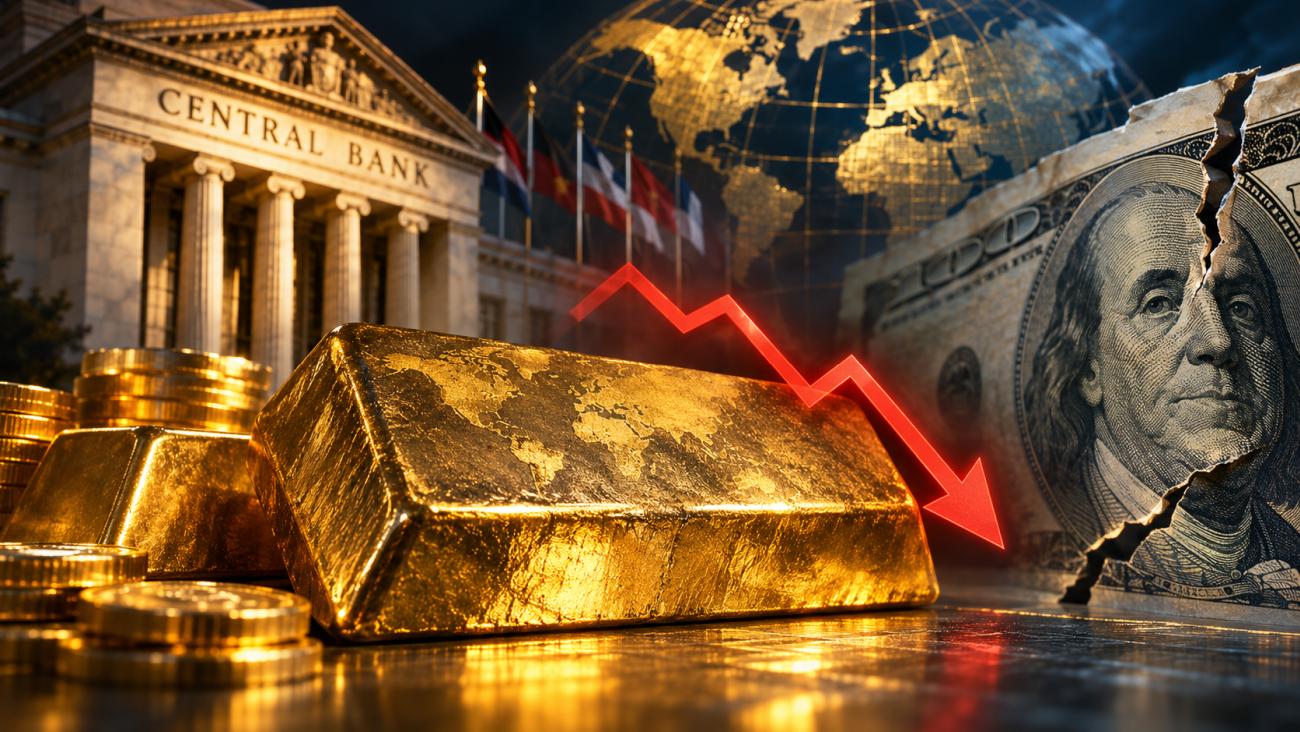
In the third quarter of 2026, the world’s central banks stepped up their gold buying by more than 40% on a year earlier. The head of the Bundesbank told the industry’s biggest conference that the shift into gold has further to run. A survey of reserve managers found most of them expect the dollar’s share of global reserves to shrink. On the surface, every signal points the same way: the official sector is quietly walking away from the dollar.
And yet gold itself is about a quarter below the record it set in January.
Both facts are true, and the gap between them is where the investment lesson sits. The move by central banks into gold is real and structural. The popular conclusion drawn from it, that the dollar system is breaking up and gold can only go higher, does not survive contact with the data.
Start with the demand. According to the World Gold Council, central banks added 321 tonnes of gold in the third quarter, up 42% on a year earlier and well above the five year quarterly average of 227 tonnes. China’s central bank was the largest reported buyer at 63 tonnes, followed by Poland at 40. Kazakhstan, Uzbekistan and the Czech Republic also added. Russia was the only sizeable reported seller.
The motives are not mysterious. In the Council’s 2026 survey of 76 central banks, 89% of reserve managers expected global official gold holdings to rise over the next year and 74% expected the dollar’s share of reserves to be lower in five years. Among emerging market respondents, 85% cited gold as a hedge against geopolitical risk.
At the LBMA conference in October, Bundesbank president Joachim Nagel put the case plainly. Physical gold carries no counterparty risk, unlike foreign bonds and deposits that can be frozen, and he expects the move towards more diversified reserves to continue. After the G7 froze Russia’s central bank assets in 2022, every reserve manager in a country with uneasy relations with Washington learned the same lesson: a Treasury bond is only as safe as your standing with the country that issued it.
Academic work is catching up with the trend. A 2026 CEPR discussion paper by Kai Arvai, Nuno Coimbra and Marco Pinchetti, titled “Fool’s Gold? How the US Dollar Lost its Shine”, models reserve managers choosing between liquid but sanctionable government bonds and illiquid but sanction-proof gold. It finds that periods of high geopolitical risk coincide with higher gold prices and higher Treasury yields, and that countries less aligned with the United States in UN voting add more gold.
This is where the story usually jumps to its conclusion. Gold has overtaken US Treasuries as a share of global reserves, the argument goes, so the dollar era is ending.
The first half of that sentence is correct. The European Central Bank’s annual report on the international role of the euro found that gold made up about 27% of global reserve assets at the end of 2025, ahead of Treasuries at about 22%. But the same report explained why. Gold prices rose roughly 60% in 2025 and 30% in 2024, which mechanically inflated gold’s share. Measured at end-2023 gold prices, gold and the euro would each sit at about 16% of reserves, with Treasuries still at 26%. Most of the “shift” was a price move, not a reallocation.
Nagel made the same point in October. Much of gold’s rise to almost a quarter of reserves reflects the price, not only changing behaviour. The ECB went further and said it does not expect the trend to be sustainable, noting that gold pays no interest, is costly to store and swings sharply in price.
The currency data tells a similar story of drift rather than collapse. The IMF’s latest figures put the dollar at 56.7% of allocated foreign exchange reserves at the end of June, against 20.6% for the euro and just 2.1% for the renminbi. The dollar’s share is lower than it was at the turn of the century, and the euro gained ground in the latest quarter. But no rival is anywhere near replacing it. The ECB’s own press release described the euro’s international role as having increased only moderately in 2025, while noting record euro-denominated debt issuance and growing fragmentation in cross-border payments.
What is forming is less a multipolar reserve system than a hedged dollar system. Central banks still hold dollars for liquidity and trade, and are adding gold as insurance against the risk of being locked out.
Now to the part the gold bulls tend to skip. Gold hit a record of about $5,416 an ounce in late January. By early November it was trading around $4,046, roughly 25% lower and barely changed from a year earlier.
The decline happened during exactly the kind of crisis gold is supposed to protect against. The war involving Iran pushed up energy prices and inflation. Instead of cutting rates, the Federal Reserve resumed raising them, and by late September the US ten year yield had reached about 5.23%, close to its highest level since 2007. Higher real yields raised the opportunity cost of holding a metal that pays nothing, while a firmer dollar made gold more expensive for everyone else.
The most revealing episode came from a central bank. In March, as the energy shock hit the Turkish lira, Turkey’s central bank drew down about 60 tonnes of gold, mostly through swaps, to raise dollars and defend its currency. That had been one of the most consistent official buyers, adding gold for 23 straight months. When the crisis came, it needed dollars, and gold was what it had to turn into them.
That is the paradox at the heart of the de-dollarisation story. Gold protects a central bank against sanctions. It does not protect against a dollar funding squeeze. In that kind of crisis, gold is something you sell to raise dollars, not a replacement for them.
None of this makes the official shift into gold irrelevant. It changes markets in quieter ways than the headlines suggest.
The first effect is on US borrowing costs. The CEPR research implies that when sanction risk rises, the United States earns a smaller “convenience yield”, the premium investors normally accept for holding the world’s safest, most liquid asset. If part of the official sector permanently wants less exposure to Treasuries, the market has to find other buyers, and those buyers demand a higher return. That is consistent with a world where US yields stay structurally higher than the 2010s norm, which matters for every asset priced off them, from equities to mortgages to emerging market debt.
The second effect is on how investors judge emerging market resilience. Many central banks now report reserves flattered by gold’s price surge. A country whose reserve cover looks comfortable at $5,000 gold looks less comfortable at $4,000, and the losses tend to arrive just as the dollar strengthens and local currencies come under pressure. Analysts assessing sovereign and currency risk should look at reserves both including and excluding gold, and at how much of the gold is held in a form that can be quickly swapped or sold.
The third effect is on currency carry. When US rates were falling, investors could borrow cheaply in dollars and earn higher yields in emerging markets. A Federal Reserve that is raising rates narrows that gap and makes the trade more fragile, regardless of what reserve managers do with their gold. The two trends can coexist: central banks adding gold for the long run while the dollar strengthens in the short run, which is close to what has happened this year.
For a diversified portfolio, the sensible conclusion sits between the two camps.
Central bank buying is a genuine source of long-term, relatively price-insensitive demand. The third quarter showed buyers adding heavily even with prices near historic highs. That makes deep, lasting collapses in gold less likely than in past cycles and supports a strategic allocation as insurance against geopolitical and fiscal shocks.
But central bank demand did not prevent a 25% drawdown, and it will not override the two forces that matter most for gold in the short run: real interest rates and the dollar. Investors who bought this year’s narrative at the January peak have learned that the hard way.
A practical approach is to treat gold as a hedge with a specific job, not a bet on the end of the dollar. Size it as insurance, rebalance into weakness rather than chasing strength, and judge it alongside real yields rather than headlines about de-dollarisation. Watch the official data too. The quarterly World Gold Council figures and the IMF’s currency composition releases will show whether central banks are genuinely reallocating or simply benefiting from price moves.
The world’s reserve managers are not abandoning the dollar. They are buying insurance against it. Investors would do well to copy the behaviour and ignore the slogan.