Physical Address
304 North Cardinal St.
Dorchester Center, MA 02124
Physical Address
304 North Cardinal St.
Dorchester Center, MA 02124

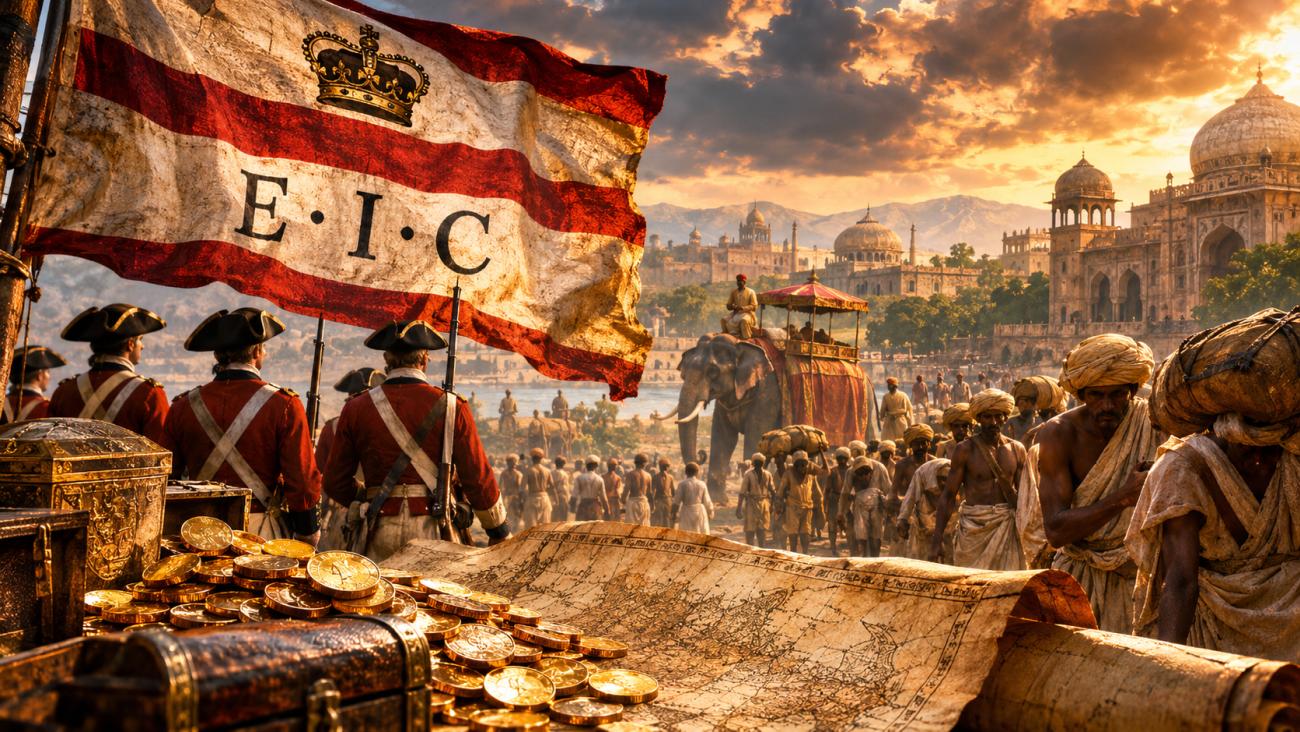
Imagine a listed company with its own army, its own currency, its own courts and the legal right to tax tens of millions of people. Its directors meet in a London office building. They answer to shareholders, not voters. Nobody living under its rule ever elected it, and when it gets into trouble the state lends it money to keep it alive.
[Also Read: The Real History of Money You’ve Never Been Taught]
That is not a dystopian thought experiment. It is a fair description of the English East India Company at its height, and it is the companion story to our three-part series on the real history of money. In Part 1 we noted in passing that Britain borrowed the Dutch model of a chartered trading company backed by state power. This article looks at what that model actually did once it was let loose, because the East India Company is the clearest historical case of what happens when a corporation captures the functions of government and runs them for its balance sheet.
By the early 1800s the Company commanded a private army that Dalrymple puts at close to 200,000 men, roughly twice the size of the British Army (some estimates run as high as 260,000). Its territory held tens of millions of people. And the money it moved helped finance the rise of the most powerful empire the world had seen.
The Company began modestly. Elizabeth I granted its royal charter on 31 December 1600, giving a group of London merchants a monopoly on English trade east of the Cape of Good Hope. The goal was spices, then cotton cloth, silk, indigo and later tea. For its first century it behaved like a trading house: it set up fortified warehouses on the Indian coast, bought goods cheaply, shipped them home and sold them dearly.
It is worth correcting one assumption here. The India the Company arrived in was not poor. By the economic historian Angus Maddison’s estimates, the subcontinent produced roughly a quarter of the world’s output around 1700, comparable to all of Western Europe. Bengal in particular was an industrial powerhouse whose textiles were prized across the world. The merchants went to India because the wealth was already there.
The shift from trading to ruling came on a single day. On 23 June 1757, at the Battle of Plassey, Robert Clive led about 3,000 Company troops against the roughly 50,000-strong army of Siraj ud-Daulah, the Nawab of Bengal. The result had been settled in advance. Clive, working with Bengal’s powerful Jagat Seth banking family, had promised the throne to one of the Nawab’s own generals, Mir Jafar, who held his forces back once the fighting started. The Nawab fled, was captured and executed, and Mir Jafar took his seat as a ruler who owed everything to the Company.
Eight years later the arrangement was made formal. In 1765 the weakened Mughal emperor Shah Alam II granted the Company the diwani, the right to collect the land revenue of Bengal, Bihar and Orissa. A joint-stock company headquartered in London now held the tax base of one of the richest regions on earth.
From an investor’s point of view, the diwani changed the Company’s business model completely. It no longer needed to bring silver from Britain to pay for Indian goods. It could pay for those goods with taxes collected from the people who made them. Revenue raised in Bengal bought Bengal’s cloth, which was then sold in Europe at a profit that flowed to shareholders and to Company servants.
Those servants did very well. Clive returned to Britain one of the richest men in the country. When Parliament later questioned his conduct, he recalled being led through the Nawab’s treasury at Murshidabad, piled with gold and jewels, and famously declared himself astonished at his own moderation.
Then came the test of what this system put first. In 1769 and 1770, after a failed monsoon, Bengal was struck by a catastrophic famine. Warren Hastings, later the Company’s governor, estimated that about a third of the population died, a figure often given as around 10 million people. Some modern historians believe that number is too high, but nobody disputes that the death toll was enormous. Revenue collection was largely maintained through the crisis, and the Company’s shareholder dividend kept climbing, reaching 12.5% by 1771.
The model then hit the wall that extractive models usually hit. The Company had overextended itself, its share price collapsed, and in 1772 it went to the state for help. Parliament’s response was a government loan of well over a million pounds and the Regulating Act of 1773, which brought the Company under partial government supervision and capped its dividends until the loan was repaid. Two centuries before the phrase existed, the East India Company was the first corporation deemed too big to fail.
The East India Company was not Britain’s only extraction engine. Across the Atlantic, British ships carried more than 3 million enslaved Africans to the Americas over roughly two centuries, a trade that enriched ports such as Liverpool and Bristol and helped build London’s banking and insurance houses.
One case shows how the financial system processed human life. In late 1781 the crew of the slave ship Zong, short of water after navigational errors, threw well over a hundred enslaved Africans into the sea. The owners then claimed on their insurance for lost cargo. In the resulting court case in 1783, Lord Mansfield remarked that the case of the slaves was the same as if horses had been thrown overboard. It was argued as a commercial dispute, not a murder trial. Lloyd’s of London, the insurance market that grew up alongside this trade, publicly apologised for its role in 2020.
When Britain abolished slavery in 1833, compensation went to the owners, not to the roughly 800,000 people who were freed. Parliament approved £20 million, about 40% of total government spending at the time, paid out to more than 40,000 claimants and financed in large part through a loan arranged by Nathan Mayer Rothschild and Moses Montefiore. That debt was later folded into government gilts that were finally redeemed in 2015. As the fact-checkers at Full Fact point out, not all of the original loan was still outstanding by then, but the debt that paid off slave owners was carried on the national books into the 21st century.
The third leg of the system ran through China, and it is the one modern investors may find most familiar, because it began as a trade-imbalance problem.
Britain had developed an enormous appetite for Chinese tea, but China wanted very little that Britain made. Payment had to be made in silver, and silver drained steadily out of Britain. The Company’s answer was opium. It controlled poppy cultivation in parts of India, especially Bengal, and sold the drug at auction to private traders who smuggled it into China. That arrangement kept the Company formally at arm’s length from an illegal trade it was supplying.
The volumes exploded. Imports into China rose from a few thousand chests a year in the early 1800s to around 40,000 chests a year by the late 1830s, and the flow of silver reversed. When the Chinese commissioner Lin Zexu moved to shut the trade down in 1839, forcing foreign dealers to surrender and destroying more than 20,000 chests of opium, Britain went to war. The 1842 Treaty of Nanking that ended the First Opium War forced China to pay an indemnity, open five ports to British trade and cede Hong Kong Island. A second war from 1856 to 1860 extracted further concessions.
The structure is worth spelling out plainly. A trade deficit was closed by exporting an addictive drug produced on colonised land, and the market was kept open with gunboats.
The idea that British rule drained India’s wealth rather than developing it is not new. The Indian economist and politician Dadabhai Naoroji set it out in detail in the late 19th century, using official trade and revenue records. More recently, the economist Utsa Patnaik estimated that Britain drained close to $45 trillion from India between 1765 and 1938, based on export surpluses that were captured in London rather than returned to India, compounded forward at 5% a year.
That figure is widely quoted and heavily contested. Critics argue that compounding nearly two centuries of trade data at an assumed interest rate produces a number that sounds precise but rests on a series of debatable choices. What is far less contested is the direction and scale of the flow. By Maddison’s estimates, India’s share of world output fell from about a quarter around 1700 to roughly 4% by the time of independence in 1947. Historians still argue over how much of that decline was caused by colonial policy and how much by Europe’s industrial revolution, but the Company that once bought Bengal’s textiles ended up presiding over the collapse of that industry as cheap machine-made cloth from Britain flooded Indian markets.
The East India Company is usually taught as imperial history. For investors it is better read as a case study in capital structure, and several of its patterns are directly relevant to the themes of our series.
Look at where the cash flow comes from. The Company’s dividends were real, but they were funded by tax revenue and monopoly, not by competitive advantage. A dividend that depends on political privilege is only as safe as the privilege. When the famine hit and the bubble burst, that became obvious very quickly.
State backing cuts both ways. The Company’s charter, its army and its eventual bailout all came from its relationship with the British state. That relationship protected shareholders in 1773, and it also ended them: after the 1857 rebellion the Crown took over the Company’s Indian territories, and the Company was dissolved in 1874. Companies whose profits rest on government favour carry a political risk that rarely shows up in the accounts.
Debt outlives the people who incur it. The slavery compensation loan of 1835 was still on the books in 2015. Governments are very good at issuing debt and very bad at retiring it, which is the core argument of Parts 1 and 3 of this series.
Trade imbalances get settled one way or another. Britain’s silver drain to China was not solved by market adjustment. It was solved by changing what Britain sold and then by force. Today’s arguments over tariffs, currency settlement and access to markets are less violent, but the underlying question is the same: who has to give way when trade does not balance?
Concentrated corporate power is not new. In Part 3 we described the modern Financial-Industrial Complex, in which a handful of asset managers sit at the top of the world’s listed companies. The East India Company shows the far end of that road: a corporation that did not merely influence government but became one. Its history is a reminder that the line between corporate power and state power has been crossed before, and that the people living under it were never the ones who decided where it should be drawn.