Physical Address
304 North Cardinal St.
Dorchester Center, MA 02124
Physical Address
304 North Cardinal St.
Dorchester Center, MA 02124

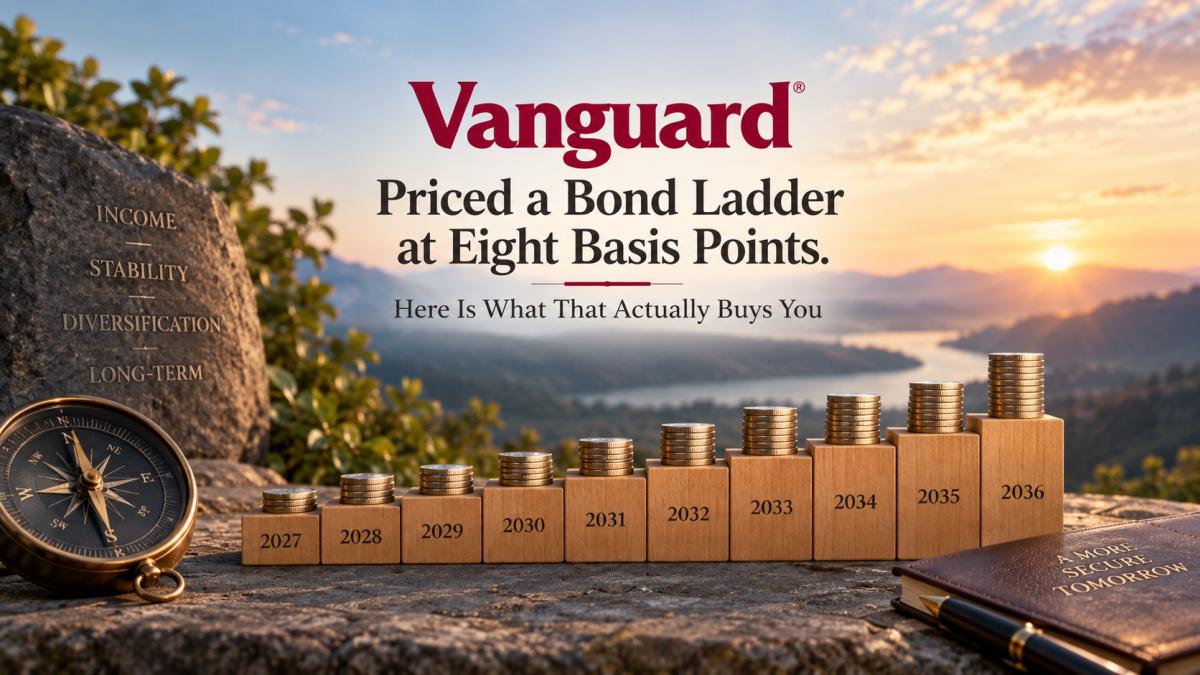
Vanguard almost never arrives first. It arrives late, prices aggressively, and lets the incumbents explain why their fee was reasonable all along. That is exactly what happened in the target maturity bond ETF market this year, and the reaction from retail investors has been slightly hysterical in both directions.
On 26 March 2026 the firm launched ten Target Maturity Corporate Bond ETFs under the BondBuilder banner, covering maturity years from 2027 through 2036, each priced at 0.08%. A month later it wrapped those funds into four ready made ladder model portfolios spanning 0 to 3, 0 to 5, 0 to 7 and 0 to 10 year ranges. The category it walked into is worth roughly $70 billion, and most people building retirement income portfolios have never consciously looked at it.
The interesting part is not the fee. The interesting part is what these products are, what they are not, and the single decision that determines whether the income they throw off is worth keeping.
A conventional bond fund is perpetual. It holds a rolling basket, sells bonds as they age out of the target range, buys new ones, and never gives you your money back on a schedule. You are exposed to duration forever.
A target maturity fund does something different. Every bond inside it comes due in the same calendar year. When that year arrives the bonds mature, the portfolio converts to cash, and the fund liquidates and distributes the proceeds to shareholders. It behaves like a bond in its life cycle, trades like a stock during market hours, and diversifies like a fund across a hundred or more issuers.
The structure is old. What became the BulletShares suite launched in 2010 under Claymore, Invesco acquired it later, and BlackRock entered with iShares in 2013. Morningstar’s assessment of the Vanguard entry puts the two incumbents at roughly $25 billion and $22 billion in defined maturity assets respectively, with Invesco separately reporting $27.6 billion across BulletShares at the end of April. Sixteen years of funds reaching their termination date and paying out is a real track record, and it is the strongest argument for the category.
One naming confusion is worth clearing up before it costs someone money. iShares iBonds are exchange traded funds you buy in a brokerage account with no purchase cap. Treasury I bonds are inflation linked savings bonds bought directly from the government, capped at $10,000 per person per year, with a rate that resets every six months. Similar sounding, entirely different instruments, different liquidity and completely different use cases.
Take the iShares iBonds Dec 2026 Term Corporate ETF as a reference point. It charges 0.10%, pays monthly, and has been running since September 2016. In late July its 30 day SEC yield sat at 4.21% with an average yield to maturity of 4.13%. The longer dated rungs, such as the 2027 corporate fund, price somewhat higher as you extend out the curve.
So model a five rung ladder. Four hundred thousand dollars, split into five equal $80,000 slices, one slice each into 2027, 2028, 2029, 2030 and 2031 investment grade corporate funds. At a blended 4.6% across the five rungs, which is roughly where the investment grade corporate curve has been sitting, that produces about $18,400 a year. Divide by twelve and you get roughly $1,530 a month, paid without selling a single share.
Those yields move daily. Check the current figures on each fund page before you commit capital, because a ladder built on last quarter’s numbers is a ladder built on fiction.
When the 2027 rung liquidates at the end of that year, you take the cash and buy a 2032 fund. The ladder rolls forward one year and the structure stays intact. This is the part that matters most and gets the least attention: only a fifth of your capital reprices annually. If rates fall, four fifths of the portfolio is still earning what you originally locked. If rates rise, you reinvest into the better environment. A ladder is not a bet on where rates go. It is a deliberate refusal to make that bet.
Vanguard at 0.08% against iShares and Invesco at 0.10% is a two basis point spread. On $100,000 that is $20 a year. Twenty dollars.
Anyone framing this as a fee revolution is selling attention. What Vanguard’s entry actually signals is category validation, plus continued downward pressure across the board. Invesco, for instance, added Treasury BulletShares in June 2026 at seven basis points, undercutting everyone on the government bond side. State Street has been running actively managed target maturity corporate and municipal funds since 2024. Four serious issuers competing keeps costs low and lineups broad.
For most investors the honest answer is that the provider barely matters. Pick whichever has the maturity years you need with decent trading volume, and spend your energy on the two decisions that do move the needle.
Start with the biggest one. These are not bonds. An individual Treasury held to maturity repays face value under a legal obligation. A fund has no such contract. It distributes whatever the net asset value happens to be at liquidation. Across the funds that have matured the outcome has tracked expectations closely, but closely and contractually are not synonyms, and the distinction becomes real in a credit event.
Second, price moves before maturity. In 2022 the broad US bond market fell roughly 13%, its worst calendar year on record. A defined maturity fund held through that period recovered as its bonds pulled to par. A defined maturity fund sold during it locked in the loss. The end date only protects the investor who actually reaches it.
Third, corporate versions carry credit risk. Investment grade is not risk free. Downgrades during a recession can force selling at unfavourable prices, and that hits every shareholder. If you want the credit risk stripped out, use the Treasury versions and accept a lower yield.
Fourth, and this one is genuinely underdiscussed, the yield decays at the end. Vanguard says it plainly in its own product documentation: during the twelve months before liquidation the bonds mature into cash, and the fund’s yield drifts toward prevailing money market rates. Your final year in each rung is not earning what the headline suggested when you bought it. Any projection that ignores this overstates lifetime income.
None of these are disqualifying. They are simply facts that change how you use the tool: hold to maturity, do not panic sell, use Treasury versions for the money you cannot afford to see wobble.
Interest from these funds is taxed as ordinary income, not as qualified dividends. In isolation, manageable. In combination with the rest of a retirement income picture, expensive.
Bond interest counts toward provisional income, the figure that determines how much of a Social Security benefit becomes taxable. Once a married couple’s provisional income crosses $44,000, up to 85% of benefits enter the tax base. Inside that phase in range, each additional dollar of bond income can carry an effective marginal rate materially above the bracket the investor thinks they occupy. This is the tax torpedo, and it does not announce itself on any statement.
The second layer is Medicare. The 2026 IRMAA thresholds begin at $109,000 for single filers and $218,000 for joint filers, against a standard Part B premium of $202.90 a month. Crossing the first joint threshold by one dollar triggers roughly $2,297 in additional annual premiums for a couple. It is a cliff, not a gradient, and it runs on a two year lookback, so this year’s income sets the premium two years out. The bill arrives long after the decision that caused it.
The fix is boringly simple. Hold corporate target maturity funds inside a tax deferred account, where the interest does not touch provisional income and does not feed the Medicare calculation. If the money must sit in a taxable account and the investor is in a high bracket, the municipal versions yield less but the income is federally exempt. One caveat there: tax exempt interest is added back into the Medicare income test, so municipals dodge the income tax and not the premium cliff.
Same funds. Same yield. Two accounts. Thousands of dollars of difference per year, decided by a single choice at purchase.
A ladder built from these funds is not a superior investment. It is a different job description. It converts a fixed income allocation from a duration bet into a schedule of dated cash flows, which is what someone spending from a portfolio actually needs. Kiplinger’s overview of the category makes the same structural point: the maturity year in the fund name is the whole product.
It is a poor fit for anyone still accumulating, anyone who might need the capital at an unpredictable moment, or anyone who will be tempted to sell when the screen turns red in month eighteen. It is a good fit for someone who knows what they need in 2029 and would like to stop guessing about it.
The fee war is a marketing story. The account placement is the money. A yield you can plan around beats a yield you have to hope for, and the difference between the two is usually decided before the first distribution ever lands.
This article is general information and not personalised investment, tax or financial advice. Yields, fees and tax thresholds change. Verify current figures and consult a qualified professional about your own situation.