Physical Address
304 North Cardinal St.
Dorchester Center, MA 02124
Physical Address
304 North Cardinal St.
Dorchester Center, MA 02124

There is a version of the AI financing story that gets told as vendor financing, with Lucent and Nortel as the cautionary tale. Supplier lends to customer, customer buys supplier's product, revenue looks spectacular until the loans go bad and the whole edifice reverses. It is a good story and it is roughly the right shape, but it misses the most important structural feature of what was announced this month, which is that the supplier has arranged for someone else to hold the paper.
There is a version of the AI financing story that gets told as vendor financing, with Lucent and Nortel as the cautionary tale. Supplier lends to customer, customer buys supplier’s product, revenue looks spectacular until the loans go bad and the whole edifice reverses. It is a good story and it is roughly the right shape, but it misses the most important structural feature of what was announced this month, which is that the supplier has arranged for someone else to hold the paper.
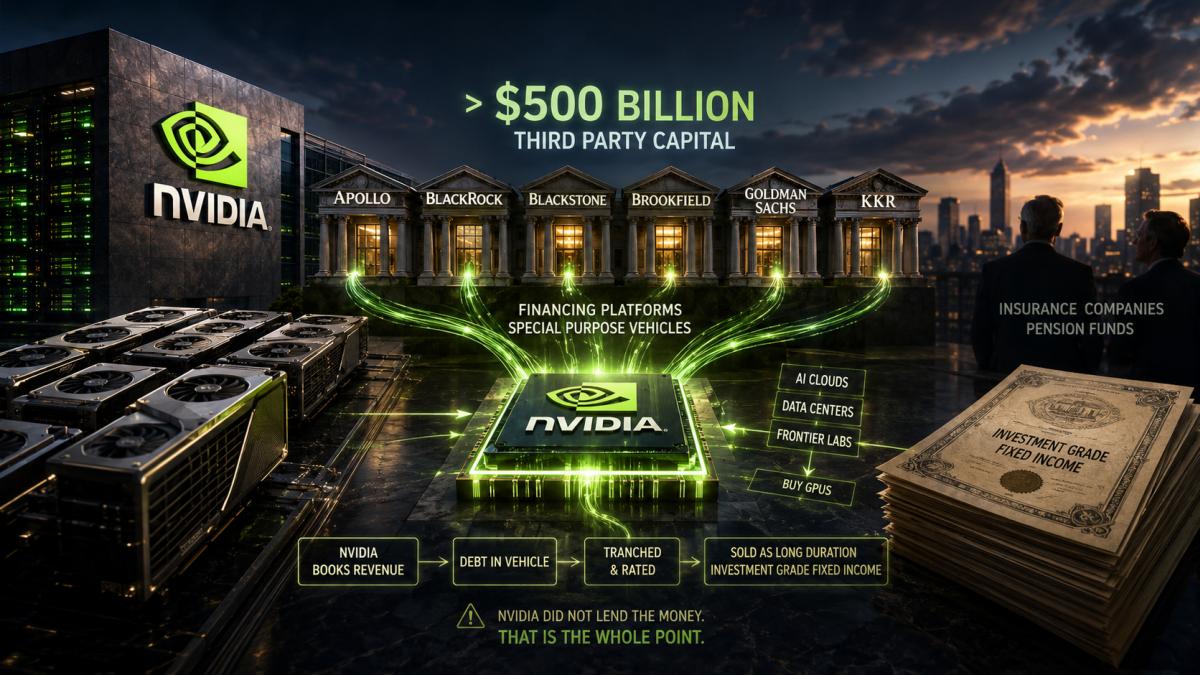
On August 10, Nvidia announced memoranda of understanding with Apollo, BlackRock, Blackstone, Brookfield, Goldman Sachs and KKR to build independent compute financing platforms targeting more than $500 billion of third party capital. Jensen Huang described the goal as turning Nvidia compute into an investable asset class, something you borrow against the way you borrow against commercial property or a toll road. He said he approached only those six firms and none declined.
Read that carefully, because the framing matters more than the headline number. Nvidia is not lending. Nvidia is not guaranteeing the whole thing. Nvidia is organising the market that funds its own customers, and then stepping to the side.
The $500 billion is a mobilisation target, not a loan book. The agreements are non-binding, no per-partner allocation has been disclosed, and no first borrower or project has been named. Analysts working through the structure have noted that Nvidia has floated residual value support for up to a quarter of a given opportunity, without defining what an opportunity measures, whether that support sits in first loss position, who values the collateral, or whether any aggregate cap applies.
That vagueness is not a scandal. It is the normal state of a deal announced before documentation. But it does mean the correct posture is to treat the number as a signal about intent rather than a fact about exposure. What the announcement tells you is that the internally funded phase of the AI buildout is finished and the externally funded phase has begun, and that the sponsor felt it necessary to say so publicly.
Follow the chain rather than the headline. Six asset managers raise capital. That capital goes into special purpose vehicles that lend to AI clouds, data centre developers and frontier labs. Those borrowers buy GPUs. Nvidia books revenue. The debt sits in the vehicle, gets tranched, gets rated, and gets sold as long duration investment grade fixed income.
Who buys long duration investment grade fixed income? Insurance companies and pension funds. One detailed credit analysis of the structure makes exactly this point: the risk travels past Nvidia, past the banks, through the vehicles, and arrives on insurance balance sheets relabelled as something conservative. Fee income accrues to the arrangers up front. Duration risk accrues to whoever holds the paper at maturity.
The collateral question is the part worth sitting with. Commercial real estate depreciates over decades and a toll road still collects tolls in year thirty. An AI accelerator faces a successor product roughly every eighteen to twenty four months, by design, because rapid obsolescence is the supplier’s business model. Lending against hardware on a long duration schedule when the hardware’s economic life is compressed by the lender’s own counterparty is not automatically wrong, since the underlying cash flow comes from compute contracts rather than from the metal itself. But it does mean the residual value assumptions inside these vehicles are doing enormous work, and residual value assumptions are exactly what nobody stress tests until they have to.
The most useful data point of the last two months was not the announcement. It was the reaction in the swaps market weeks earlier. Nvidia’s five year credit default swap surged to a record 82 basis points on July 27, its largest single day move since the contract began trading actively, after reports of AI commitments potentially exceeding $750 billion including a large guarantee arrangement tied to OpenAI compute leases. It has since pushed back above that level. From roughly 40 basis points in late June to around 80 now is a doubling in the price of default protection on a company generating tens of billions of dollars of quarterly free cash flow.
Nobody sane thinks Nvidia is going bankrupt. Eighty basis points is still a low absolute number. The information is in the derivative, not the level. Credit traders repriced not the balance sheet but the contingent liabilities attached to it, the guarantees and backstops and offtake commitments that sit outside the debt line and only become visible when someone tallies them up.
This is happening while the broader funding environment for the buildout stiffens. Investor cover ratios on hyperscaler bond deals fell from nearly five times in February to roughly two times by July, and AI related bond issuance has been testing the limits of buy side appetite all year. Demand is not gone. It is being negotiated harder, which is what happens just before it is priced differently.
There is a second structural shift that gets less coverage because it is boring. For most of the past decade the marginal buyer of large cap US equities was the issuers themselves. Buybacks were the price insensitive bid that showed up regardless of valuation, funded by cash flow that had nowhere better to go.
That cash flow now has somewhere to go. Surging capital expenditure has forced a visible shift in hyperscaler repurchase behaviour, and the same companies have moved to the other side of the ledger through equity issuance, with Alphabet raising roughly $85 billion in a single quarter. Goldman’s strategists still expect aggregate buybacks near $1.4 trillion to absorb roughly $700 billion of equity supply this year, so the market wide bid has not disappeared. But at the level that matters, the specific companies driving index returns, the net contribution has deteriorated sharply, and AI related issuance now accounts for something close to 40% of US follow on volume.
The claim that Big Tech has become a net seller is too strong as a market wide statement. The narrower claim is the one that holds and it is damaging enough: the companies with the largest index weights are absorbing capital rather than returning it, and the mechanical support that flattered a decade of returns is thinning exactly when concentration is highest.
Then there is the buffer, or the absence of one. The US Strategic Petroleum Reserve fell below 300 million barrels in August, its lowest level since January 1983, after a 172 million barrel release authorised in March in response to the Strait of Hormuz disruption. It stood near 415 million barrels before that. Authorised capacity is 714 million.
The reserve is not empty, and the statutory floor is far below current levels, so the rhetoric about having no reserve is overheated. What is true is narrower and more relevant: the largest energy shock absorber in the system has been substantially spent responding to one event, at a moment when the marginal new source of electricity demand is a data centre complex being built on borrowed money. Two separate fragilities, one energy and one credit, converging on the same physical infrastructure. Neither causes the other. Both reduce the system’s tolerance for a third thing going wrong.
Here is where the popular version of this thesis falls down, and it is worth saying plainly because the error is being repeated everywhere.
Gold and silver are not ignored, hated, or cheap. Gold traded above $4,600 an ounce this week, up roughly 37% year over year. Senior miners have run more than 50% in twelve months and sit near decade highs, with the largest producers posting record quarterly free cash flow as realised prices ran far above all in sustaining costs. The sector spent 2025 lagging bullion badly and that gap has now largely closed. Anyone describing this as the loneliest trade in the market is describing 2023.
The structural argument for the metals survives the correction, and in some ways it is strengthened by it. If a credit accident in AI financing produces the standard policy response, and the fiscal position leaves no room for the alternative, then holding assets that cannot be issued makes sense. Central bank buying, deficit trajectories, and pressure on the long end are all real. But that argument has to be made at current prices, not at imaginary ones. Buying a sector that has already doubled while telling yourself it is unloved is how people manage to be directionally right and still lose money.
Three things worth watching, in order of usefulness.
First, the documentation on the compute financing platforms. When the first deal prices, the terms will reveal what the market actually thinks these assets are worth: the residual value assumptions, where first loss sits, and the spread relative to comparable infrastructure paper. Structures tell you more than announcements.
Second, whether Nvidia’s swaps hold their new range or drift back toward the late June level. Sustained widening while the guarantee commitments firm up means contingent liabilities have become the story. Retracement means July was a scare.
Third, broad high yield spreads, which remain near record tights around 2.7 percentage points. The single name stress is real and the index stress is absent. That divergence resolves eventually, and the direction of the resolution is the trade.
None of this requires a view on whether AI is transformative. The railways were transformative and the railway financing still blew up. The question is never whether the technology works. It is who is holding the paper when the funding structure gets tested, and this month that question received a very specific answer.