Physical Address
304 North Cardinal St.
Dorchester Center, MA 02124
Physical Address
304 North Cardinal St.
Dorchester Center, MA 02124

Scroll through any investing forum right now and the word "bubble" arrives before the second sentence. The comparison writes itself: a narrow band of technology names dragging the entire index higher, valuations that make traditional metrics look quaint, and a chorus of skeptics pointing at the year 2000 as the obvious template. Yet beneath the noise sits a more interesting argument, one that retail and professional investors keep circling back to. What if the spending driving this rally is structurally different from the speculative excess that defined the dot-com mania? What if artificial intelligence capital expenditure behaves less like a luxury and more like a cost-cutting necessity that companies fund even when the economy turns?
Scroll through any investing forum right now and the word “bubble” arrives before the second sentence. The comparison writes itself: a narrow band of technology names dragging the entire index higher, valuations that make traditional metrics look quaint, and a chorus of skeptics pointing at the year 2000 as the obvious template. Yet beneath the noise sits a more interesting argument, one that retail and professional investors keep circling back to. What if the spending driving this rally is structurally different from the speculative excess that defined the dot-com mania? What if artificial intelligence capital expenditure behaves less like a luxury and more like a cost-cutting necessity that companies fund even when the economy turns?
The question deserves a serious answer rather than a reflexive eye-roll in either direction. The bull case and the bear case are both stronger than their loudest proponents admit.
The most compelling argument for the optimists is deceptively simple. Dot-com spending in 1999 was largely discretionary. Companies bought banner ads and built websites because growth was cheap and the future felt limitless. When sentiment cracked, that spending evaporated almost overnight because it was never essential to operations.
AI capital expenditure, the argument goes, is different in kind. If a large enterprise can replace a measurable slice of its labor cost with automation, the spending becomes defensive rather than aspirational. A recession would, in theory, accelerate adoption rather than kill it, because cost pressure is exactly when management teams hunt for efficiency. McKinsey research published in 2026 identified revenue-equivalent productivity gains in the range of 2.8 to 4.7 percent across banking and financial services from AI deployment, with comparable figures in pharmaceuticals and advanced industries. Those are not science-fiction numbers. They describe real margin improvement that a chief financial officer can defend in a downturn.
This is where the recession-resistant framing comes from, and it is not nonsense. A tool that pays for itself by cutting headcount or accelerating output has a very different demand curve from a fiber-optic cable laid in anticipation of traffic that never materialized.
The single most important distinction between 2000 and today is who is leading the charge. At the dot-com peak, the market’s darlings were burning capital. Cisco traded at roughly 130 to 200 times earnings. Pets.com had no earnings to speak of. The entire edifice rested on revenue that lived years in the future.
The 2026 leaders are a different animal. As one detailed comparison of the two eras lays out, today’s largest gainers are generating the highest dollar profits in corporate history while trading at roughly half the multiple their dot-com predecessors commanded. Nvidia sits near 35 times forward earnings against Cisco’s 132, and it produces several times the free cash flow Microsoft did at the 2000 peak. The technology sector’s aggregate forward price-to-earnings ratio hovers around 25 to 30 today, versus the 50 to 58 range that prevailed at the height of the prior boom.
Fidelity’s research team made a related point that cuts to the heart of the matter. Their analysis of the signals worth watching for a genuine bubble noted that the ratio of capital spending to free cash flow across the broad market peaked at nearly four times in 2000. Today that same ratio sits below one, which means the giants are largely spending what they earn rather than what they borrow. The aggregate net profit margin of the index recently topped its five-year average. These are not the fingerprints of a market detached from fundamentals.
None of this makes the skeptics wrong. It makes them precise.
The first crack is concentration. A handful of mega-cap names now represent somewhere between 35 and 40 percent of the broad index, a level that exceeds even the dot-com peak by a meaningful margin. Nvidia alone has at times accounted for the largest single weighting in the index. When fewer than ten companies determine the bulk of an index’s return, every investor in a standard market-cap fund is making a far more concentrated bet than they realize. Concentrated gains compound beautifully on the way up and brutally on the way down.
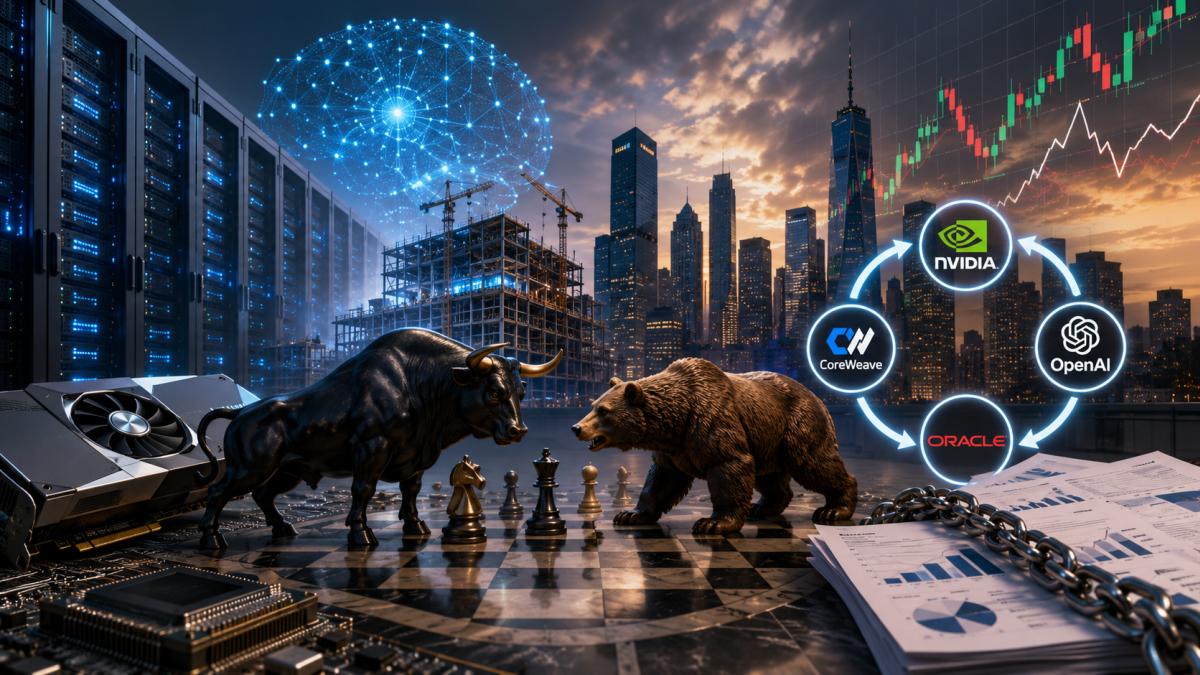
The second crack is circular financing, and this is where forum skeptics have done genuinely sharp work. The capital is increasingly flowing in loops. Nvidia invests in OpenAI. OpenAI commits to enormous compute purchases routed through Oracle and others. Those providers buy Nvidia chips. Bloomberg’s reporting on the web of AI mega-deals maps how the same dollars appear to circulate among a small cluster of firms, each transaction reinforcing the valuations of the others. Supporters call it a virtuous circle that locks in scarce supply. Critics call it a closed loop that manufactures the appearance of demand. Both descriptions can be true until the moment they are not.
The third crack is the revenue gap at the demand layer. The infrastructure buildout assumes end demand that has not fully shown up. When a leaked report in April 2026 suggested that the largest single buyer of AI compute was missing internal revenue and user targets, infrastructure names sold off in unison. That reflexivity is the tell. A supply chain that lurches on a single customer’s headline is a supply chain pricing in a future that remains unproven.
If there is one episode that should temper the optimists, it is Oracle. The company raised its capital expenditure guidance sharply to support a massive compute commitment, opening a funding gap of more than 27 billion dollars a year relative to operating cash flow, which it chose to bridge with debt. Penn Capital’s analysis of the financing risk inside the supercycle traced what happened next with uncomfortable clarity. The equity market initially cheered the ambition. The credit market did not. Oracle’s five-year credit default swap spread widened from roughly 40 basis points to about 200, implying a sharply higher probability of default for an investment-grade borrower. The stock then fell dramatically as equities caught up to what credit had already priced.
The lesson is old and durable. Equity markets reward ambition. Credit markets reprice risk. When the two disagree, the bond desk is usually right first. Hyperscaler capital intensity now runs at 45 to 57 percent of revenue, a level that resembles a utility or heavy industrial company far more than a traditional software business, and a portion of that buildout is increasingly debt-funded.
The honest answer is that both halves of the forum debate are describing real features of the same market. The profitability of the leaders is genuine and historically unusual. The spending is, for now, largely funded from cash flow rather than speculative borrowing. The cost-saver logic gives AI capital expenditure a sturdier demand floor than dot-com advertising ever had.
And yet the concentration is higher than 2000, the financing is turning more circular and more leveraged at the margins, and the entire structure leans on end demand that has to keep accelerating to justify the build. The Bank of England, the Federal Reserve, and a long list of fund managers have flagged the same tension. As Man Group framed it in their examination of the cycle’s hidden risks, rising valuations justify heavier spending, heavier spending signals explosive future demand, and that signal reinforces the valuations. The loop holds right up until the revenue curve fails to steepen in time.
This is the part worth sitting with. A bubble is not defined by whether the underlying technology is real. The internet was entirely real in 2000, and the companies that survived went on to reshape the global economy. A bubble is defined by the gap between price and the cash flows that price assumes. The most likely outcome is therefore neither a clean repeat of 2000 nor a permanent escape from financial gravity. It is something messier: a market where the strongest names earn their keep, the weakest second-tier players get washed out when financing tightens, and the index itself swings hard on the fortunes of a shrinking number of giants.
Different this time is the wrong frame. Different in some ways, dangerously familiar in others, is closer to the truth. The investors who navigate it best will be the ones who can hold both ideas at once: that the cash flows are real, and that concentration plus circular financing can still turn a real boom into a painful correction. The technology surviving the storm has never been in question. The price paid to own it always is.