Physical Address
304 North Cardinal St.
Dorchester Center, MA 02124
Physical Address
304 North Cardinal St.
Dorchester Center, MA 02124


The bear case on artificial intelligence has completed its journey from contrarian to consensus, and almost nobody has noticed what that transition costs. When a position is held by career Treasury analysts, the Bank for International Settlements, the ratings agencies, a large share of financial media and roughly every second post on investment social media, it has stopped being an insight. It has become the ambient mood. Arguing that the AI trade is overextended in mid 2026 is not a call. It is a description of the weather.
The bear case on artificial intelligence has completed its journey from contrarian to consensus, and almost nobody has noticed what that transition costs. When a position is held by career Treasury analysts, the Bank for International Settlements, the ratings agencies, a large share of financial media and roughly every second post on investment social media, it has stopped being an insight. It has become the ambient mood. Arguing that the AI trade is overextended in mid 2026 is not a call. It is a description of the weather.
This matters because the consensus has settled on the least useful version of the question. Whether the bubble bursts is now close to a rhetorical exercise. When it bursts, and more importantly through which mechanism and in what order, remains almost entirely unexamined. That question has money attached to it. The first one does not.
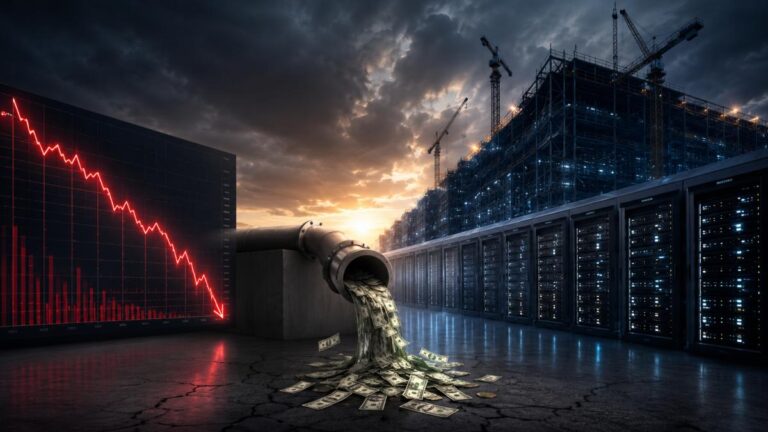
The answer is not found in sentiment, valuation multiples or user surveys. It is found in the credit structure. Asset bubbles built on equity enthusiasm deflate slowly and ambiguously. Bubbles built on leverage end on a specific date, when a specific counterparty fails to make a specific payment. The AI buildout is the second kind, and that makes its timing mechanically observable rather than a matter of opinion.
Start with the number everyone is quoting wrongly, because getting it wrong leads directly to the wrong thesis.
When independent journalist Ed Zitron obtained OpenAI’s audited financials and published them at Where’s Your Ed At, with the Financial Times independently verifying the documents, the figure that travelled was a net loss of roughly 38.5 billion dollars on 13.07 billion dollars of revenue. That number is real, and it is also mostly an accounting artefact. The bulk of it comes from a 41.55 billion dollar charge tied to changes in the fair value of convertible interests and warrant liability, generated by the conversion from nonprofit to for profit structure. It is not cash leaving the building.
The figure that should concern an investor is the operating loss of 20.92 billion dollars, driven by 19.18 billion in research and development that on its own exceeded total revenue. A source speaking to the FT put genuine out of pocket cash burn nearer to 8 billion dollars for the year, against a cash position around 25 billion.
This distinction is not pedantry. It determines the entire timing thesis. A company burning 38 billion in cash is weeks from a crisis. A company with a 21 billion dollar operating loss, 50 billion in assets and continuous access to capital markets is not in imminent danger, and is instead in a slow contest between its cost curve and its financiers’ patience. Anyone forecasting an imminent collapse from the headline number is forecasting from a non cash charge.
The popular bear narrative runs on demand. Consumers will not pay, enterprises see no return, therefore the thing collapses. The demand evidence is real. Gartner’s April 2026 survey of 782 infrastructure and operations leaders found that only 28 percent of AI use cases fully meet return expectations while one in five fails outright. Similar findings recur across MIT, S&P Global and PwC work.
But weak returns do not, by themselves, end anything. Companies tolerate disappointing returns for years. What they cannot tolerate is a payment date arriving without the cash to meet it. Disappointment is a slow variable. Refinancing is a hard one.
The leaked Treasury draft obtained by NOTUS is unusually precise about this, and the precision has been widely ignored in the coverage. Career analysts identified three conditions under which AI firms pose systemic risk: financial conditions changing, productivity goals being missed, and choke points constraining growth. Productivity goals are already being missed and nothing has broken. That tells you productivity is not the binding constraint. Financial conditions are.
Follow the money and it converges on Oracle, which occupies the structurally weakest position in the entire complex.
Oracle is, as CNBC put it, building data centres with debt while every major peer funds capacity from operating cash flow. It carries well over 100 billion dollars of debt, free cash flow ran to negative 24.7 billion by the end of its fiscal third quarter, and analysts do not expect it to turn cash flow positive before 2030.
Against that sits a remaining performance obligation book of roughly 638 billion dollars. This is the number bulls cite as vindication. Examine its composition. S&P downgraded Oracle to BBB minus on 9 July 2026, one notch above speculative grade, and named OpenAI specifically as the vulnerability, because OpenAI represents approximately half the backlog. Only around 12 percent of that book converts to revenue within twelve months. Oracle has committed cash today against contracted revenue that arrives over a decade, from a counterparty that has never generated a profit.
Credit markets began pricing this well before equity markets did. Oracle’s five year credit default swap spreads reached levels not seen since the financial crisis, banks arranging project finance for its data centre builds started hedging their own exposure by buying protection on Oracle debt, and bondholders led by the Ohio Carpenters’ Pension Plan sued the company in January 2026. Meanwhile the Abilene expansion was scrapped after financing negotiations stalled, and thousands of jobs went with it.
That is what a chain link under tension looks like before it fails.
Oracle is merely the visible instance. The structural problem is that most AI infrastructure debt does not sit on public balance sheets at all.
Analysis from Quinn Emanuel traces the architecture: private credit funds including Blackstone, Blue Owl, Apollo, Pimco and BlackRock originate the majority of data centre debt through off balance sheet special purpose vehicles and direct lending to neoclouds. Outstanding private credit exposure to AI related companies has gone from near zero to over 200 billion dollars, with Morgan Stanley projecting a further 800 billion over two years. Roughly 1.5 trillion in external financing is estimated as necessary across the ecosystem by 2028.
The BIS Annual Economic Report published on 28 June 2026 named circular financing collapse among its three most urgent threats to global financial stability, flagging that assets in these interlocking arrangements may be pledged multiple times. Rehypothecated collateral across overlapping equity, debt and commercial agreements is the precise structure that converted an American housing correction into a global crisis in 2008.
The historical rhyme is closer than the dotcom comparison everyone reaches for. Nortel and Lucent lent money to their own customers to purchase their own equipment, booking the proceeds as revenue. When customers defaulted, the loans and the revenue evaporated together. Nvidia holding a stake in CoreWeave while committing up to 100 billion dollars to OpenAI, whose spending returns to Nvidia as GPU purchases, is the same shape.
Here is the structural point that receives the least attention and deserves the most.
Between June 2025 and June 2026, the share of tokens processed through OpenRouter by American models fell from roughly 70 percent to roughly 30 percent. Chinese open weight models from DeepSeek, Zhipu, Moonshot, Alibaba and MiniMax now process the majority. Reuters reports GLM 5.2 running at roughly one sixth the cost of closed American frontier models, at broadly comparable benchmark performance. Coinbase halved its AI spend by switching defaults. Airbnb moved customer service inference to Qwen.
Treat this as a market share story and you miss it. It is a price story, and price stories propagate into capital structures.
Every data centre financing model assumes inference revenue at something like current margins. If inference is commoditising toward marginal cost because competitive open weight models are permanently available at a fraction of the price, then the revenue that services this debt does not arrive at the assumed margin regardless of how strong demand turns out to be. Volume growth does not rescue you from margin collapse. It accelerates the cash requirement.
This is a far more dangerous argument than the popular one about consumers refusing to pay twenty dollars a month, because it survives the scenario where AI adoption succeeds completely.
A correction worth making, because the opposite reading is circulating widely and leads somewhere false.
The claim that Meta and xAI are leasing out data centre capacity because they overbuilt and have no use for it inverts the actual reporting. Anthropic approached Meta in June 2026 seeking to lease capacity in a deal reported at up to 10 billion dollars over two years. Anthropic is separately paying roughly 1.25 billion dollars monthly for SpaceX’s Colossus 1 site through 2029, holds around 19 billion in TeraWulf commitments, five gigawatts of Amazon capacity, a Google and Broadcom TPU arrangement and 30 billion committed to Azure.
That is not a company with nowhere to put spare compute. That is a compute constrained buyer contracting from every supplier with racks, including direct competitors.
The genuine signal here is different and more interesting. Anthropic negotiated monthly payment terms with early exit rights into both the SpaceX and proposed Meta arrangements. A sophisticated buyer insisting on the ability to walk away is a buyer that has priced the possibility of compute becoming abundant and cheap. Note who is taking the duration risk instead: the lenders financing the buildings.
If the mechanism is credit rather than sentiment, the monitorable signals are specific.
Watch Oracle’s RPO conversion rate quarter over quarter. Backlog is only revenue if it converts, and 12 percent annual conversion against front loaded capex is the arithmetic that matters. Watch for a downgrade to speculative grade, which would force selling from investment grade mandated funds holding roughly 120 billion of Oracle paper in the Bloomberg high grade index, a mechanical seller with no view on AI whatsoever. Watch the private credit marks, because the first honest writedown on a data centre SPV reprices every comparable position. Watch OpenAI’s next raise for the terms rather than the headline valuation: the 17.5 percent guaranteed minimum return offered to private equity firms in its enterprise joint venture, a vehicle separate from its core financing, is nonetheless a revealed cost of capital that belongs on high yield paper. Watch inference pricing at the floor.
And watch the political mechanism. OpenAI’s proposal to hand 5 percent of its equity to a US sovereign wealth vehicle is framed as sharing the upside, and is best read as goodwill purchasing rather than a bailout in itself. But it establishes a precedent. Once the state holds equity, the argument for supporting the asset in a downturn writes itself.
The order is more knowable than the date. Credit spreads widen before equity falls, which they already have. A leveraged intermediary fails first, most likely a neocloud or an SPV rather than a household name. Private credit marks follow, forcing repricing across the sector. A ratings action triggers mandate driven selling. Only then does the equity complex reprice, and by that point the move is already largely complete.
The date depends on refinancing calendars and covenant tests rather than on any moment of collective realisation. Bubbles of this construction do not end when everyone finally understands. They end when someone cannot pay. On current evidence that constraint binds somewhere in the credit stack well before it reaches the model labs everyone is watching.
Which means the most crowded question in markets right now is also the least useful one.