Physical Address
304 North Cardinal St.
Dorchester Center, MA 02124
Physical Address
304 North Cardinal St.
Dorchester Center, MA 02124

Almost every new investor carries the same private fear. You finally move a meaningful sum out of the bank, you buy the index fund everyone recommends, and seven days later the market drops 20 percent. The money you spent years saving is suddenly worth far less, and the internet is full of people telling you to stay calm because it always comes back.
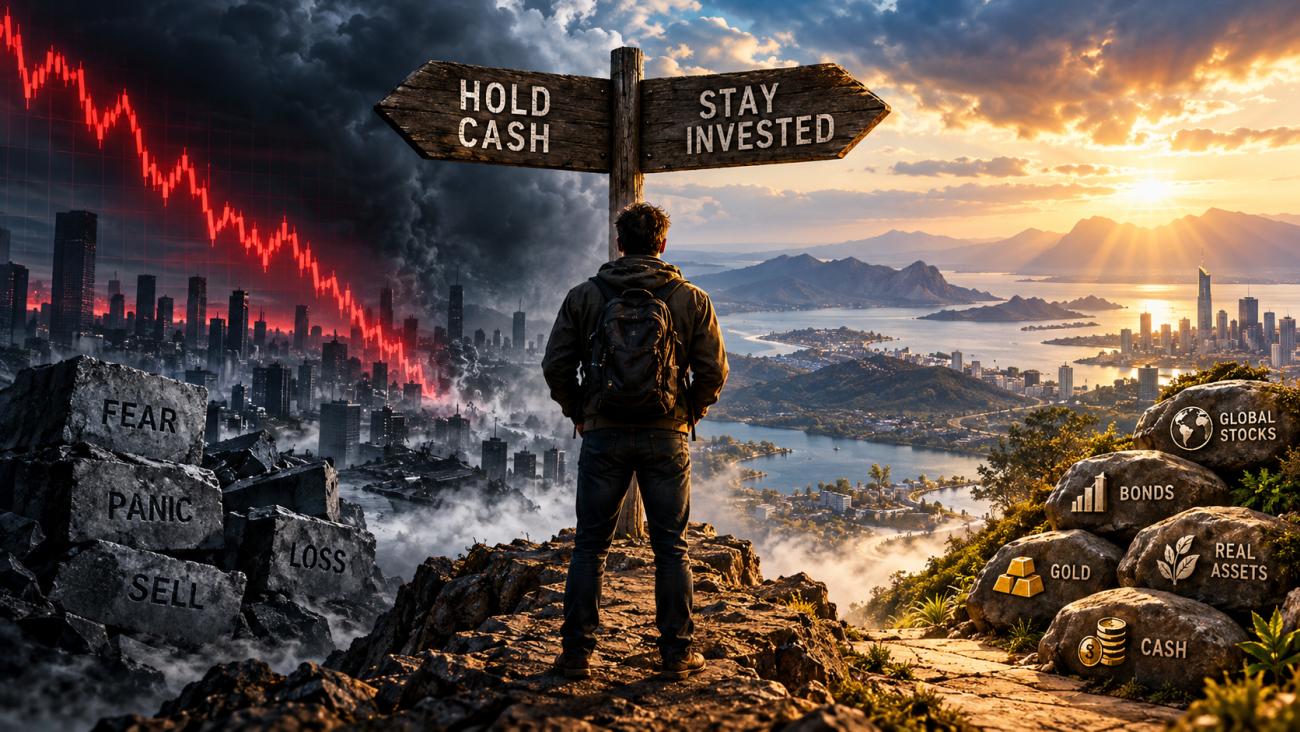
The investment world has two standard answers to this fear, and they contradict each other. One camp says keep your powder dry: hold cash, wait for the crash, then buy cheaply. The other camp says time in the market beats timing the market: get invested and never look back. Both have data on their side, and both are answering the wrong question.
The better question is not whether a crash is coming. It is. The better question is whether your portfolio is built so that you will still own it when the crash is over.
The case against sitting in cash is well documented. J.P. Morgan’s research on missing the market’s best days found that an investor who stayed in the S&P 500 from 1999 to 2018 roughly doubled their money, while one who missed only the 10 strongest sessions ended with about half as much. The problem for cash holders is that the biggest up days tend to arrive in the middle of panics, precisely when waiting feels wisest.
But the stay-invested camp has its own blind spot, and it is buried in the word “always.” The claim that markets always recover is really a claim about one market, the United States, over one century that happened to be exceptionally kind to it. Step outside that sample and the story changes.
Japan is the case that the buy-and-hold crowd rarely mentions. The Nikkei 225 peaked on the last trading day of 1989, and it took 34 years and 2 months to close above that level again, finally clearing it in February 2024. An investor who put everything in at the top spent an entire working career waiting to break even on price.
That is the real version of the nightmare scenario. A market cannot fall more than 100 percent, so the worst outcome is not a deeper crash than 1929. It is a longer one: a lost generation in which your capital does nothing while your life moves on.
Ironically, 1929 itself is less frightening than its reputation. The Dow did not regain its September 1929 closing high until November 1954, which is where the famous “25 years to recover” statistic comes from. Yet market historian Mark Hulbert has argued that once you account for dividends, deflation and the Dow’s narrow composition, an investor in the average stock was back to break-even by late 1936. The caveat is that late 1936 was itself a peak, followed by another severe slide, so “recovered” is a generous word for a moment you could only have captured by selling it.
The lesson from both episodes is the same. The single biggest risk is not volatility. It is concentration in one market at a time when that market looks unbeatable. In 1989 Japanese companies dominated global stock rankings. In 2026 a handful of American technology and AI names carry an unusually large share of global index weight. History does not repeat on schedule, but it does punish investors who assume today’s leader is permanent.
If the market does crash next week, the damage an investor suffers depends less on the market than on what that investor does next. Morningstar’s annual study of the gap between fund returns and investor returns found that the average dollar in US funds earned 7.0 percent a year over the decade to 2024, versus 8.2 percent for the funds themselves. The investors who captured almost all of their funds’ returns were those holding simple, all-in-one allocation funds.
A fair contrarian note: not everyone accepts that the gap proves investors are bad at timing. A 2026 paper in the Financial Analysts Journal re-examined the same data and concluded that poor timing explains only a small fraction of the shortfall, with the rest driven by how the returns are calculated. Either way, the practical conclusion survives. Fewer moving parts and fewer discretionary trades tend to leave more of the return in your pocket.
[Also Read: Powder Dry vs Fully Invested – We had Qwen and Claude Argue Both Cases]
What drives the selling that does happen is simple. An investor who puts 100 percent of a lump sum into equities, and who has never watched a real portfolio lose a third of its value, has no idea how they will react until it happens. Many find out that their true tolerance is far lower than the risk questionnaire suggested, and they sell near the bottom. The crash does not cause the permanent loss. The exit does.
For anyone holding a lump sum, there is a well-researched middle path between all in and all out. Vanguard’s analysis across several major markets found that investing the full amount immediately beat phasing it in over time in roughly two out of three historical periods, for the obvious reason that markets rise more often than they fall.
Read that the other way around, though, and one period in three favoured the cautious investor. Drip-feeding a lump sum into the market over several months is best understood as regret insurance. You accept a slightly lower expected return in exchange for never being the person who invested everything on the Friday before a crash. The research also suggests that shorter phasing windows give up less return than longer ones, so the insurance does not need to run for years to do its job.
For someone who genuinely loses sleep over timing, that trade can be entirely rational. An investment plan you follow will beat a theoretically superior one you abandon.
The textbook answer to crash risk is a balanced portfolio of shares and bonds, on the theory that bonds rise when stocks fall. Most of the time that holds. But 2022 exposed its weak point. Morningstar’s review of 150 years of market declines found that 2022 was the one year in the entire record when bonds offered no cushion during a stock market fall, because inflation and rapid rate hikes pushed both assets down together.
That points to a more useful way of thinking about diversification. Instead of owning assets that simply differ from shares, own assets that fail for different reasons:
A deflationary crash, like 2008, tends to reward high-quality government bonds. An inflationary shock, like 2022, punishes bonds and has historically been kinder to gold, short-dated cash and real assets. A single-country bust, like Japan after 1989, is softened only by owning other countries. No one asset handles all three, which is exactly why a portfolio should hold more than one.
It depends on the decisions you make before it happens, not after.
If the money is needed within the next few years, for a home deposit or school fees or a planned expense, it should not be in the stock market at all, crash or no crash. If the money is long-term but you fear bad timing, phasing it in over a few months buys peace of mind at a modest and measurable cost. And if the portfolio is spread across assets that break under different conditions, and across more than one country, then a crash next week becomes an unpleasant chapter rather than the end of the story.
Keeping your powder entirely dry means paying a steep price for a crash that may not arrive on your schedule. Charging in with everything means betting that you will behave perfectly during the worst weeks of your investing life. The contrarian position is neither. It is building something you will not be tempted to sell, and then letting the market do what it has done for most of the last century, while remembering it has not done so everywhere.
This article is for educational purposes only and is not personalised investment advice. Past performance does not guarantee future results.