Physical Address
304 North Cardinal St.
Dorchester Center, MA 02124
Physical Address
304 North Cardinal St.
Dorchester Center, MA 02124

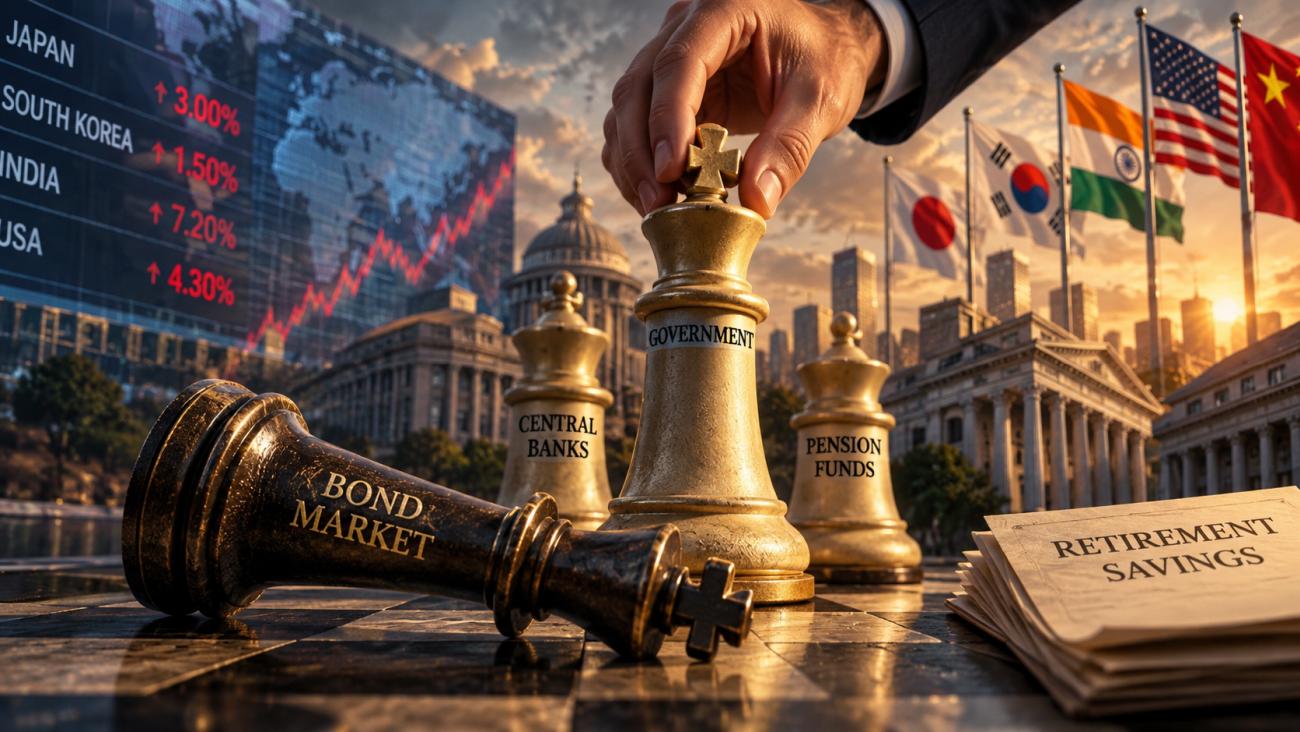
For most of modern financial history, the bond market was the one referee no government could bribe. Borrow recklessly and lenders demanded a higher rate in a public auction for everyone to see. Run an incoherent economic policy and the currency punished you within hours. Equities fell when they deserved to fall. None of it was pleasant, but that discomfort was the whole mechanism. It stopped capital from piling into things that did not work.
That referee is now being escorted off the field. Over the past few months, officials in Washington, Tokyo, Seoul, New Delhi and Beijing have each stepped into their own markets to hold up a price the private market was unwilling to pay. The tools differ from country to country. The pattern does not. The most important part of that pattern is where the money is now coming from. When central bank balance sheets run short of room, governments are reaching into the retirement savings of their own citizens.
If you want to see what a market looks like after two decades of official support, look at Japan. The Bank of Japan owns roughly half of all outstanding Japanese government bonds, and it has spent the past two years trying to slowly reduce its purchases. The market’s response to that gradual retreat has been brutal.
On September 1, the benchmark 10-year JGB yield reached 3% for the first time since September 1996, with the 20-year also at a three-decade high and the 30-year heading for a record close near 4.18%. The 10-year yield has more than tripled in two years. Investors are openly questioning whether Prime Minister Sanae Takaichi can fund her strategic spending ambitions without wrecking the public finances, with government debt already above 200% of GDP.
The lesson is simple. The pressure the state spent years suppressing did not disappear. It waited. The moment the central bank eased its grip even slightly, the pressure came straight back.
What Tokyo did next is what makes this story bigger than Japan. With the Bank of Japan unable to keep absorbing supply, the government turned to the next deepest pocket in the country.
[Also Read: The Great Pension Theft]
Takaichi and Finance Minister Satsuki Katayama have both called on Japanese pension funds to invest more at home. The Government Pension Investment Fund, one of the largest retirement pools on earth, currently splits its portfolio evenly across domestic bonds, foreign bonds, domestic equities and foreign equities. In late August, its management committee held a rare holiday-month meeting, the first publicly announced one in seven years, only months after concluding that no review of its allocation was needed. Markets immediately read it as groundwork for raising the domestic bond target above 25%.
Think about what that means in practice. The central bank was the buyer of last resort for Japanese debt. Now the buyer of last resort needs a buyer of last resort, and the candidate is the retirement savings of Japanese workers. We explored how Japan’s bond stress feeds into global carry trades in The Tokyo Time Bomb That Wall Street Is Choosing to Ignore. This is the next chapter of that story.
If Japan were the only example, you could call it a uniquely difficult situation. Korea shows it is becoming standard practice.
South Korea’s National Pension Service manages the retirement money of an entire nation, roughly a trillion dollars in assets. In April, with the won trading above 1,500 to the dollar, authorities raised the fund’s strategic currency hedge ratio from 10% to 15% and gave it flexibility to go further. Because hedging foreign holdings means selling dollars forward, the country’s largest pool of dollars effectively became a source of dollar supply for the currency market. In plain terms, the pension fund was enlisted to defend the won.
It was not an easy decision. Reports indicated the fund itself was uneasy about using citizens’ retirement money this way. By June, with the won still under pressure, officials were admitting that nearly every available tool had already been used, and that pushing the hedge ratio higher again would carry a heavy political cost.
Japan was defending a bond market. Korea was defending a currency. Different problems, identical reflex: when official reserves run thin, reach for the pension pot.
India offers a slightly different version, where the state does not borrow the public’s savings so much as pay a premium to attract someone else’s.
After the rupee slid to record lows earlier this year, the Reserve Bank of India opened a special swap facility on June 8. Indian banks could take in foreign currency deposits from non-resident Indians, and the central bank would absorb the cost of hedging those dollars. The response was enormous. The scheme pulled in a confirmed $136.4 billion, more than 60% above target, and the window was shut a month early.
Success created its own problem. Swapping all those dollars into rupees flooded the banking system with cash, leaving the RBI to drain a record liquidity surplus. More importantly, these are not dollars India earned through exports or long-term investment. They are deposits that mature in three to five years and will have to be repaid in dollars. The currency was defended today with a bill that arrives later, and the public balance sheet carries the hedging cost in between.
The examples so far came with a technical justification: liquidity, stability, hedging policy. Beijing rarely bothers.
China’s so-called national team is a group of state-backed vehicles that buy equities whenever the market comes under pressure. After a sharp chip and AI selloff in mid-July dragged the Shanghai Composite down 3% in a single session, China Reform Holdings said it had bought 50 billion yuan of stocks using money borrowed through a central bank relending facility, while China Chengtong added billions more. That is central bank money flowing directly into equities to defend a price level.
The results were telling. According to reporting from Asia Times, the lift from the state buying faded within two to three days before many chip names slid again. Buying can hold a number for a while. It cannot make buyers appear who were not there before.
It would be comforting to think this is an Asian phenomenon. It is not. The United States simply does it with better public relations.
After the 30-year Treasury yield hit a 19-year high in August, the Treasury Department announced it would at least double the size of its long-end liquidity support buybacks, from $2 billion to a minimum of $4 billion per operation, effective September 9 through November 4. The government is buying back its own long-dated debt, financed by issuing shorter-term paper.
Yields dropped sharply on the news and then crept back. Strategists at ING said the move signalled discomfort with long-term borrowing costs and warned it could be repeated again and again if long yields kept rising. Treasury Secretary Scott Bessent insists the program is about market liquidity rather than controlling yields, while also reminding markets that he has a big toolkit. Deutsche Bank’s George Saravelos was more direct, describing it as a soft form of financial repression and warning that capping long bond prices pushes the adjustment onto the dollar instead.
Financial repression, for anyone unfamiliar with the term, describes policies that keep a government’s borrowing costs down by handing savers and investors a worse return than a free market would provide. It is a tax that never appears on a tax bill.
The obvious question is whether any of these governments can simply stop. Japan has tried, twice.
The Bank of Japan ended quantitative easing in March 2006 and raised rates that summer, confident deflation was beaten. By 2010 it was back with comprehensive easing, and by 2013 it was running the largest asset purchase program in the developed world. In 2016 it introduced yield curve control, capping how high government bond yields could go. It formally abandoned that framework in 2024 but kept buying bonds on a large monthly schedule, because stopping outright was never really an option.
Each attempted exit required the intervention to continue in some other form. That is the core problem. Remove the official buyer and there may be no market underneath at the current price, only the level nobody was willing to pay.
For investors, the uncomfortable conclusion is that several of the world’s most important prices are no longer telling you the truth. A government bond yield held down by buybacks, pension reallocations or central bank purchases understates the real risk of lending to that government. A currency defended with pension hedges or borrowed deposits looks more stable than its fundamentals justify. A stock index propped up by state funds reflects policy, not demand.
The cost of that suppression does not vanish. It gets pushed onto whoever is funding it: pensioners whose portfolios are steered by policy rather than return, taxpayers who absorb hedging costs, and holders of currencies that quietly weaken to take the strain. The longer the real price is held back, the larger the eventual repricing tends to be.
A defensive posture in this environment means questioning how much long-duration sovereign debt you really want to own at artificially supported yields, avoiding concentration in any single currency whose stability depends on intervention, and paying attention to assets that do not rely on a government’s balance sheet to hold their value. The dates worth watching include the GPIF’s allocation decision, the US Treasury’s next quarterly refunding on November 4, any further change in Korea’s pension hedging rules, and the maturity wall on India’s swapped deposits later this decade.
Governments are buying time, and they are paying for it with other people’s savings. Markets have a long memory for that kind of transaction, and eventually they insist on settling it.
This article is for informational purposes only and does not constitute financial advice. Always conduct your own research before making investment decisions.