Physical Address
304 North Cardinal St.
Dorchester Center, MA 02124
Physical Address
304 North Cardinal St.
Dorchester Center, MA 02124

For about eighteen months, Leopold Aschenbrenner looked like the man who had worked out the AI trade before anyone else. His hedge fund, Situational Awareness, was built on a thesis that was easy to state and hard to argue with: artificial intelligence would demand an extraordinary quantity of compute, memory, data centre capacity and electricity. If that was right, the companies supplying the physical backbone of the boom stood to be among the decade's biggest winners.
For about eighteen months, Leopold Aschenbrenner looked like the man who had worked out the AI trade before anyone else.
His hedge fund, Situational Awareness, was built on a thesis that was easy to state and hard to argue with: artificial intelligence would demand an extraordinary quantity of compute, memory, data centre capacity and electricity. If that was right, the companies supplying the physical backbone of the boom stood to be among the decade’s biggest winners.
For a while the market agreed emphatically. The fund returned 439% net through the end of June 2026 and its assets swelled to roughly $45 billion, a figure larger than most multi-strategy firms accumulate over decades of patient asset gathering. It was, on paper, the best performing large fund in the world.
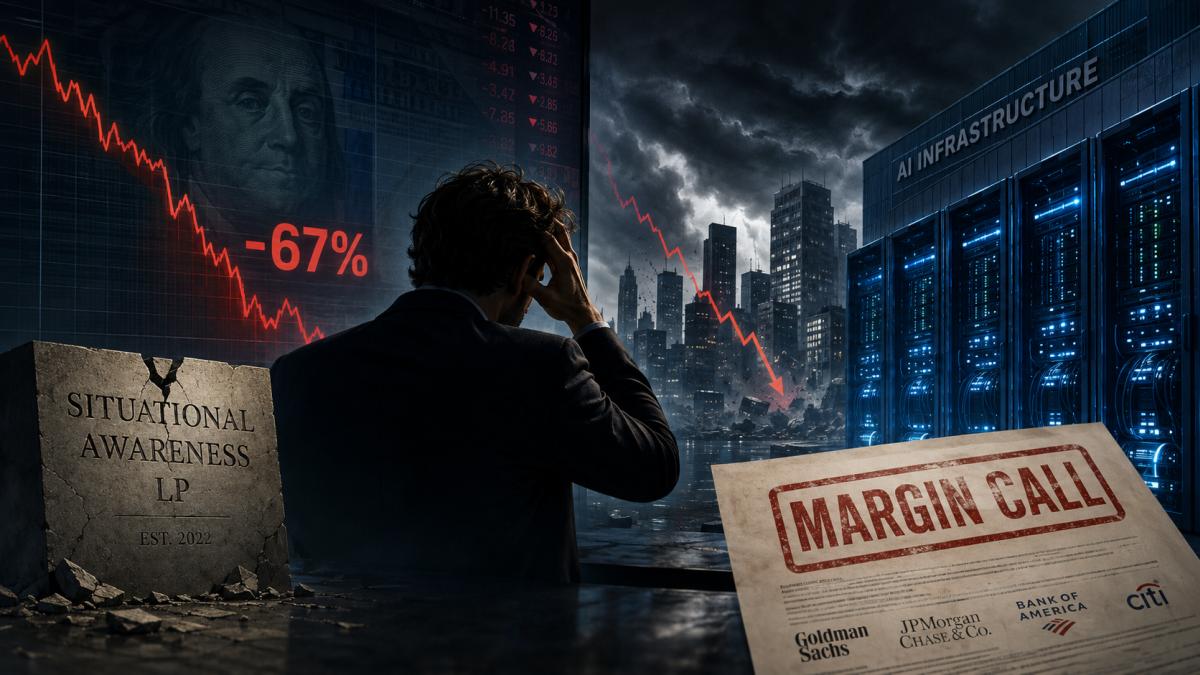
Then July happened. A sharp sell-off across AI infrastructure names collided with a leveraged, concentrated book, and the portfolio lost 67% of its value in a single month. By the end of the month the fund had been forced to sell the bulk of its public equity portfolio to Ken Griffin’s Citadel to satisfy margin calls from its prime brokers.
The temptation is to read this as a verdict on artificial intelligence. It is not. The AI thesis may yet prove entirely correct, and several of the stocks involved have already clawed back part of their losses. What the episode actually demonstrates is something older and less comfortable: investing well is not only about predicting the future accurately. It is about surviving the route to it.
That is where Situational Awareness came apart, and the failure mode is not exclusive to funds managing tens of billions. It applies to anyone who has ever put an outsized position behind a conviction.
Aschenbrenner was not a conventional fund manager. Before launching the firm he was known for his AI research and for the essay that gave the fund its name, which argued that highly capable systems would arrive sooner than the consensus expected and would carry enormous economic and geopolitical weight. He had no prior experience running institutional money.
The investment strategy followed directly from the worldview. If AI development accelerated, someone had to build the infrastructure. Advanced chips would be needed. Memory demand would spike. Data centres would multiply, and they would consume electricity on an industrial scale.
The logic was clean. The trouble is that a macro thesis, however sound, tells you almost nothing about what to buy, at what price, in what size, or with how much borrowed money behind it.
This is where most investors come unstuck. You can identify a genuine multi-decade trend and still lose money by paying the wrong entry price. You can pick the right company and destroy yourself with leverage. You can own genuinely excellent businesses and still turn a routine drawdown into a terminal event by putting too much of the portfolio behind a single narrative.
The fund itself was a real, formally structured investment entity. SEC filings list Situational Awareness LP as a Delaware limited partnership with Aschenbrenner signing as managing partner. This was not an amateur operation. Which makes the point sharper rather than softer: institutional structure and genuine intellectual insight did not protect it.
Portfolio construction is not a secondary concern that follows the idea. It is at least as important as the idea.
Borrowed money is the oldest trap in finance because it works beautifully right up until the moment it does not.
Consider an investor with $1 million who borrows another $4 million and puts the full $5 million to work. A 10% gain produces $500,000, a 50% return on the original capital. That looks like genius. A 10% loss produces the same $500,000 in the other direction, wiping out half the equity. At 4x leverage, a 25% decline in the underlying portfolio is a complete loss of capital.
Situational Awareness was reportedly running leverage as high as 4x against its public book. At that ratio, the market did not need to be right about anything for very long. It only needed to move.
What makes leverage genuinely dangerous is not the arithmetic, though. It is that lenders do not wait patiently for a thesis to mature. They hold collateral, and when that collateral loses value they demand more of it. The SEC’s investor bulletin on margin accounts is blunt about the consequence: a broker can sell your securities without consulting you first, you do not choose which positions get liquidated, and you are not entitled to an extension. FINRA makes the same point to retail investors, and it applies identically at the institutional scale, where prime brokers including Goldman Sachs, JPMorgan, Bank of America and Citigroup were working with the fund on its margin requirements.
This creates the most destructive feedback loop in markets. Prices fall, collateral shrinks, forced selling begins, prices fall further, more collateral is required. At some point in that spiral the quality of the original thesis stops mattering entirely, because the investor is no longer the one deciding whether to sell.
By the end of July, Situational Awareness was unwinding its entire public equity book, and assets had collapsed from roughly $45 billion at the start of the month to around $10 billion. Roughly $35 billion in value evaporated in a few weeks.
Leverage does not simply amplify risk. It removes your decision-making authority at precisely the worst moment.
The coverage has focused almost entirely on the long positions, but the more interesting failure sits on the other side of the book.
The fund was not only long AI infrastructure. It was simultaneously short software companies that Aschenbrenner expected AI to disrupt. Names like Adobe were on the wrong side of the trade when the AI complex sold off.
Think about what that structure implies. It looks like a hedge. Long the builders, short the disrupted. In a normal market those two legs offset each other, and the fund captures the spread between them.
But it was never a hedge. Both legs were expressions of the same single belief, which is that AI capability would advance fast enough to make infrastructure scarce and incumbent software obsolete. When the market repriced the speed of AI adoption downward, both legs lost money at once. The long book fell because infrastructure demand looked less urgent. The short book rose because the disruption looked less imminent.
This is the trap that catches sophisticated investors far more often than unsophisticated ones. A portfolio that looks structurally diversified, with longs and shorts across different sectors, can be a single undiversified bet wearing a costume. The question is never how many positions you hold. It is how many independent things have to be true for you to make money.
For Situational Awareness, the answer was one.
The long book compounded the problem. Regulatory filings showed the portfolio clustered in memory, semiconductors and AI infrastructure, with SanDisk and Micron alone accounting for more than 56% of disclosed US holdings, alongside major positions in Nebius, CoreWeave and SK Hynix. Each of those names shed more than 35% of its value during the rout.
Concentration is not automatically a flaw. Several of the great investors ran concentrated books deliberately. But concentration demands exceptional discipline precisely because it narrows the margin for error, and it is fundamentally incompatible with leverage. One or the other can be survivable. Together they are not.
The deeper issue is correlation. Investors routinely mistake owning several different companies for being diversified. Owning a memory manufacturer, a chip designer, a data centre operator and an AI cloud business gives you four tickers and one bet. The SEC’s own guidance on asset allocation makes the distinction plainly: diversification works only when holdings respond differently to the same conditions.
There is a further hazard specific to consensus narratives. The AI story was seductive because each link followed from the last: more models require more chips, which require more memory, which require more data centres, which require more power. But markets take a good story and eventually price in a near-perfect version of it. Once expectations reach that level, even strong results disappoint, and a company can post excellent earnings and fall anyway because investors were positioned for something better.
That is the specific danger of investing in a narrative everyone already believes. There is no one left to convert.
Some of the shares involved subsequently recovered part of their losses. It is tempting to read that as proof the fund was merely unlucky, but that reading misses the mechanism entirely.
A leveraged investor does not need to be wrong about long-term value to be destroyed. They only need to be unable to survive the interval.
Suppose you buy at $100 believing the asset is eventually worth $200. You may be entirely correct. But if you borrowed to fund the position and the price touches $70, your broker may liquidate you long before the thesis has a chance to play out. You were right about the destination and you still lost the money, because the market does not pay investors for holding correct opinions they could not afford to hold.
It pays for survival.
Cash, position limits and diversification look inefficient during bull markets. They visibly prevent you from putting every available dollar behind your best idea, and in a rising market that restraint feels like a tax on conviction. What they actually buy is time, and time is the scarcest asset a leveraged investor has.
Aschenbrenner, for his part, blamed short sellers who targeted the fund’s positions for worsening the decline. That may even be partly true. But it is also beside the point. Positions that can be attacked by other market participants are positions that were visible, crowded and financed with borrowed money. The vulnerability was structural, and the predators were a symptom.
The Citadel side of this trade is where most commentary draws exactly the wrong conclusion.
When a large investor must liquidate billions of dollars of stock quickly, the open market cannot absorb it without the selling itself crushing prices. That creates an opening for a firm with the balance sheet, infrastructure and distribution to take the whole book at a discount and then dismantle it in an orderly way.
Citadel did precisely that. Griffin told clients in an August letter that the firm had shed more than 80% of the aggregate risk from the acquired portfolio, having completed nearly 100 block trades totalling over $4 billion in market value, including the largest intraday block trades of the year in ten separate names. The flagship Wellington fund finished July up 5.9%.
Notice what that is not. Citadel did not buy the AI thesis. It bought a liquidity mismatch, hedged it, and distributed it. Griffin said as much in the letter: the ability to distribute the risk was central to the investment case. The trade worked because Citadel was structurally capable of doing something Situational Awareness could not, which was to hold and unwind the book on its own timetable.
The same assets were fatal to one owner and profitable to another. Nothing about the securities changed. What differed was position size, leverage, liquidity and the capacity to wait.
This is worth internalising, because investors habitually evaluate assets in isolation. An investment does not exist independently of the person holding it. A position appropriate for a multi-strategy firm with hedging capability can be ruinous for a retiree. A drawdown that is survivable with no debt is terminal with 4x leverage. Context is not a footnote to the analysis. It frequently is the analysis.
The worst conclusion to draw from this collapse would be that artificial intelligence is therefore a bubble with no economic substance. That does not follow, and the historical pattern argues strongly against it.
Technological revolutions reliably produce genuine transformation and speculative excess simultaneously. The internet remade the global economy and the dot-com bust still destroyed enormous amounts of capital. Railways reorganised entire nations and railway speculation still ruined fortunes. Both things were true at once, and the people who understood the technology correctly were not automatically the ones who made money from it.
AI may well require vastly more compute and energy over the coming decade. Semiconductor firms, memory producers, utilities and data centre operators may all benefit enormously. But an industry growing does not make every stock in it a good investment, and it certainly does not make the moment of peak optimism the right entry point.
This is among the hardest disciplines in investing, because humans conflate the product with the security. You can believe artificial intelligence will reshape the economy and still think particular AI shares are absurdly priced. You can think electric vehicles are inevitable and avoid a specific manufacturer. You can expect Bitcoin to exist in thirty years without believing it should be bought at any price.
The future can be genuinely exciting and the investment can be genuinely dangerous. These are separate questions and they deserve separate answers.
The lesson here is not to avoid ambitious ideas. It is to avoid converting conviction into fragility, and that conversion usually happens quietly, through position sizing and borrowing rather than through any single dramatic decision.
A few uncomfortable questions are worth sitting with. What happens to your portfolio if this position falls 30%? What happens if everything connected to this theme falls together, on the same day, for the same reason? Are you actually diversified, or do you simply own several expressions of one belief? Could you hold these positions through two years of a depressed market without selling anything?
And the one that matters most: could you survive being right too early?
Markets can stay irrational for a long time, but an unleveraged investor can stay solvent for very much longer than a leveraged one. That asymmetry is the entire game. You do not need to capture every rally, own the maximum position, or convert a good idea into an all-or-nothing wager. The objective is not the most spectacular six-month return on record. It is to remain in the game long enough for compounding to do its work.
The numbers made this story spectacular. A fund that had returned 439% in six months lost 67% in one, saw its public book sold in a single block, and shrank from roughly $45 billion to around $10 billion.
It is worth noting that the fund did not die. Having removed its leverage and retained its private holdings, it remained up roughly 80% for the year on the strength of its earlier gains. Aschenbrenner has continued deploying capital. This was a near-death experience rather than a death, which in some ways makes it more instructive, because the fund now demonstrates exactly what it would have been worth had it never levered up in the first place.
Underneath the headline figures sits a very old set of lessons. A brilliant idea can be ruined by poor risk management. A correct prediction can be a losing trade. A portfolio can look hedged while being a single bet. And leverage can convert a temporary decline into a permanent loss.
The AI buildout may run for years, and some of the companies constructing it may become enormously valuable. But markets do not pay investors for seeing the future correctly. They pay investors who are still standing when the future arrives.