Physical Address
304 North Cardinal St.
Dorchester Center, MA 02124
Physical Address
304 North Cardinal St.
Dorchester Center, MA 02124

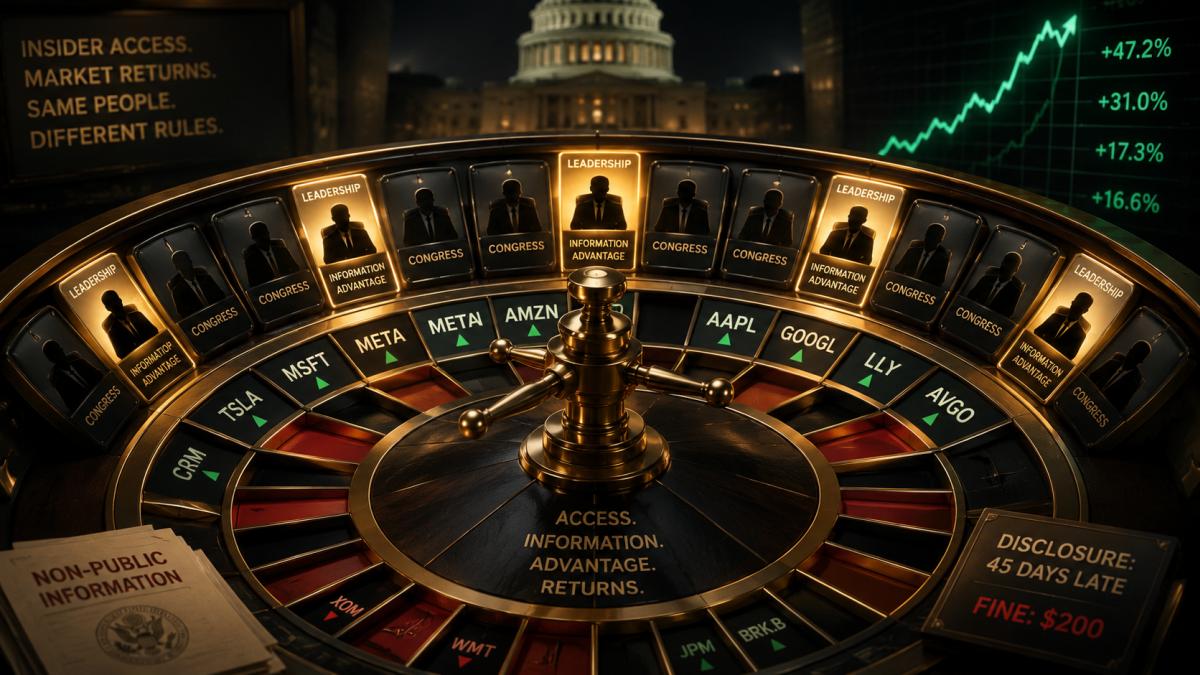
Every developed country has rules against insider trading. Every developed country also has a small, privileged group of people who get briefed on regulatory changes before the public, sit on committees that shape entire industries, and routinely meet with the CEOs of companies whose stock prices their decisions will move within hours. In most countries those two facts are kept apart by a combination of blind trusts, hard divestment rules, and prosecutorial willingness to make examples of violators. In the United States, those two facts have been allowed to collide in the open for more than a decade, and the resulting market structure is one of the most reliable sources of equity alpha in the world.
Every developed country has rules against insider trading. Every developed country also has a small, privileged group of people who get briefed on regulatory changes before the public, sit on committees that shape entire industries, and routinely meet with the CEOs of companies whose stock prices their decisions will move within hours. In most countries those two facts are kept apart by a combination of blind trusts, hard divestment rules, and prosecutorial willingness to make examples of violators. In the United States, those two facts have been allowed to collide in the open for more than a decade, and the resulting market structure is one of the most reliable sources of equity alpha in the world.
It is also one of the few alpha sources where the data is free, the methodology is auditable, and the underlying inefficiency is structurally protected by the fact that the only people who could legislate it away are the same people earning the returns.
The 2025 numbers are the cleanest data point. The S&P 500 returned 16.6% for the year. According to the Motley Fool’s analysis of Unusual Whales data, Republican members of Congress averaged 17.3% and Democrats averaged 14.4%. That looks unremarkable until you note that 100 of the 311 disclosed portfolios beat the index, with the top ten lawmakers all delivering more than double the S&P’s return. Representative Warren Davidson came in at 78.8%, Donald Norcross at 70.8%, Terri Sewell at 67.9%. Senator Rick Scott managed 54.8%. None of these names appeared in the 2024 top ten, which is the part that should make you pause: this is not one or two lucky stock pickers compounding, it is a rotating cast of legislators consistently appearing somewhere in the right tail of the distribution.
The 2024 numbers were even louder. Democrats averaged 31% and Republicans 26% against an S&P return of 24.9%. Nancy Pelosi’s tracked portfolio outperformed nearly every major hedge fund tracked by PivotalPath, which put the industry average at 10.7% that year. Pelosi’s 2024 number beat Citadel’s flagship, beat Millennium’s, beat almost every multi-strat operating at scale. Ro Khanna’s AI-focused trades returned 112.1% in excess of the S&P from January 2024 through April 2026 on a ProCap Insights analysis, which is a return profile most quant funds would publish as their best year of the decade.
The standard objection is that these are estimates based on disclosed trades and may be flattered by selection bias or timing assumptions. Fair point, and the studies that have tried to control for it land in mixed territory. A 2004 working paper found senators beat the market by roughly 12% per year in the 1990s. A 2022 Dartmouth paper found no evidence of stock-picking skill in the post-STOCK Act era at the aggregate level. The most recent and most damning evidence sits in between: an NBER working paper by Wei and Zhou tracked twenty lawmakers who ascended to leadership positions between 1995 and 2021, found they underperformed the market before reaching leadership, and then outperformed regular members by up to 47% per year afterward. The same individuals, the same trading platforms, the same broad market environment. The only variable that changed was the quality of the information flowing across their desks.
That is the cleanest natural experiment we have. The conclusion is unavoidable.
The 2012 Stop Trading on Congressional Knowledge Act is one of the most successful pieces of theatrical legislation in modern American history. It looks like a serious anti-corruption measure, it is cited as one in every reform debate, and in practice it functions almost entirely as legal cover for the activity it nominally regulates.
The mechanics are straightforward. Members must file Periodic Transaction Reports within 45 days of any trade above $1,000. The information is then posted publicly. On paper, this creates transparency. In practice, the 45 day window is roughly fifteen times longer than the disclosure window for corporate insiders under SEC Form 4 rules, which gives any non-public information a generous runway to play out before the public learns about the trade. And the penalty structure is the part that makes the whole thing functionally toothless. According to the Campaign Legal Center’s tracking of STOCK Act enforcement, the first-time fine for a late filing is $200, the Ethics Committee has discretion to waive it, and no sitting or former member of Congress has ever been criminally prosecuted under the law in its fourteen years of existence.
A $200 fine is not a deterrent. It is a license fee. When members of Congress executed 13,324 trades worth $635.6 million in 2025 alone, per a Common Cause study published in December, the maximum aggregate disclosure penalty for filing every single one of them late would round to a rounding error on a single mid-cap trade. The economic logic of the regime is that disclosure is required, late disclosure is mildly inconvenient, and trading itself is entirely unrestricted.
The 119th Congress (2025 to 2026) has more than two dozen pending bills aimed at restricting member trading. Several have actually moved. The PELOSI Act passed the Senate Homeland Security Committee on an 8-7 vote in July 2025, was rebranded the HONEST Act, and placed on the Senate Legislative Calendar in December. The House Administration Committee advanced its own version, H.R. 7008, in January 2026. A separate, broader bill is tracked by Congress.gov as H.R. 1908, the End Congressional Stock Trading Act, with a companion resolution providing for full-floor consideration.
Public support is overwhelming. The 2023 Nielsen poll found 86% of Americans favor banning member trading. President Trump endorsed the concept at the State of the Union address. Speaker Johnson and Majority Leader Scalise have both signaled support. The bill text exists, the committee votes have happened, the political cover is in place.
[Also see: Congressional Stock Picks as an Investment Strategy: Following the Money in Washington]
And nothing will pass in anything resembling its current form, for the same reason nothing has passed in any prior Congress since the STOCK Act itself. The marginal voter on these bills is a sitting legislator who would be voting to surrender a measurable source of personal wealth, and the bills consistently get watered down at exactly the points where they would bite. The current Senate version exempts the President and Vice President from divestment requirements until after their term, which in the case of the incumbent administration means never. The House version uses a definition of “covered investment” that exempts diversified mutual funds and certain trusts, which is precisely the structure most active congressional traders already use for the bulk of their wealth, leaving the high-conviction individual stock positions either grandfathered or wrapped in family-member ownership.
This is not a cynical reading. It is the explicit text of the legislation that has actually moved through committee.
The British system is sometimes held up as a contrast, and it is technically stricter in that the United Kingdom prohibits MPs from voting on matters where they have a direct financial interest. In practice the disclosure thresholds are extraordinarily high. UK members of the House of Commons only have to register a shareholding if it exceeds £70,000 in value or 15% of a company’s shares. The House of Lords doubled its threshold to £100,000 in 2024, which is roughly one hundred times the equivalent US Senate threshold. As a result, a 2023 Guardian investigation found that more than fifty MPs held undeclared stakes in major listed companies including BP, Barclays, and the major housebuilders.
So the British system is more opaque, the German system is more restrictive, and the Singaporean system is more aggressively enforced. None of this changes the central US fact, which is that the combination of timely-but-not-quick disclosure, weak penalties, and a 535-member legislature where any individual reform vote can be defused by minor amendments produces an exploitable structural pattern.
The investable angle has gotten more interesting since two ETFs were launched in February 2023 specifically to mirror congressional disclosed trades. According to Morningstar’s analysis of the Unusual Whales Subversive ETFs, the Democratic-tracker (ticker NANC) returned 73% from inception through August 2025, outpacing the Vanguard S&P 500 ETF by twelve percentage points. The Republican-tracker (ticker GOP) returned 41% and lagged the same benchmark by twenty points. The Democratic version is the better proxy for the underlying alpha thesis, which makes sense given the higher concentration of long-tenured leadership on the Democratic side over that period.
The structural risk to these vehicles is exactly the legislative reform path described above. If a meaningful trading ban passes, the underlying signal disappears and the ETFs collapse into tracking-error noise around their benchmark. But the base rate on US legislative reform of this specific issue suggests that the strategy has a multi-year runway before any binding rule actually takes effect, and the recent acceleration of AI-mediated trade copying for individual investors (which I covered in my earlier piece on the dissolution of Wall Street’s information moat) makes the trade easier to implement at the retail level than at any previous point.
The cleaner position is not the ETF at all. It is to treat congressional disclosures as a free real-time signal of which sectors are being legislatively positioned for, weight those sectors more heavily in a separately constructed portfolio, and let the underlying market beta do its work. The point is not to copy Pelosi’s exact entries, which by the time you see them are already two to seven weeks stale. The point is to read the pattern across the leadership cohort and understand which industries are being quietly bid up by the people who will write the rules those industries operate under.
Every alpha source has an expiry date, and this one is genuinely closer than it has been at any point since 2012. The H.R. 7008 path has more momentum than any prior reform attempt, public sentiment is at a peak, and the institutional opposition is fractured for the first time. If a clean ban does pass in 2026 or 2027, the signal becomes a historical curiosity and the ETFs unwind.
The base rate still says it does not pass. The legislators voting on it are the beneficiaries, the amendment process has reliably defanged every prior attempt, and the current bills already contain the carve-outs that will keep the practical loophole open even if a version of the headline language reaches the President’s desk. Trade the inefficiency while it exists, but treat the existence of pending reform as a real, dated risk to the position. The most expensive way to play this is to assume the gravy train runs forever. The cheapest way is to assume it runs for another two to three years, harvest accordingly, and move the capital before the rules change underneath it.