Physical Address
304 North Cardinal St.
Dorchester Center, MA 02124
Physical Address
304 North Cardinal St.
Dorchester Center, MA 02124

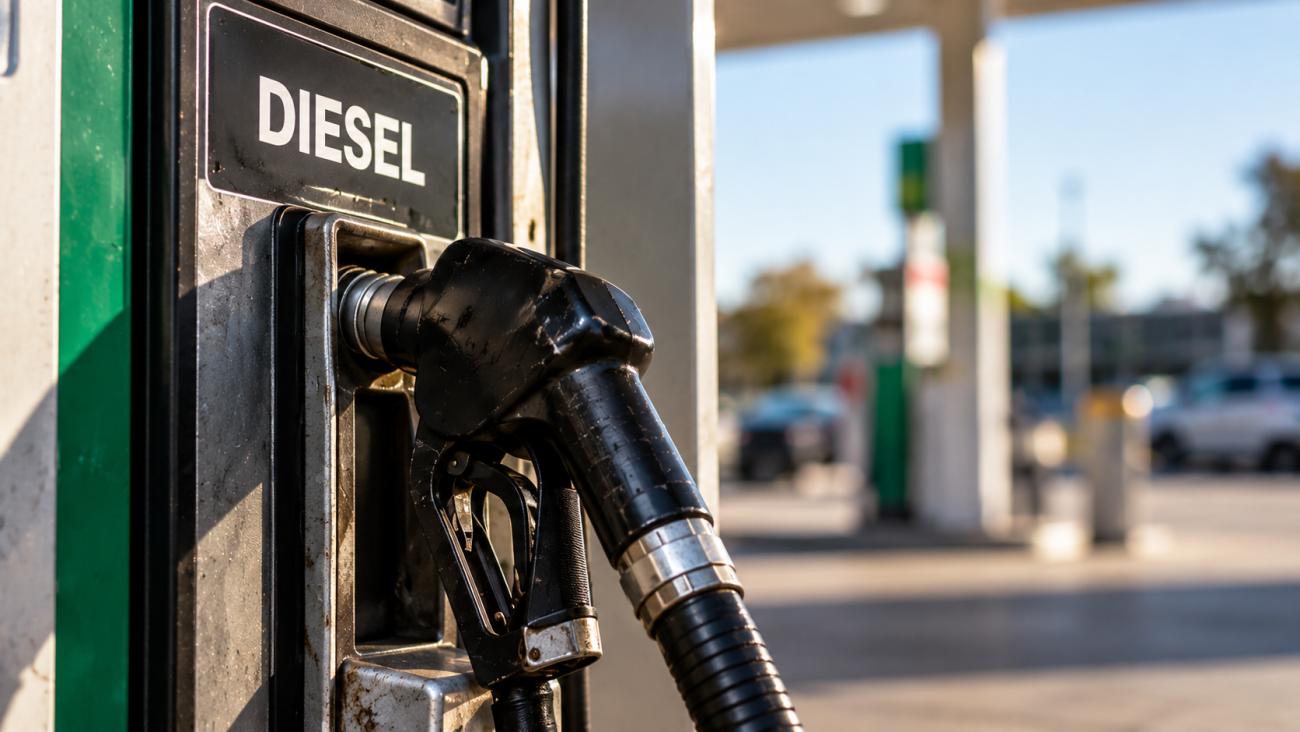
Ask most investors what oil costs and they will read you a number off a futures screen. Right now that is the least useful price in the whole energy complex. The price that is feeding into inflation prints, bond yields and currency markets is the price of a refined barrel of diesel, and for months it has told a far more alarming story than crude.
On October 23 the average US pump price for diesel was about $6.32 a gallon, compared with roughly $3.63 on the same day a year earlier, according to AAA figures cited by OilPrice.com. Crude has risen as well, but not by enough to explain that gap. The rest of it sits in a number most market commentary skips over: the crack spread.
The futures contract quoted on financial television is a promise to deliver oil a month or more from now. A refiner that needs crude this week pays the prompt physical price, which in a tight market can carry a hefty premium over the screen. Then it pays again to get the barrel to its dock.
Freight has turned into a cost line big enough to move the landed price on its own. Chartering a supertanker from the US Gulf Coast to Asia cost around $80 million per voyage on October 9, which works out to about $40 a barrel. By October 16 it had eased to just under $70 million, or roughly $34 to $35 a barrel, still close to six times the cost a year earlier, according to RBN Energy.
Add a prompt premium and a freight bill of that size to the futures price and an Asian or European refiner can be paying tens of dollars a barrel above the headline. We unpacked that gap in Paper Oil vs Real Oil: Why the Headline Crude Price Is Understating This Energy Shock. US refiners with pipeline access to inland crude are partly shielded, because they can buy close to the WTI price. Importers have no such cushion.
Nobody fills a truck with crude. Refiners buy crude, split it into gasoline, diesel, jet fuel and other products, and sell those. The gap between what they pay for the input and what they get for the output is the crack spread. In a normal market it is a competitive, unglamorous margin. Through the 2010s the diesel crack mostly ran somewhere between $20 and $30 a barrel.
In September 2026 it averaged about $111 a barrel. That is a record in raw dollars and, by the reckoning of a detailed study from The Trading Tools, also above the October 2022 peak once inflation is stripped out. The same work shows the refining margin is now larger than the cost of the crude itself, and that around two-thirds of diesel’s price increase since February came from the margin rather than from oil.
The global picture is no better. Diesel benchmarks pushed past $200 a barrel in September and, even after easing, are still close to double the price of crude, according to the International Energy Agency figures cited in this OilPrice.com report on Morgan Stanley’s outlook. In other words, people buying diesel are paying as though oil were trading at levels the futures market has never printed.
The reason is physical destruction of conversion capacity. Refineries in the Gulf have been hit, and Ukrainian drone strikes have knocked about 3.1 million barrels a day of Russian refining offline, close to half the country’s capacity, while Moscow has kept a diesel export ban in place since July, according to S&P Global. That produces an odd situation. Refineries that are offline do not consume crude, so the world can have relatively more crude than finished fuel. In 2008 the bottleneck was oil itself. This time it is the plants that turn oil into something usable. The bill at the pump looks the same either way.
This week supplied a neat demonstration. Brent futures climbed to a five-month high above $114 on fears of a wider conflict, yet physical crude out of the Middle East got cheaper. As shuttle tankers and ship-to-ship transfers move more barrels out of the Gulf, Iraq’s Basrah Medium was reportedly sold at about $10 below the Dubai benchmark, compared with near parity a month earlier, OilPrice.com reported.
So in the Gulf, paper is now running ahead of physical, the reverse of the pattern we described earlier in the year. Crude’s direction has become a tug of war between a war-risk premium and recovering flows. Diesel’s direction does not depend on that fight. It depends on refining capacity, and damaged refineries take months or years to repair.
Policy fixes have been small next to the hole. When the White House announced a diesel supply arrangement with Russia on October 9, the NYMEX diesel crack fell $6.45 in a day to $96.80, per S&P Global. The first cargo under that deal, about 300,000 barrels, left the Baltic on October 23 and is not due in New York until November 7. For a market measured in millions of barrels a day, that is a rounding error.
This is where energy turns into a rates story. US consumer prices rose 3.7% in the year to September, up from 3.4%, with gasoline up 34.2% from a year earlier and fuel oil up 74.2%. Gasoline alone accounted for more than half of the month’s 0.6% increase, and core inflation edged up to 2.6%, according to Trading Economics. The Federal Reserve already raised rates in September and meets again this week.
Diesel matters more than its weight in the index suggests. It powers trucks, trains, farm equipment, construction and much of global shipping, so a lasting spike filters into the price of nearly every physical good with a lag. That makes it hard for a central bank to treat the shock as transitory, and it is a big part of why yields have stayed stubborn.
The damage also depends on where the economy starts. An economy with strong real growth and robust hiring can absorb an energy shock. One with a softening labour market cannot do so as easily, and expensive fuel then works like a second tax stacked on top of high borrowing costs. That combination is what pressures equities and, in the short run, non-yielding assets such as gold, silver and bitcoin, which tend to wobble whenever a hot energy print pushes real yields higher.
History offers a sobering base rate. Across nine diesel crack spikes since 1989, the S&P 500’s median return over the following year was about 3.4%, against roughly 12% for all years, and the three episodes in which the crack stayed elevated for most of a year coincided with drawdowns of 17% to 22%, per The Trading Tools study. The current reading is around 3.2 times its three-year norm, higher at this stage than any prior episode.
Japan is the cleanest case study of how a product shock becomes a currency story. It has almost no domestic hydrocarbons, and more than 90% of its crude imports came through the Strait of Hormuz before the war. In the six months from April to September, its trade deficit almost doubled to ¥2.82 trillion, about $17.8 billion. Petroleum import volumes fell 21.2%, but the value of those imports rose 26.3%, OilPrice.com reported. Japan is paying more for less.
The pressure is not limited to crude. Japanese industry runs on imported petrochemical feedstocks such as naphtha and LPG, and its power sector leans on liquefied natural gas. Qatar, normally a fifth of global LNG supply, shipped only about 17 million tonnes in the first seven months of the year, roughly 65% below the prior year, and two damaged liquefaction trains representing around 17% of its capacity could take years to restore, according to analysis summarised by IENE.
Every extra dollar on that import bill has to be bought with yen. That sits on top of the more familiar driver, the interest rate gap. A policy-rate differential of roughly 250 to 275 basis points keeps the yen attractive as a funding currency, and the coordinated intervention at the end of July pulled USD/JPY from above 163 back toward 155 without changing those fundamentals, as LSEG’s analysis points out. The pair has since drifted back toward the high 150s.
There is a feedback loop here that matters for everyone else. When Tokyo defends the yen, it sells foreign reserves, which are largely dollar assets. A Japanese energy squeeze can therefore end up adding pressure to US yields at the very moment American inflation is already running hot.
On current trends, not soon. Refiners have deferred scheduled maintenance to keep fuel flowing at record margins, and that work cannot be postponed forever. Morgan Stanley expects global planned outages to peak at about 3.4 million barrels a day in the second quarter of 2027, roughly two and a half times a normal spring, while the IEA does not expect lost inventories to be rebuilt before the second half of 2027, per the same OilPrice.com report. That points to tight diesel markets well into next year.
Two developments could shorten the timeline: a durable settlement that normalises traffic through Hormuz, and a ceasefire that stops the strikes on Russian refineries. If either arrives, the reversal could be abrupt. In six of the nine past spikes studied by The Trading Tools, the diesel crack fell by between 46% and 77% within six months. Margins this extreme attract every spare barrel the system can find, and they rarely glide back to normal.
For a contrarian, the most important point is that the consensus is watching the wrong price. A few practical implications follow.
First, track the diesel crack and distillate inventories alongside Brent. They are a better read on what inflation and the Fed will do next than the crude headline.
Second, be wary of crude-only exposure that depends on the war premium. When futures rise while physical barrels soften, the paper rally is the part most likely to give way if tensions ease, while refining tightness can outlast it.
Third, expect rate-sensitive assets to stay under pressure while energy keeps printing hot. The turn in diesel is likely to come before the turn in yields, which makes the crack spread a useful early signal for bonds, precious metals and growth stocks alike.
Fourth, treat the yen as an energy trade as much as a carry trade, and keep an eye on intervention, since reserve sales by Tokyo spill directly into the US Treasury market.
None of this is a recommendation to buy or sell any particular asset. It is a case for reading the energy shock correctly. Crude is where the headlines are. Diesel is where the cost is being paid, and until refining capacity comes back, it is the price that will keep steering rates, currencies and risk appetite.