Physical Address
304 North Cardinal St.
Dorchester Center, MA 02124
Physical Address
304 North Cardinal St.
Dorchester Center, MA 02124

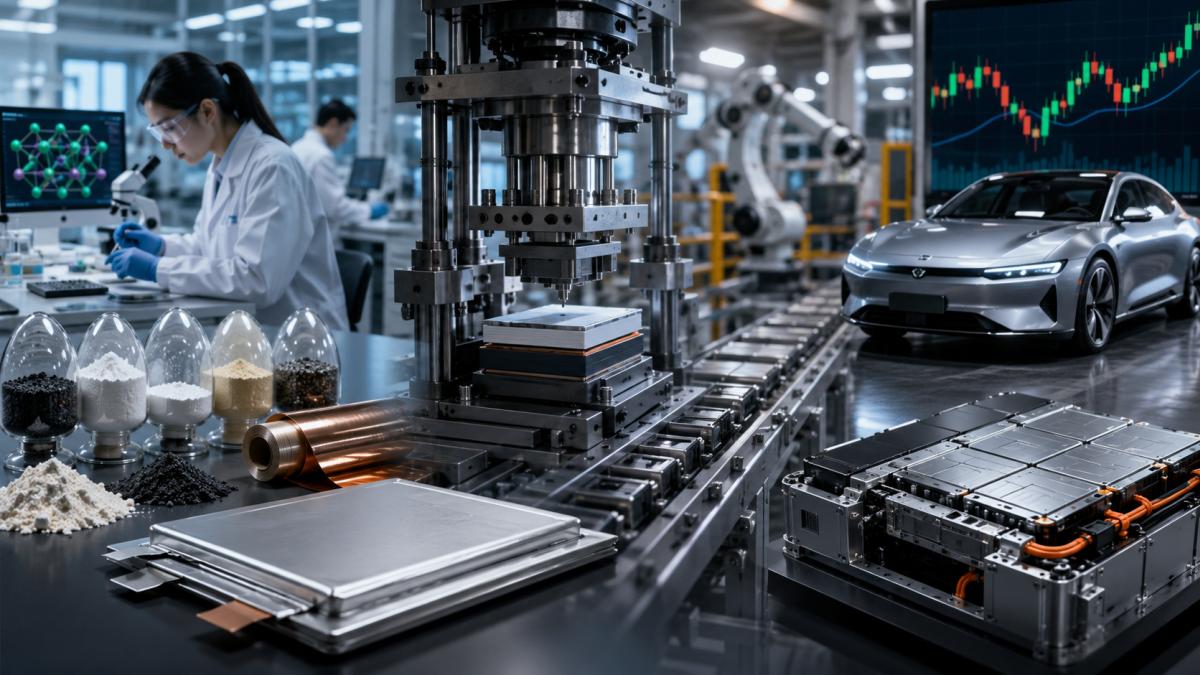
Every few months a new headline declares that the solid-state battery, the so-called holy grail of energy storage, has finally arrived. The latest comes from Wuhan, where Dongfeng Motor says its 350 Wh/kg solid-state cell will reach mass production and vehicle integration in the second half of 2026, enabling driving ranges past 1,000 km. The specifications are genuinely impressive: cells that keep working after being crushed by 50 percent, that survive 170 degrees Celsius without smoke, and that retain over 74 percent of their charge at minus 30 degrees. For anyone tracking the EV supply chain, it is the kind of announcement that moves share prices.
Every few months a new headline declares that the solid-state battery, the so-called holy grail of energy storage, has finally arrived. The latest comes from Wuhan, where Dongfeng Motor says its 350 Wh/kg solid-state cell will reach mass production and vehicle integration in the second half of 2026, enabling driving ranges past 1,000 km. The specifications are genuinely impressive: cells that keep working after being crushed by 50 percent, that survive 170 degrees Celsius without smoke, and that retain over 74 percent of their charge at minus 30 degrees. For anyone tracking the EV supply chain, it is the kind of announcement that moves share prices.
It should not. Not yet, anyway. The gap between a pilot line that can produce a few thousand cells under controlled conditions and a gigafactory that can stamp out millions at automotive cost and quality is the single most expensive chasm in modern manufacturing. Understanding where the genuine bottleneck sits, and which players are honest about it, is worth far more than chasing the next range claim.
The important detail buried in the Dongfeng disclosure is the chemistry. The company chose an oxide-polymer composite route rather than the sulfide path that most of the heavyweight cell makers are pursuing. That choice is deliberate. Oxide-polymer chemistry has a more mature raw material supply chain and is compatible with existing production equipment, which is precisely why it can hit a 2026 timeline when rivals are pointing at 2027 and beyond. Dongfeng also claims full self-reliance across electrodes, electrolyte, and pack integration, and it formed a 19-member Hubei industrial consortium in May to push the effort along.
Here is the catch that the press release glides past. The strongest performers in the lab are the high-conductivity sulfide cells, not the oxide-polymer composites. Oxide and polymer systems tend to trade away either ionic conductivity or the very energy density that makes the technology worth pursuing. A 350 Wh/kg composite cell is a real improvement over today’s roughly 250 to 300 Wh/kg lithium-ion packs, but it is not the 500 Wh/kg leap that the sulfide camp is chasing. What Dongfeng is shipping in late 2026 looks more like an aggressive semi-solid step than the destination. That distinction matters enormously for anyone trying to value the trade.
The science of making a solid-state cell work in a laboratory is largely solved. The economics of making one at scale are not. Independent analysis pegs sulfide solid-state cells in the pre-pilot phase at anywhere from 800 to over 2,000 US dollars per kWh, against roughly 100 to 130 dollars per kWh for mature lithium-ion. One widely circulated teardown estimate puts an early 100 kWh solid-state pack at around 80,000 dollars in battery cost alone, which is the sticker price of an entire performance sedan for the battery by itself.
The reason is physics turned into manufacturing pain. Replacing a liquid electrolyte that fills every microscopic gap with a brittle ceramic layer means you have to press two solids together so perfectly that ions can still cross the interface. A nanometre of air gap and the cell fails. Sulfide stacks in particular demand sustained high-tonnage compression to maintain interfacial contact, which forces rigid, heavy casings that can eat into the very weight savings the technology promises. Scaling from 20 Ah laboratory samples to 60 Ah automotive-grade cells is where the industry keeps stalling, as detailed in this teardown of why 2025 production targets slipped. Yields that sit near 50 percent have to climb toward 95 percent before the cost curve bends, and that is a process-engineering grind measured in years, not quarters.
Costs will fall. Sulfide electrolyte prices in China have already dropped from 70,000 to 80,000 yuan per kilogram in 2023 to 10,000 to 20,000 yuan in 2025, with a target near 7,000 yuan in 2026, according to this detailed cost breakdown of the solid-state puzzle. Dry-electrode coating, the manufacturing approach that eliminates toxic solvents and giant drying ovens, is the genuine swing factor on capital expenditure. But these are gradual curves, not cliffs, and they argue for patience rather than a 2026 buying frenzy.
The most useful filter for this sector is to separate marketing dates from money-backed roadmaps. CATL, the world’s largest cell maker, rates its own all-solid-state program at technology readiness level 4, meaning lab validation, and openly targets level 7 to 8 by 2027 for small-scale pilot production, with genuine mass commercialization closer to 2030. CATL has filed sulfide cathode patents and reserved 626,000 tons of copper foil capacity worth roughly 66 billion yuan for 2026 through 2028, as covered in this analysis of CATL’s pre-pilot sulfide push. That is a company spending real capital while refusing to overpromise on dates.
Toyota and its partner Idemitsu, who hold one of the deepest sulfide patent portfolios in the industry, have repeatedly guided to 2027 or 2028 for commercialization, with early volumes confined to high-margin halo vehicles, as laid out in Toyota’s own statement on the Idemitsu collaboration. On the Western side, QuantumScape inaugurated its Cobra-process Eagle pilot line in February 2026 and is now working on demonstrating scalable production, a step that still precedes commercial volume by years, according to its 2026 shareholder filing. McKinsey’s battery analysts are blunt about the consensus: semi-solid batteries are maturing toward mass production now, but commercial-scale all-solid-state output is unlikely before 2030, a view spelled out in their Battery 2035 outlook.
So the honest map looks like this. Pilot lines and semi-solid compromise cells are real and shipping in 2026, mostly into premium and demonstration vehicles. A handful of expensive, low-volume all-solid-state EVs appear around 2027 and 2028. Meaningful mass-market adoption, the kind that actually disrupts the incumbent lithium-ion cost structure, clusters around 2030 and beyond.
The investment lesson is not that solid-state is hype. The physics is too good to ignore, and the technology is genuinely inevitable on a long enough horizon. The lesson is that the word “mass production” is being stretched far past its normal meaning, and the market keeps rewarding press releases as if they were earnings.
The smarter exposure is rarely the company with the loudest range number. It is the picks-and-shovels layer: the sulfide electrolyte and lithium sulfide suppliers, the dry-electrode equipment makers, the high-purity precursor and copper foil providers whose order books fill up regardless of which cell chemistry wins. These are the names with contracted revenue tied to the 2026 to 2028 build-out, not speculative product launches. The cell makers themselves carry binary technology risk and brutal capital intensity, while the materials and tooling layer gets paid by everyone in the race.
A useful comparison point for how easily the market conflates a demonstration with a deliverable is the earlier wave of startup claims, which is worth revisiting in our look at whether Donut Labs really has production-ready solid-state batteries. The pattern repeats: a striking spec, a near-term date, and a quiet absence of the yield and cost data that actually determine commercial viability.
Watch yields, watch cost per kWh, and watch contracted offtake volumes. Those three numbers tell you whether a roadmap is real. Range figures and crush-test videos tell you whether the marketing department is awake. Dongfeng’s 2026 cell may well be a fine product. But treating it as the moment solid-state batteries arrive at scale is exactly the kind of error that separates patient capital from the crowd chasing the next headline.