Physical Address
304 North Cardinal St.
Dorchester Center, MA 02124
Physical Address
304 North Cardinal St.
Dorchester Center, MA 02124

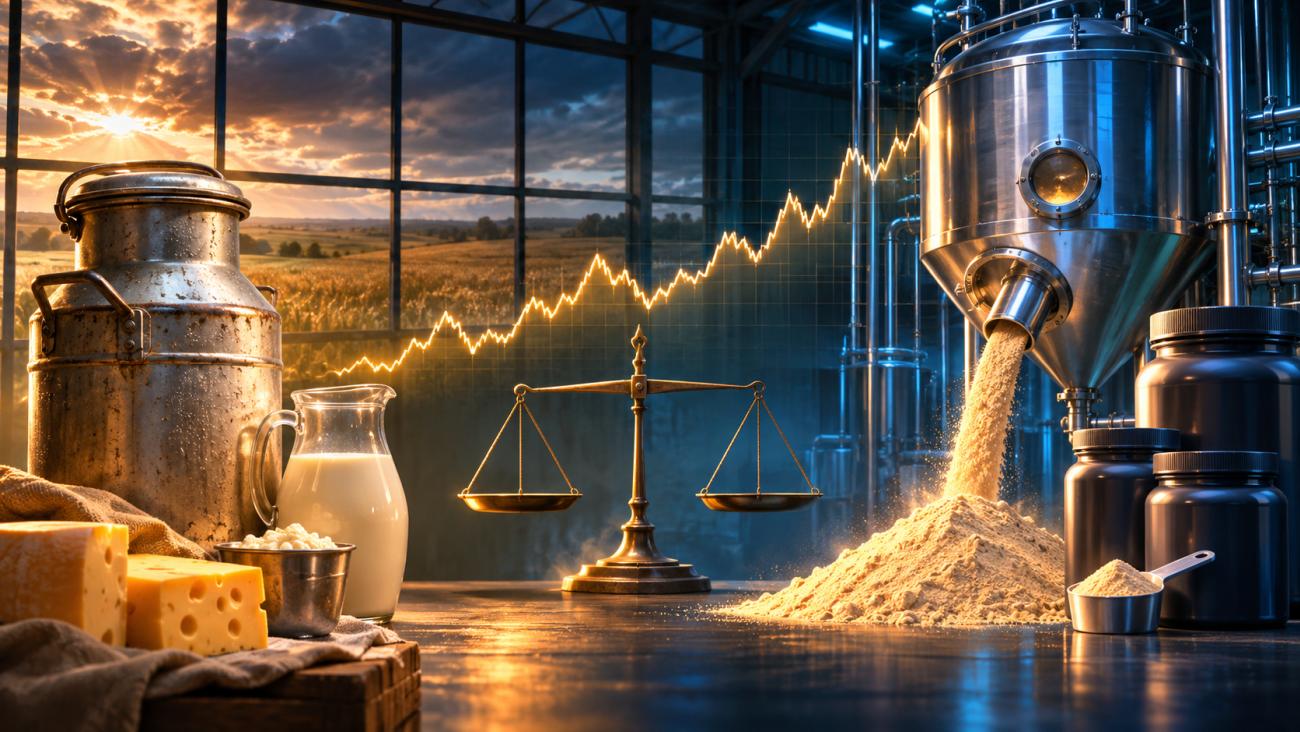
Some of the most interesting trades of 2026 have nothing to do with chips or gold. One of them is in the powder people stir into their morning shakes. Food grade whey, a leftover of cheesemaking that used to be cheap enough to give away, became one of the tightest commodity markets in the world this year. In late May, European whey protein concentrate hit a record of 26,450 euros per tonne, more than double its level less than a year earlier, and the purer isolate grade cost about two and a half times what it had a year before.
Into that squeeze walks a new kind of factory. A recent documentary takes viewers inside Farmless, an Amsterdam startup that grows protein from microbes fed on a liquid made from carbon dioxide and hydrogen. There are no fields, no cows and no crops in the supply chain. The founder, physicist Adnan Oner, presents it as the next step in a lineage that runs from the first farms to the Haber-Bosch process.
It is a compelling film. It is also a pitch. The contrarian question for investors is not whether the science works. It plausibly does. The question is whether the economics hold once the whey shortage that makes them look so good starts to ease.
Strip away the soundtrack and the documentary walks through a fairly simple chain. Renewable electricity is used to make hydrogen. Hydrogen is combined with captured CO2 into a simple alcohol. The company does not name it on camera, but the chemistry described points to methanol or a close relative. That alcohol is then fed to a bacterium Farmless says it found after screening a large library of microbes, chosen for growing very fast, carrying a very high protein content and tasting acceptable.
The fermentation runs continuously rather than in batches, which is the main engineering claim. Batch fermenters spend much of their cycle filling, ramping up and coasting, so a vessel that keeps its cells permanently at peak growth can, in theory, make the same output with far less steel. The broth that comes out is mostly water, so it is heat treated, then spray dried into a powder the company says is around 80% protein and contains all the essential amino acids.
The more revealing parts of the film are about hardware. The team describes biology outrunning the equipment. Cells grow so fast they would cook themselves without aggressive cooling, which pushed the company into building its own jacketed vessels, chillers and pumps. Engineers talk about overnight soldering jobs and runs that go on for months. That is a good sign of a serious team. It is also a sign of how much capital the next stage will need.
The plan on screen is ambitious. A commercial site in the port of Amsterdam with eight production lines, each targeted at close to 1,000 tonnes of protein a year, and a goal of 128 modules by 2035. The founder frames the company as a SpaceX style manufacturer for biology. The documentary also spends time on food security and even Mars, which makes for good television but has no bearing on near term cash flow.
Several of the statistics in the film are directionally right and specifically loose, which is worth knowing before anyone repeats them.
On land, the film puts the share of habitable land used for protein at around 40%. Our World in Data puts all agriculture at about 44% of habitable land, with roughly 80% of that going to livestock, which supplies around 38% of global protein. The land story is real. The exact framing in the film blends categories.
On fertiliser, the claim that roughly half of humanity is fed thanks to Haber-Bosch holds up. Our World in Data’s review concludes that synthetic nitrogen supports about half of the world’s population.
On farm productivity, the film says gains stopped in the 2000s. That overstates it. The USDA’s Economic Research Service shows that global agricultural productivity growth slowed to 1.14% a year in 2011 to 2021, from 1.93% the decade before. Slower, yes. Stalled, no.
On energy, the contrast between expensive food and cheap solar is fair in spirit. Our World in Data estimates that solar costs fell about 90% over a decade and drop roughly 20% with each doubling of installed capacity. The film’s precise percentages could not be matched to a source and are better left out.
None of these corrections sinks the thesis. They do show the habit every investor should apply to founder films: the direction is often right, while the size of the claim is stretched.
The documentary presents microbial protein as a new frontier. It is not. In the 1970s, the British chemical giant ICI built what was then the largest fermenter in the world at Billingham to make Pruteen, a single cell protein grown on methanol. The Science Museum’s catalogue notes that Pruteen used a methanol eating bacterium, reached about 72% protein, and was discontinued in the late 1980s because it could not match competitors’ prices.
The competitor was soybean meal. When soy prices spiked in the mid 1970s, single cell protein looked brilliant. When soy fell back and oil, the source of ICI’s methanol, became expensive, the margin vanished. The technology worked. The spread did not.
That history matters because Farmless is running a modern version of the same trade. The inputs are greener and the target is human food rather than animal feed, so the price it must beat is premium whey rather than soy. The structure is identical: a factory product priced against an agricultural commodity that can swing violently in either direction.
The bull case for protein from air has never looked better on paper. By US wholesale data, whey concentrate went from about $2.50 a pound in mid 2023 to a record $13 in June 2026. Demand from high protein snacks, older consumers and users of GLP-1 weight loss drugs has run ahead of a supply that depends on how much cheese the world makes.
A rough calculation shows why that matters. At the late May European record, a single 1,000 tonne line would gross in the region of 26 million euros a year if its powder sold at whey parity. At mid 2023 prices it would earn about a fifth of that. The same factory, with the same engineering, is either an attractive business or a struggling one depending on a price it does not set.
The squeeze is already loosening. The same data series shows whey at about $11.75 a pound in September and lower again in early October, below the June peak. Glanbia is adding isolate capacity in New Mexico due in 2027, and Agropur is expanding plants in Canada and the US, according to the Fortune report above. Whey shortages are self correcting because high prices pull in supply. Microbial protein has to arrive at scale before that correction finishes.
The one subject the documentary barely touches is regulatory approval, and for a European food company it may be the single biggest variable. Any ingredient not eaten in meaningful amounts in the EU before 1997 needs novel food authorisation before it can be sold there. Farmless’s own funding announcements listed continuing that approval process as a use of funds when it raised a 4.8 million euro seed round in December 2023, taking total funding to about 6 million euros. No authorisation has been announced since.
The best guide to how long this takes is Finland’s Solar Foods, which makes a similar gas fermented protein called Solein. It filed its EU application in October 2021. EFSA delivered a positive opinion on 9 November 2026, and the company now expects final authorisation between June and August 2027. That is close to six years from filing to shelf.
The detail inside that opinion is just as instructive. Inderes, which covers Solar Foods, notes that EFSA measured Solein’s protein quality score at 54% to 57%, below the 75% line usually used to mark good quality protein, and cleared it only for specific categories such as cereal bars and fortified drinks at set maximum levels. Pilot product may underperform later batches. Still, a regulator’s view of protein quality can differ sharply from the marketing claim that an ingredient is comparable to whey. Investors should treat Farmless’s version of that claim as untested until an independent assessment says otherwise.
Farmless is private, so most investors cannot own it. Solar Foods trades on Nasdaq First North in Helsinki and is the closest listed comparison, which makes it a useful stress test of the whole category.
The company has raised more than 100 million euros for its second factory and operations, but booked revenue of just 0.1 million euros in the first half of 2026. The final investment decision on that plant was still pending at the time of the November EFSA update, conditional on binding customer contracts and complete financing. In February, Inderes estimated the company’s share of the first two phases at 179 million to 199 million euros, with 89 million coming from grants, and rated the stock Reduce. Its market value sat around 140 million euros in mid 2026.
When the money needed to build a first full scale plant is larger than the market value of the whole company, dilution and partner deals are not a risk. They are the plan. Farmless, with publicly disclosed funding in the single digit millions of euros plus a 1 million euro EU regional grant, is far earlier on the same curve. An eight line commercial site will need a much larger cheque than anything it has announced.
Two further issues deserve more attention than the film gives them.
The first is feedstock. Farmless’s advantage is that it buys a storable liquid rather than running electrolysers itself. That shifts the risk rather than removing it. Green methanol is still expensive. A peer reviewed study in Energy & Environmental Science put e-methanol at 1,200 to 1,500 euros per tonne at the best sites in 2020, falling to roughly 600 to 680 euros by 2030, and only reaching market prices around 2040. Shipping is lining up as the first big buyer of that same fuel, which means a protein maker could end up bidding against container lines for its main input.
The second is scale. Even if all 128 modules were built by 2035, they would produce roughly 128,000 tonnes of protein a year. A back of the envelope estimate puts global protein consumption at around 240 million tonnes a year, based on about 80 grams per person per day across eight billion people. That makes the full 2035 ambition about one twentieth of one percent of the market. The founder acknowledges in the film that even a very large company would be a rounding error. That is honest, and it means the investment case rests entirely on premium pricing in niches like sports nutrition, not on displacing farming.
The funding backdrop is the most interesting part of this story for anyone with a contrarian streak. Alternative protein investment fell to 881 million dollars in 2025, its first year below a billion since 2018, with fermentation funding down about 44%. Capital has moved to artificial intelligence. When a sector is this out of favour, the survivors can raise money at sensible valuations and the hype cycle is no longer doing the pricing.
That is the bull case in one sentence. The bear case is the Pruteen lesson in one sentence: a technology that works is not the same as a spread that lasts.
For investors who want exposure, a few practical points follow.
Watch the whey price, not the press releases. The economics of every company in this space improve or deteriorate with whey concentrate. If supply additions in 2027 pull prices back toward pre squeeze levels, the margin story weakens just as these companies are trying to raise money for their first big plants.
Treat regulatory milestones as the real catalysts. For Solar Foods, the Commission’s final decision and a binding offtake contract matter more than any capacity announcement. For Farmless, the first sign that its ingredient has been formally assessed and cleared for sale would be worth more than any number of new tanks.
Price in dilution. A pre revenue company funding a first of its kind factory will almost certainly issue more shares, sign away value to industrial partners, or both. Buying before the financing is settled means paying for the risk without being paid for it.
Remember the alternative winners. The companies quietly benefiting from the protein boom today are the ones already making whey. Their capacity expansions are the competition that protein from air has to beat.
Farmless has built something genuinely clever, and its engineers clearly know the hard problems are now in physics and plumbing rather than biology. The film is worth watching for that alone. But the market it is entering has punished this exact idea before, and the shortage that makes it look inevitable today is already showing signs of easing. For now, the smart position is interest without conviction: follow the milestones, keep an eye on whey, and let the regulators and the financiers move first.
This article is for information and discussion only and is not investment advice. Do your own research and consider speaking to a licensed financial adviser before making investment decisions.