Physical Address
304 North Cardinal St.
Dorchester Center, MA 02124
Physical Address
304 North Cardinal St.
Dorchester Center, MA 02124

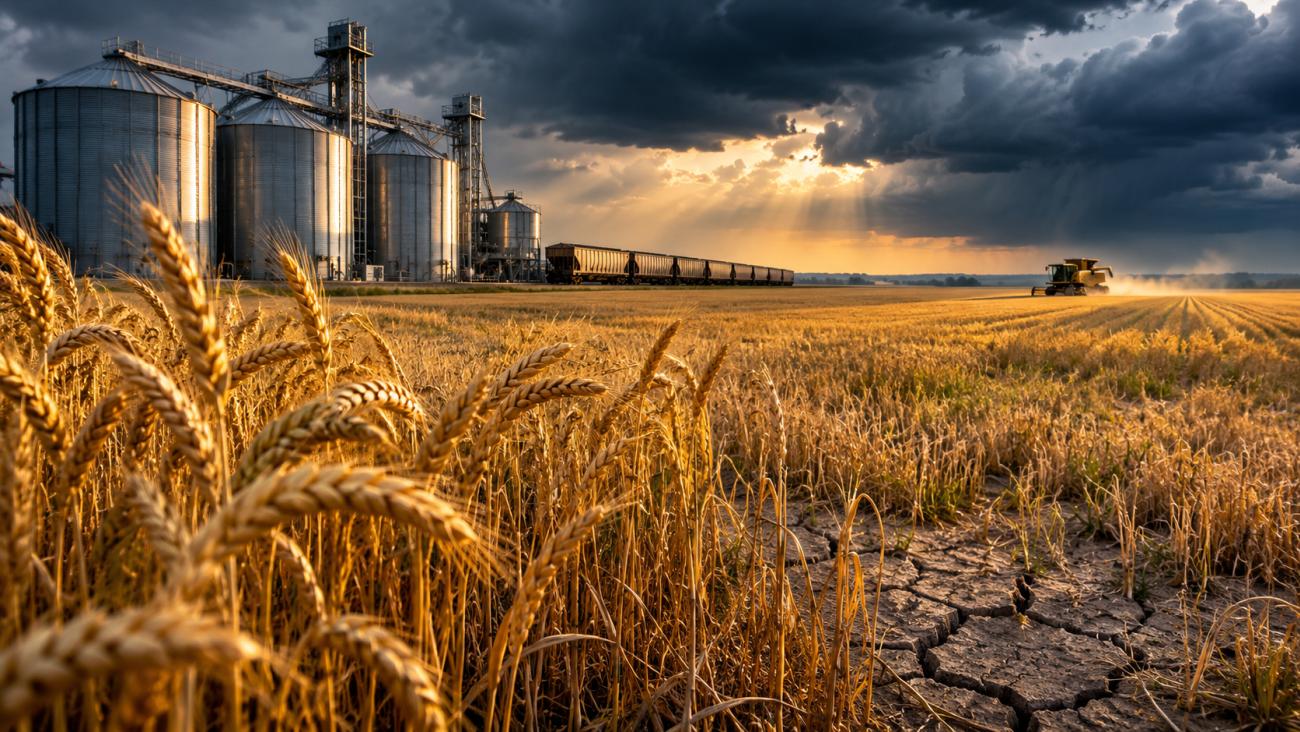
Grain prices are falling while 33 governments tell households to stockpile. A contrarian look at why the fertilizer squeeze means the food bill arrives in 2027.
Grain is getting cheaper, and governments are telling people to stock their cupboards. Both things are true, and markets are paying attention to only one of them.
Global grain prices have been falling for months. At the same moment, an unusual number of governments are quietly advising households to keep several days of food, water and medicine at home. Investors who look only at the price screen see a commodity complex that has calmed down after a turbulent first half. Investors who look at what is happening to next year’s crop see something else entirely. This piece argues that the second view is the one the market is underpricing.
A recent Newsweek roundup mapped 33 countries whose authorities now advise citizens to hold emergency supplies, from the UK, France and Germany to Japan, Canada and several Latin American states. The stated reasons vary. Some cite war risk, some cite cyberattacks on infrastructure, some cite extreme weather.
None of them claim to see a famine coming, and that is the important part. Officials are not reacting to a single forecast disaster. They are reacting to a system that has very little slack left in it, and asking households to rebuild a small part of the buffer that the state and the supermarket chains spent decades removing.
That distinction matters for anyone allocating capital. A one-off shock gets priced, absorbed and forgotten. A system running with thin margins of safety produces a different kind of risk: long stretches of apparent calm, followed by sharp, correlated moves when several things go wrong together.
On the surface, the food data look benign. The FAO Food Price Index fell 1.2% in October to 133.9 points. More striking, the cereals sub-index dropped 4.5% in a single month and now sits about 12.6% below where it was a year ago. Wheat and maize are cheap relative to last autumn.
Fertilizer has calmed down too. After the Gulf war that began on 28 February shut most traffic through Hormuz, urea briefly traded above $850 a tonne in April, up roughly 80% in two months, according to the World Bank. By late summer, ceasefires, partial reopenings of the strait and Chinese export cargoes had roughly halved that price.
Read in isolation, these numbers tell a recovery story. The problem is that food prices are a lagging readout of decisions made many months earlier, and those decisions were made under very different conditions.
Most commodity shocks travel quickly. An oil disruption shows up at the pump within weeks, as we argued in our earlier look at how the oil market was telling two different stories. Food is slower, because the production cycle is measured in seasons rather than days.
Consider the timeline for a European winter wheat crop. Many growers had already locked in much of their nitrogen for the 2026 harvest before prices spiked, so this summer’s crop went in on something close to a normal fertilizer budget. That crop has been harvested, milled and is in today’s bread. The grain being sown this autumn is a different matter. Its inputs were priced after the shock, it will be harvested next summer, and its cost and yield will reach consumers through 2027.
Phosphate adds a second delay. Unlike nitrogen, which must be applied every season, phosphate builds up in soil, so farmers can skip a year with limited immediate damage. That makes it an easy cost to cut under pressure, and it means some analysts expect part of the yield penalty from this year’s cutbacks to surface only in the 2028 harvest. Today’s cheap cereal prices reflect the crop grown before the shock. They say very little about the one grown after it.
Here is where the contrarian case sharpens. Fertilizer prices have fallen from their peak, but farmers are still buying far less of it. ICIS data cited in late October put EU nitrogen demand at about 20% below normal seasonal levels, with phosphate purchases down by at least 30%. Fertilizer imports into Germany, Poland and France are down by between 43% and 56%.
Supply is not loosening as much as the urea chart implies either. European natural gas prices have climbed back to well over double last year’s level, which squeezes the region’s own nitrogen producers. In September, AGF Nitrogen, Europe’s second-largest fertilizer maker, warned it may cut ammonia output as gas and carbon costs pushed product prices beyond what farmers can pay. China, meanwhile, set its 2026 urea export quota at around 3.3 million tonnes, about a third below what it actually shipped in 2025.
So the picture is lower application rates on a crop that is already in the ground, falling domestic production capacity, and a major exporter deliberately keeping more at home. None of that appears in the FAO cereal index yet, because none of it has been harvested.
The fertilizer shock did not arrive alone, and that is what separates this year from a normal bad year.
Geography first. A 2017 Chatham House study of food trade chokepoints found that the share of traded grain and fertilizer passing through at least one maritime chokepoint had risen from 43% to 54% over about fifteen years, and that 10% of that trade had no viable alternative route at all. This year Hormuz showed what that dependence looks like in practice, with fertilizer cargoes stranded in the Gulf for months. A route does not need to close outright to matter. Higher war-risk insurance and longer voyages feed directly into landed costs.
Then the digital layer. Overnight on 11 to 12 October, attackers took control of refrigeration systems in hundreds of French supermarkets, forcing fridges and freezers up to around 50°C and destroying stock across Intermarché, Leclerc, Carrefour, Coopérative U and Monoprix stores. No food was scarce anywhere in France. The failure was in the connected control systems, traced to a vulnerability in refrigeration management software. Lean, networked distribution is cheap to run and fast to break.
Then the weather. England has just recorded its smallest combined cereal and oilseed harvest since records began in 1984, at 16.03 million tonnes, after drought and repeated heatwaves. Farm groups in several Spanish regions reported cereal losses of 30% or more. Looking ahead, NOAA now gives a nearly 70% chance that the current El Niño will be the strongest on record, with 2027 described as virtually certain to set a new global temperature record.
That last point deserves weight. The global food system copes with a bad harvest because bad harvests rarely happen everywhere at once. Research published in Nature Climate Change found that the annual probability of climate stress hitting all the major wheat breadbaskets simultaneously roughly quadrupled, from 0.3% to 1.2%, between 1967 to 1990 and 1991 to 2012. Still a small number. But a record El Niño landing on an under-fertilized crop is precisely the kind of correlated event that number describes.
The most dangerous amplifier is political, not agronomic. When harvests look uncertain, countries holding food become reluctant to sell it.
The last two food crises were not really about global shortage. In 2008, harvests were reasonable, but export bans and precautionary hoarding drove much of the price spike. In 2022, IFPRI found that export curbs covered about 17% of all calories traded internationally. This year we have already seen China restrict fertilizer exports at the worst possible moment for importers, and last year Beijing all but stopped buying American soybeans during the tariff fight. Neither move was driven by scarcity. Both were leverage.
Governments have drawn the obvious conclusion, and they are rebuilding stockpiles they dismantled after the Cold War. As the Financial Times reported via the Irish Times, Norway has begun holding state grain reserves again, Finland is moving its emergency holdings from six months of supply to nine, India’s rice reserves reached nearly 58 million tonnes by December 2025, and Brazil spent about $100 million on public stocks last year. A World Bank review cited in the same piece found climate volatility to be one of the fastest-growing reasons for state intervention in food markets.
For investors, the point is simple. State reserve building is a persistent, price-insensitive bid. It also makes export restrictions more likely in a squeeze, because every government now has a domestic buffer it is politically committed to filling first.
A contrarian should argue with their own thesis, so here is the bear case.
Stocks are ample in places. Rice inventories are large, Spain entered this season with heavy carryover from the second-largest crop in its history, and urea prices have already shown how fast they can collapse once shipping resumes. Farmers adapt, switching from corn to less nitrogen-hungry crops such as sunflower and soy. El Niño impacts are probabilistic, and NOAA itself cautions that a record-strong event does not guarantee record damage. And after 2022, global food prices were back near pre-war levels within about a year.
All fair. But notice what those points have in common. They argue the shock will be manageable, not that it will be absent. Markets are currently pricing something closer to absent.
None of this is a call for panic buying of grain futures. It is a case for thinking about timing and exposure rather than headlines.
The first signal to watch is the gap between input data and crop prices. If EU nitrogen and phosphate demand stays depressed into spring while cereal futures remain soft, the market is implicitly assuming normal yields from a crop that was not fed normally. Spring crop condition reports and USDA’s early 2027 balance sheets will test that assumption.
The second is retail pass-through. In the UK, the British Retail Consortium’s chief executive said in late October that the dam is starting to break on costs retailers have absorbed for two years, as shop price inflation hit 2.1% and ambient food jumped to 3.2%. Retail margins that have been cushioning consumers are a buffer that runs out. Watch food retailers’ guidance and margin commentary over the next two reporting seasons.
The third is the producer split. Nitrogen makers with access to cheap North American shale gas sit on the right side of a world where European plants are being priced out. European producers sit on the wrong side. That divergence can persist even if headline urea prices stay calm.
The fourth is the import-dependent periphery. Countries that buy most of their staple grains abroad and spend a large share of household income on food carry the real tail risk. In 2008, food price spikes contributed to unrest in dozens of countries. Currencies and sovereign debt in that group are where a food shock tends to become a financial one.
Governments are not stockpiling because they have seen a secret forecast. They are stockpiling because they have read the same agricultural calendar the market is ignoring. The fertilizer cuts, the weather and the political hoarding of 2026 have mostly not reached the price of food yet. They are sitting in fields, waiting for harvest.
Cheap grain today is a report on last year’s decisions. The bill for this year’s decisions arrives in 2027, and the market does not appear to have opened the envelope.
This article is general market commentary and not personal financial advice.