Physical Address
304 North Cardinal St.
Dorchester Center, MA 02124
Physical Address
304 North Cardinal St.
Dorchester Center, MA 02124


A professor at Duke recently ran an experiment with his Silicon Valley class. He handed each student a bag of Skittles and set them loose: trade your way to a single-color hoard, and the biggest hoard of each color earns a free pass on a homework assignment. Twenty minutes, open-floor haggling, all the frantic strategy you would expect from ambitious students. Who's holding the reds? Should I dump my purples early? Can I trust the guy in the corner?
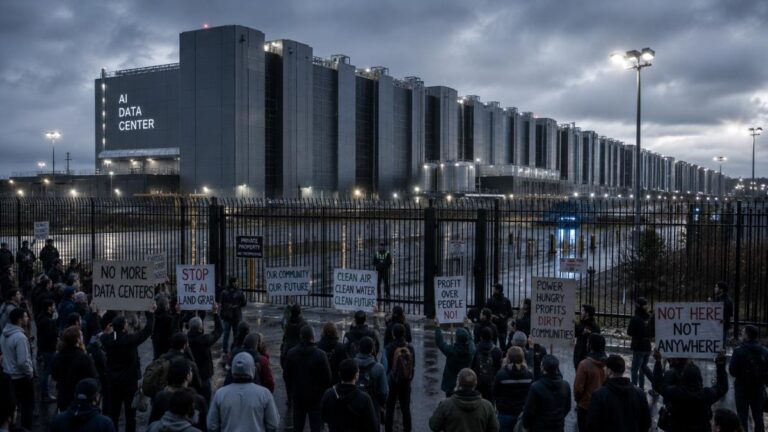
On 5 May 2026, sitting on stage at the Milken Institute Global Conference in Beverly Hills, right next to Michael Milken himself, BlackRock CEO Larry Fink stopped talking about Gulf state markets long enough to say something his audience was not expecting to hear in plain language. He was discussing the new wave of one gigawatt data centers, the kind that cost $50 billion to $75 billion to build. He noted that drone warfare had changed how the industry had to think about physical security in the Gulf Cooperation Council region. And then he kept going. "Right now we're looking at it internationally," he said, "but you know, one of my concerns is could it be a domestic terrorism using a $3,000 drone?"
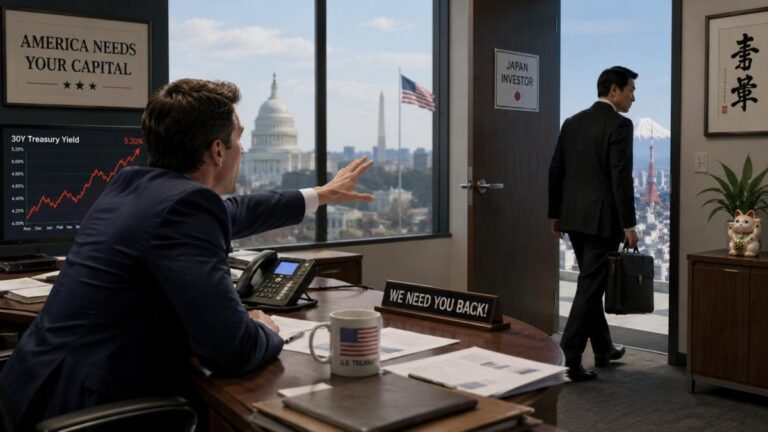
For nearly four decades, the global financial system rested on a single load bearing assumption. There would always be a queue of foreign buyers willing to absorb whatever the US Treasury wanted to sell. Japanese pension funds, life insurers, and mega banks formed the front of that queue. Now, in the quiet way that regime changes usually happen in fixed income, that queue is starting to dissolve. The implications for portfolios built around the old assumption are larger than most investors have priced in.

A former wealth manager turned economist now based in Switzerland recently published two papers, one theoretical and one empirical, that arrive at the same uncomfortable conclusion from opposite directions. He calls the mechanism a "rentier asset black hole." If his framework is right, the West's three-decade productivity slowdown is not a puzzle, not a measurement quirk, and not the residual of bad management. It is the predictable mathematical output of a single distortion sitting at the heart of every major Anglo-Commonwealth economy. And the asset doing the distorting is residential land.
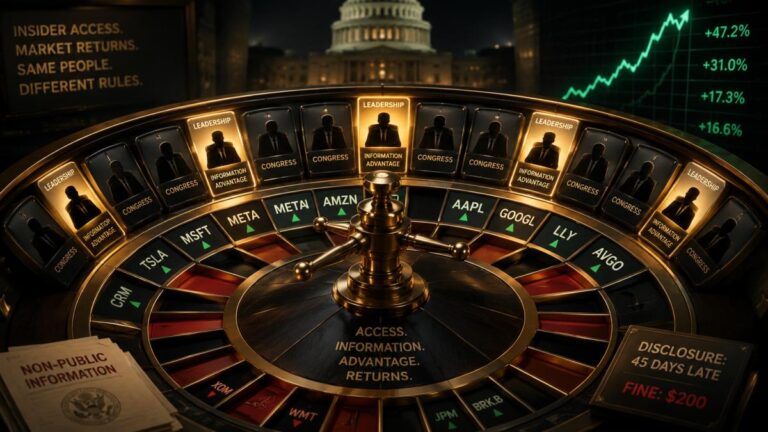
Every developed country has rules against insider trading. Every developed country also has a small, privileged group of people who get briefed on regulatory changes before the public, sit on committees that shape entire industries, and routinely meet with the CEOs of companies whose stock prices their decisions will move within hours. In most countries those two facts are kept apart by a combination of blind trusts, hard divestment rules, and prosecutorial willingness to make examples of violators. In the United States, those two facts have been allowed to collide in the open for more than a decade, and the resulting market structure is one of the most reliable sources of equity alpha in the world.

For four decades, the gap between institutional and retail investors came down to three things: better data, faster execution, and the analytical horsepower to turn the first two into decisions. Every other supposed edge (relationships, deal flow, regulatory access) was a derivative of those three. The whole premium pricing structure of the financial data industry, the entire compensation logic of buy-side research, even the architecture of how exchanges route orders, all of it rested on the assumption that a small number of firms could afford the access and the rest could not.
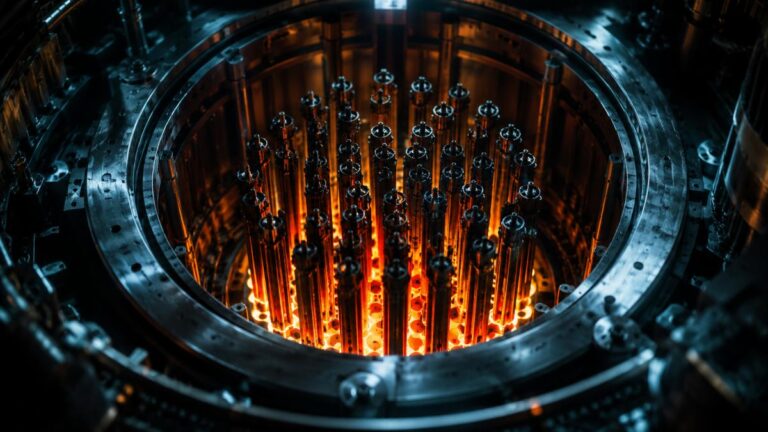
When a reactor stock triples in a week, every retail investor on the planet starts asking the same question: is it too late to buy? That question, while understandable, tends to obscure a far more interesting one hiding underneath it.…

The first thing to clear up about Japan in 2026 is that the stock market did not crash. The Nikkei 225 closed last Friday at 62,714, sitting near record territory and up roughly 67 percent on the year. The Topix is also near all-time highs. The "Japan crash" headlines floating around financial Twitter are pointing at something else entirely, and the something else is a great deal more consequential for global allocators than a normal equity sell-off would have been.

Something fundamental shifted in American markets over the last twelve months, and most retail investors have not adjusted their mental models to match. Since January 2025, the United States government has executed sixteen separate deals involving direct equity ownership in private companies, deploying roughly $20.9 billion of taxpayer capital across critical minerals, semiconductors, and strategic infrastructure. According to the Council on Foreign Relations Government Deal Tracker, this represents a deliberate expansion of Washington's industrial policy toolkit beyond the traditional grants, loans, and tax credits that defined the previous era.

Late last year, three quantum computing stocks were trading at valuations that would have made dot-com era investors blush. IonQ, Rigetti Computing, and D-Wave were riding a hype wave that began crashing the moment Nvidia CEO Jensen Huang told a CES 2025 press Q&A that useful quantum computers were still 15 to 30 years away. That single comment wiped tens of billions of dollars off the sector in a single trading session. IonQ fell roughly 39 percent. Rigetti dropped 45 percent. D-Wave collapsed by 36 percent.