Physical Address
304 North Cardinal St.
Dorchester Center, MA 02124
Physical Address
304 North Cardinal St.
Dorchester Center, MA 02124


Two central banks raised interest rates this week, the 10-year US Treasury yield pushed back above 5%, and Washington’s flagship crypto bill died in the Senate. By any traditional playbook, this was a week for risk assets to bleed. Instead, bitcoin climbed back above $80,000 on Friday, altcoins ripped higher, and crypto equities posted double-digit gains.
The headlines are calling it resilience. Before you join the chorus, it pays to separate the price action from the money that is actually driving it. When you do, the picture looks a lot less like the start of a new bull leg and a lot more like a market squeezing its own shorts into a wall of resistance.
The Federal Reserve kicked things off on September 16 with a quarter-point hike, taking its benchmark range to 3.75% to 4.00%. It was the first increase since 2023, and crypto initially reacted the way you would expect. Bitcoin slid below $76,000, ether dipped under $2,400 and Solana lost the $100 mark, according to The Crypto Times’ breakdown of Friday’s rebound.
Then the Bank of Japan followed with its own 25 basis point increase. Rather than extending the selloff, crypto turned. By Friday, bitcoin was up roughly 5.5% on the day near $80,600, and it briefly tagged $81,000 during the US session. The broader market did even better. Hyperliquid’s HYPE token jumped around 12% to a new all-time high above $91, Solana gained about 10% to roughly $110, and XRP rose more than 7%. Zcash has now added over 22% in a week.
Crypto stocks followed. According to CoinDesk’s live market coverage, Strategy traded up around 11% and Coinbase about 9% during the session.
Three explanations are doing the rounds, and each deserves a fair hearing.
The first is simple relief. Markets had braced for the Fed hike to hit harder than it did. When equities and bonds rallied together on Thursday as oil prices eased, it gave risk assets permission to recover. CoinDesk’s reporting on the crypto rally through the Fed’s first hike since 2023 captures that shift in tone.
The second is regulation. On September 17, the SEC released an Innovation Exemption that creates a five-year conditional pathway for approved venues to trade tokenized US stocks through permissioned automated market maker pools. It does not bless any individual token, but it does open a door for onchain infrastructure to plug into regulated securities markets. DeFi names responded immediately, with Uniswap’s UNI surging close to 30%. CoinDesk has a useful explainer on who stands to benefit from tokenized stock trading.
The third is mechanical. Short sellers who piled in after the Fed decision got caught. Roughly $238 million in bitcoin short positions and about $85 million in ether shorts were forcibly closed during the move, and forced buying of that kind feeds on itself for as long as the price keeps rising.
All three are real. But only one of them represents fresh money that intends to stay.
Here is where the contrarian case starts to build. Strip away the liquidations and the sentiment, and ask a simple question: who is actually buying bitcoin right now, with conviction, for the long term?
The answer, based on the data, is not many.
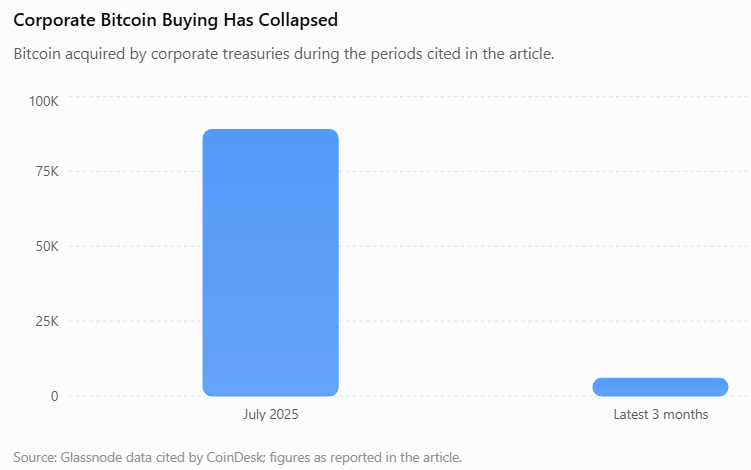
Public companies were the engine of the 2024 to 2025 bull market. Last year, corporate treasuries were adding bitcoin at a staggering rate, including around 89,000 coins in July 2025 alone. Over the past three months, according to Glassnode data cited in CoinDesk’s analysis of weak corporate demand, that same group added roughly 5,900 BTC. That is less than 7% of a single month’s buying a year ago, and most of it came from one company, Strategy.
Worse, the corporate treasury cohort is underwater. Glassnode puts their average entry around $80,500. That figure matters enormously, because it sits almost exactly where bitcoin is trading today. Holders who have been sitting on losses for months tend to become sellers the moment they are made whole. That creates a natural ceiling right at the level bulls are celebrating reclaiming.
The other demand gauges are no more convincing:
Spot bitcoin ETFs have taken in billions since early August, yet they remain about $1 billion short of breaking even for the year. The Coinbase premium, a rough proxy for US buying appetite, has been negative for most of the period since May. And total stablecoin supply, which analysts watch as a signal of new fiat entering the ecosystem, has been flat at around $300 billion to $310 billion all year.
Flat stablecoin supply during a sharp rally tells you the market is recycling existing capital rather than attracting new money.
If you want one data point that captures the gap between price and conviction, look at ether.
Ether rose this week. Over the same stretch, US spot ether ETFs bled money for three sessions in a row, losing about $141 million on Tuesday, $224 million on Wednesday and another $39 million on Thursday, according to CoinDesk’s ETF flow report. XRP funds also saw outflows.
When the regulated, institutional wrapper is being sold into strength while the underlying asset rises, it usually means the move is being driven by traders on offshore derivatives venues rather than long-term allocators. That is not a recipe for durability.
Notice which assets led Friday. Hyperliquid, Solana, Zcash, Uniswap. The higher-beta end of the market outran bitcoin by a factor of two or more.
Bulls read this as healthy breadth. Contrarians read it as late-cycle behaviour inside a bounce. Speculative rotation into smaller tokens typically happens when traders feel confident and have short time horizons. It is not what you see when patient capital is accumulating a core position. The altcoin season index remains subdued even now, which suggests this is a trading rotation rather than a structural shift.
It is worth remembering what the market actually absorbed this week. Rates went up, not down. The 10-year Treasury yield is still hovering around 5%, and traders are increasingly pricing a second Fed hike in October. The Clarity Act, which many investors had treated as the key to ending the crypto winter, failed in the Senate, and industry leaders are now debating the fallout.
CoinDesk has also flagged that bitcoin’s setup now carries uncomfortable 2022 parallels, when a tightening Fed eventually overwhelmed every short-term rally. One strong week does not change the fact that the cost of money is rising.
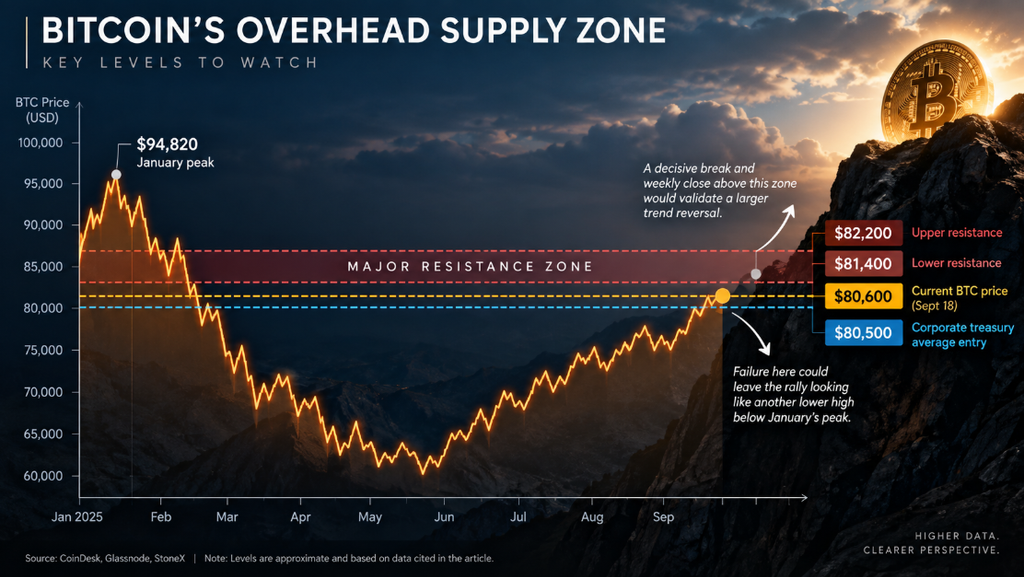
Technically, bitcoin has done something genuinely constructive. It has rallied more than 40% off its yearly low, and Friday’s surge has improved the short-term structure. But as StoneX’s technical strategist notes in his latest bitcoin forecast, price is pressing into a major resistance zone around $81,400 to $82,200. A decisive break and weekly close above that area would validate a larger trend reversal. Failure there would leave the rally looking like another lower high below January’s peak of $94,820.
Stack that resistance on top of the corporate treasury cost basis at $80,500, and you have two layers of overhead supply sitting in exactly the same place.
None of this means bitcoin must fall. It means the burden of proof sits with the bulls, and they have not yet met it.
A disciplined approach looks something like this. Resist chasing a move built on short liquidations, because those rallies tend to fade once the forced buying is exhausted. Watch the $82,000 area and the weekly close as your first real test. Pay close attention to ETF flows and stablecoin supply over the next two weeks, since genuine new demand would show up there first. And treat the altcoin outperformance as a signal of speculative appetite, not a reason to extend risk further out the curve.
If bitcoin clears resistance while ETF inflows accelerate and stablecoin supply starts expanding, the contrarian case weakens and it would be time to reassess. Until then, the smart money is not buying the headline. It is waiting to see who is still standing when the shorts run out.
This article is for informational purposes only and does not constitute financial advice.