Physical Address
304 North Cardinal St.
Dorchester Center, MA 02124
Physical Address
304 North Cardinal St.
Dorchester Center, MA 02124

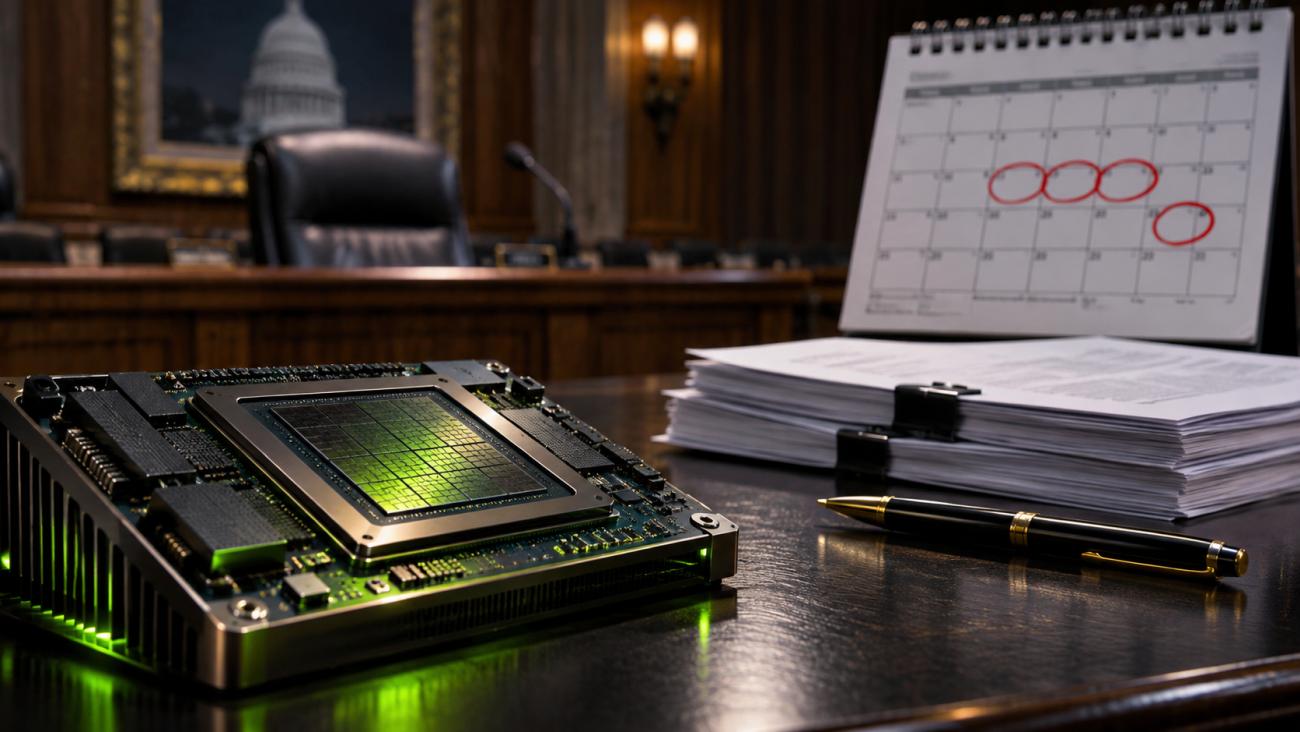
Nvidia's CEO must personally certify a delayed 10-Q days after testifying to Congress. Why that calendar matters more than the Enron comparisons.
Two very different stories are being told about Nvidia this week. In the first, the board’s decision to bring Jensen Huang back as chief executive closed the chapter, and the share price jump that followed was the market saying so. In the second, now circulating widely in video commentary, the reinstatement is the eerie opening act of an Enron-style collapse, complete with a returning founder who reassures everyone just before the floor gives way.
Both stories make the same mistake. They treat the outcome as already known. It is not. What the next fortnight actually holds is a short series of formal tests: sworn answers to Congress and, above all, a quarterly report that Nvidia’s chief executive will have to certify personally. For investors, those dates matter far more than either the rally or the doom.
If you are catching up, our earlier pieces cover the lawsuits and Nvidia’s unusual insurance choice and what the latest quarter’s balance sheet shows. This article is about the calendar.
The parallel has a surface neatness that makes it hard to resist. In August 2001, after Jeffrey Skilling resigned abruptly, Kenneth Lay returned to run Enron and assured staff and investors that the company was sound. By early December it had filed for bankruptcy. Enron had been celebrated as one of the most innovative companies in America only a few years earlier.
There is even a historical coincidence that commentators enjoy pointing out. When Enron was removed from the S&P 500 at the end of November 2001, the company chosen to take its place was Nvidia, then a graphics chip maker worth under $10 billion.
Add a returning chief executive, a national security scandal, regulators on several fronts and a quarterly report that has not yet been filed, and the outline of a familiar story appears. Outlines can mislead.
Enron’s collapse was not caused by a leadership change. It was caused by earnings that were largely an accounting construct, debt hidden in off-balance-sheet vehicles, and a business that depended on credit lines and counterparties’ confidence to keep trading. When confidence went, the cash went with it, and there was very little underneath.
Nvidia’s position is close to the opposite. It sells physical products to some of the largest and most cash-rich companies in the world. Its third quarter results show GAAP net income of $65.3 billion and free cash flow of $43.8 billion for the three months to 25 October, with roughly $53.5 billion in cash and marketable debt securities at quarter end. A company that throws off that much cash in a quarter is not one bad week of funding away from failure.
That does not mean Nvidia’s accounts are beyond question. Our earlier analysis flagged receivables growing faster than sales, a concentrated customer base and a large web of supply and financing commitments. Those are legitimate concerns about the quality and durability of earnings. They are not the same thing as fabricated profits, and nothing on the public record so far suggests Nvidia’s reported numbers are fictional. Treating the two as equivalent overstates the danger in one direction and distracts from the risks that are real.
The more useful point the bearish commentary raises is a procedural one. When Nvidia reported results on 17 November, it did not file its Form 10-Q quarterly report at the same time. Interim chief executive Colette Kress said only that the company planned to file it in the coming weeks, and gave no reason on the call. According to the same TechCrunch report, UBS analyst Timothy Arcuri was later told the delay related to the ongoing investigation and whether additional risk factors would need to be added.
That is a break with habit. FourWeekMBA’s count of EDGAR filings shows Nvidia filed its 10-Q or 10-K on the same day as its results in each of the previous nine reports. It is not, however, a late filing. Large companies have 40 days from the end of a quarter, which puts Nvidia’s deadline at 4 December.
There is a precedent worth knowing, and it is instructive in both directions. In 2006, during an audit committee review of its stock option practices, Nvidia missed its 10-Q deadline altogether. The quarterly report it eventually filed records a late-filing notice to the SEC and a NASDAQ non-compliance letter, and the review led to a restatement of earlier results. The company survived it comfortably, and the restatement concerned non-cash compensation expense rather than revenue. A delayed filing is a signal to pay attention, not proof of wrongdoing.
The video that prompted this article makes the bearish case at length. It is worth watching with the distinctions above in mind.
The earnings release that moved the share price is not the same kind of document as a 10-Q. An earnings release is furnished to the SEC and is largely a summary. The 10-Q carries the full financial statements, the legal proceedings section and the updated risk factors, which is exactly where any new disclosure about the investigations would appear.
It also carries signatures with real consequences. US federal law requires the chief executive and chief financial officer to certify that each periodic report fairly presents the company’s financial condition in all material respects, with criminal penalties for knowingly or wilfully certifying a report that does not. After this week’s reinstatement, the chief executive whose certification goes on Nvidia’s 10-Q will once again be Jensen Huang.
That is why the content of the filing matters more than its timing. The questions to read it for are specific. Does the risk factor section describe the investigations in more detail than the earnings materials did? Does the legal proceedings section add anything to what is already public? Are there any changes to how revenue is described by geography or by customer? A clean filing with careful, expanded disclosure would be reassuring. Anything that looks like a material surprise would not.
Alongside the filing sits the export story, which is where the regulatory risk is concentrated. On 23 November, the same day Huang returned, the Commerce Department added Megaspeed and six related companies in Singapore, Malaysia and Thailand to its Entity List, the US trade blacklist, with a 30-day window for shipments already in transit that runs to 23 December. Megaspeed has denied wrongdoing, and Nvidia has said it stopped selling to the company in June 2025.
Days earlier, the House Foreign Affairs Committee disclosed that Commerce had approved licences covering roughly 879,000 advanced AI chips for Chinese companies between December 2025 and May 2026, out of about 3.4 million requested. It is not clear how many were actually shipped, and Nvidia has said it has since stopped shipping H200 chips to China. The disclosure matters less for what it says about any one sale than for what it signals: export licensing has become a bipartisan subject of oversight, and Congress now has the paperwork.
Nvidia’s board, for its part, said when it reinstated Huang that it had input from senior levels of the US government and was confident his return posed no national security risk. It also said its own investigation will proceed to conclusion. Neither statement is a finding by any regulator or court.
Here is what is actually scheduled. On 1 and 2 December, Huang and Nvidia’s general counsel Tim Teter are due to sit for closed-door transcribed interviews with three House committees. On 3 December, Huang is the sole witness at a public Senate Banking Committee hearing on export controls, confirmed by committee chair Tim Scott after the reinstatement. On 4 December, the 10-Q is due. Commerce Secretary Howard Lutnick has been asked to appear before the same Senate committee on 10 December, and the Megaspeed transit window closes on 23 December.
That sequence is the useful part of the bearish argument. Testimony given under oath on 3 December and a certified filing the following day have to be consistent with each other and with whatever the internal investigation is finding. That is a high bar, and it is set by process rather than by sentiment. It could just as easily end in reassurance as in alarm.
Three practical conclusions follow.
First, separate the leadership story from the accounting story. A founder returning is not evidence of fraud, and a share price rally is not evidence of innocence. Neither tells you what the 10-Q will say.
Second, read the filing, not the headlines about it. When the 10-Q lands, the risk factors and legal proceedings sections will tell you more in ten minutes than a week of commentary. If it is filed late, that is a materially different signal from one filed quietly before the deadline.
Third, size positions for uncertainty you cannot resolve. If you own Nvidia directly or through a broad index fund, the next two weeks contain several binary moments that nobody, bull or bear, can call with confidence. The defensive response is not to bet on the outcome. It is to make sure no single outcome can do disproportionate damage to your portfolio.
Disclaimer: This article is general commentary for information purposes only. It is not financial, investment or legal advice, and the author is neither a lawyer nor a licensed financial adviser. The investigations, inquiries and hearings described are ongoing, no court or regulator has made any finding against Nvidia, its directors or executives, Megaspeed or any other person or company named, and Megaspeed has denied wrongdoing. The embedded video is third-party commentary, and its views are its author’s own. Figures and dates are taken from the public reports linked above as at 25 November 2026 and may change. Do your own research and consult a qualified professional before making any investment decision.