Physical Address
304 North Cardinal St.
Dorchester Center, MA 02124
Physical Address
304 North Cardinal St.
Dorchester Center, MA 02124

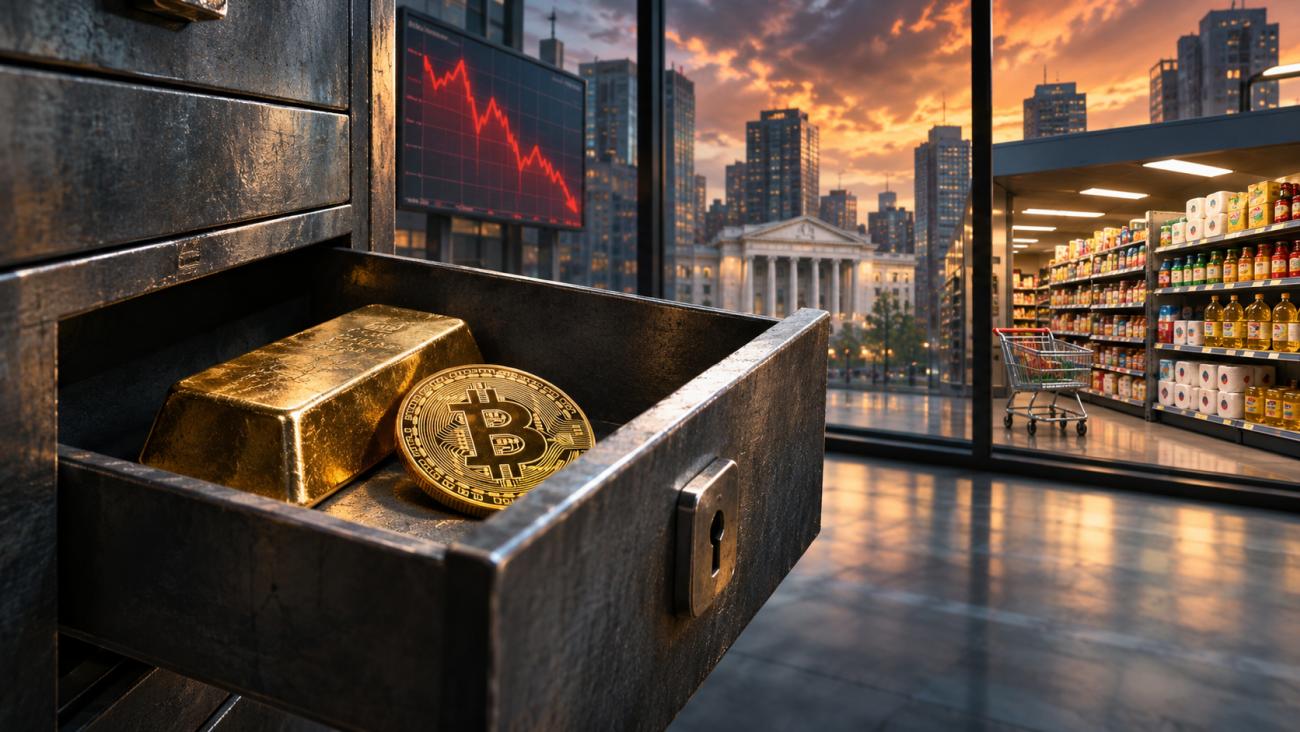
Every portfolio has an insurance drawer. For a lot of investors, that drawer holds some gold, maybe a slice of bitcoin, and the comforting belief that when the rest of the market gets ugly, these two will hold the line.
This year the insurance drawer is where the damage is. And the way the market has responded to that tells you more about what comes next than the losses themselves.
Charlie Bilello, who ranks the major asset classes every year, put the two “store of value” assets at the very bottom of his 2026 table. On his data through October 23, bitcoin was down 7.3% and gold down 7.5% for the year, and he noted that his records had never shown the pair sharing last place in any calendar year.
Things have gotten worse since. Gold futures closed at $3,886 on November 13, more than a quarter below the record close of $5,318 set at the end of January. Bitcoin slid to roughly $62,000 on November 15, its weakest level since July, while US spot bitcoin ETFs bled $2.35 billion over two weeks and the Crypto Fear and Greed Index fell to 10.
None of this requires a conspiracy theory. Gold and bitcoin share one feature that matters enormously right now: they pay you nothing to hold them. Their entire return comes from someone else being willing to pay more later. That makes them unusually sensitive to the price of money, and the price of money has jumped.
The Federal Reserve raised rates in September for the first time since 2023, then held in October with two officials, Lisa Cook and Beth Hammack, dissenting in favor of another quarter point hike. Futures traders were pricing an 83% chance of a December increase immediately after Chair Kevin Warsh’s press conference. The 10-year Treasury yield was sitting at 5.05% on November 19, after touching a 52-week high of 5.31% on October 5, roughly nine-tenths of a point higher than where the year started. The dollar index, meanwhile, pushed to its highest level since April 2025 in mid-November.
When a government bond pays you about 5% and a money market fund pays you a decent rate with no drama, the opportunity cost of holding a metal or a token with no cash flow becomes painfully visible. That is the whole story of the last-place finish, and it is a rates story, not a verdict on whether either asset still has a long-term role.
The second thing worth noticing is that the economy underneath all this is not weak. It is overheating.
US real GDP grew at a 3.4% annualized pace in the third quarter, up from 2.2% in the second. Employers added 165,000 jobs in October and unemployment slipped to 4.1%. On the price side, the Fed’s preferred gauge moved the wrong way: headline PCE inflation rose to 3.6% year on year in September, with core PCE at 3.1% and climbing 0.3% for the month. The October consumer price report then showed core prices rising 0.3% for a third consecutive month, a tenth above forecasts.
Macro investors who think in terms of two variables, growth and inflation, would place this squarely in the quadrant where both are rising. That framework is not new. Merrill Lynch formalized it two decades ago as the “investment clock,” and Bridgewater’s All Weather approach is built on the same idea that growth and inflation surprises define the environment an asset has to survive. In the hot quadrant, central banks lean on the brakes, bonds suffer, and anything priced on distant future value, from long-duration tech to non-yielding stores of value, gets marked down.
So far, so textbook. The interesting part is what investors have decided must happen next.
Watch where the money is moving and you can read the consensus forecast without anyone saying it out loud.
On November 5, the PHLX Semiconductor Index fell 12.25% in a single session, its second worst one-day decline on record and its largest since March 2020, leaving it about 38% below its June peak. At the same time, the most boring corner of the equity market has been treated like a fortress. The largest consumer staples ETF closed at an all-time high on November 16, up more than 19% for the year against roughly 9% for the S&P 500.
That rotation is a bet. It says growth is about to roll over while inflation stays sticky, the dreaded stagflation quadrant, and that the safest place to wait it out is in companies selling groceries, soap and toothpaste.
Here is the contrarian problem. “Defensive” describes a business model, not a price. Back in February, before this year’s rally was even finished, the staples sector was already trading at more than 23 times forward earnings, its richest valuation since just before the dot-com bust. The same piece pointed out what happened last time: between late 1998 and early 2000, staples fell close to 40% from peak to trough. Expensive defensive stocks can lose money in a downturn simply because their multiples shrink, even when their sales hold up perfectly.
There is a second, quieter risk. Staples are often owned for their steady dividends, which makes them behave partly like bonds. If the Fed has to keep hiking because inflation refuses to cool, the same rising yields that crushed gold and bitcoin will eventually start pressing on these bond proxies too. A trade designed to hide from higher rates can turn out to be exposed to exactly that.
The deeper flaw in the consensus is the assumption that an overheating economy must slide into stagflation. History says that is closer to a coin toss.
Lombard Odier’s macro team examined how expansions have ended and found that 47% of exits led straight back to a Goldilocks environment, 41% led to stagflation and 12% to a disinflationary slowdown. In other words, the outcome the market is now positioned for has historically been slightly less common than the benign one. The researchers argue the swing factors are productivity, which decides whether strong demand shows up as fatter margins or higher prices, and the cost of capital, which decides what investors will pay for those margins.
It is also worth being humble about reading too much into gold and bitcoin as a leading signal. These assets do react early to changes in monetary conditions, but they are noisy messengers. Gold peaked in September 2011, and US equities went on to one of the longest bull markets in history. A weak year for stores of value can mean trouble ahead, or it can simply mean cash finally pays something again.
Rather than guessing which branch the economy takes, it is more useful to ask how this year’s winners and losers are positioned for each one.
If inflation stays stubborn while growth fades, the crowd is right, and cash, short-term bills and genuinely cheap defensive names should do best. Even then, gold and bitcoin may stay under pressure while real yields remain high, and richly valued staples are not guaranteed to hold their gains.
If inflation cools first and the Fed can stop hiking, the picture flips. Falling rate expectations are precisely the tailwind that non-yielding assets have lacked all year, and money that crowded into defensives has an obvious reason to rotate back toward growth.
If the Fed overshoots and something breaks in credit or employment, long-dated bonds are the natural first winner. Once the central bank pivots to cutting, the assets most punished by tight money tend to be among the first to respond.
Line those up and an uncomfortable pattern emerges. The year’s crowded winners mostly need one specific scenario to keep winning. The year’s despised losers have a plausible path to recovery in two of the three. That is not a reason to back up the truck on gold or bitcoin, and bitcoin in particular remains a highly volatile asset that can fall a lot further. It is a reason to question selling them simply because they sit at the bottom of a league table, and to question paying a premium for safety after the crowd has already bought it.
The data calendar is unusually concentrated. The second estimate of third-quarter GDP lands on November 25, followed by the November jobs report in early December. The Federal Reserve then meets on December 8 and 9, with the decision, new projections and Warsh’s press conference on December 9. November consumer prices arrive the following morning, December 10, which means the Fed will decide without them.
Three things are worth tracking through that window:
Gold and bitcoin finishing last is a symptom of expensive money, and expensive money is a symptom of an economy that is still running hot. The market has looked at that and concluded that stagflation is next, then crowded into the most defensive stocks it could find at valuations that leave little room for error.
The contrarian view is not that the crowd is wrong about the risks. It is that the crowd has already paid for its protection, while the assets nobody wants right now carry more upside if the economy takes any route other than the one everyone is bracing for. In markets, the most dangerous place is rarely the one already priced as dangerous. It is the one priced as safe.