Physical Address
304 North Cardinal St.
Dorchester Center, MA 02124
Physical Address
304 North Cardinal St.
Dorchester Center, MA 02124

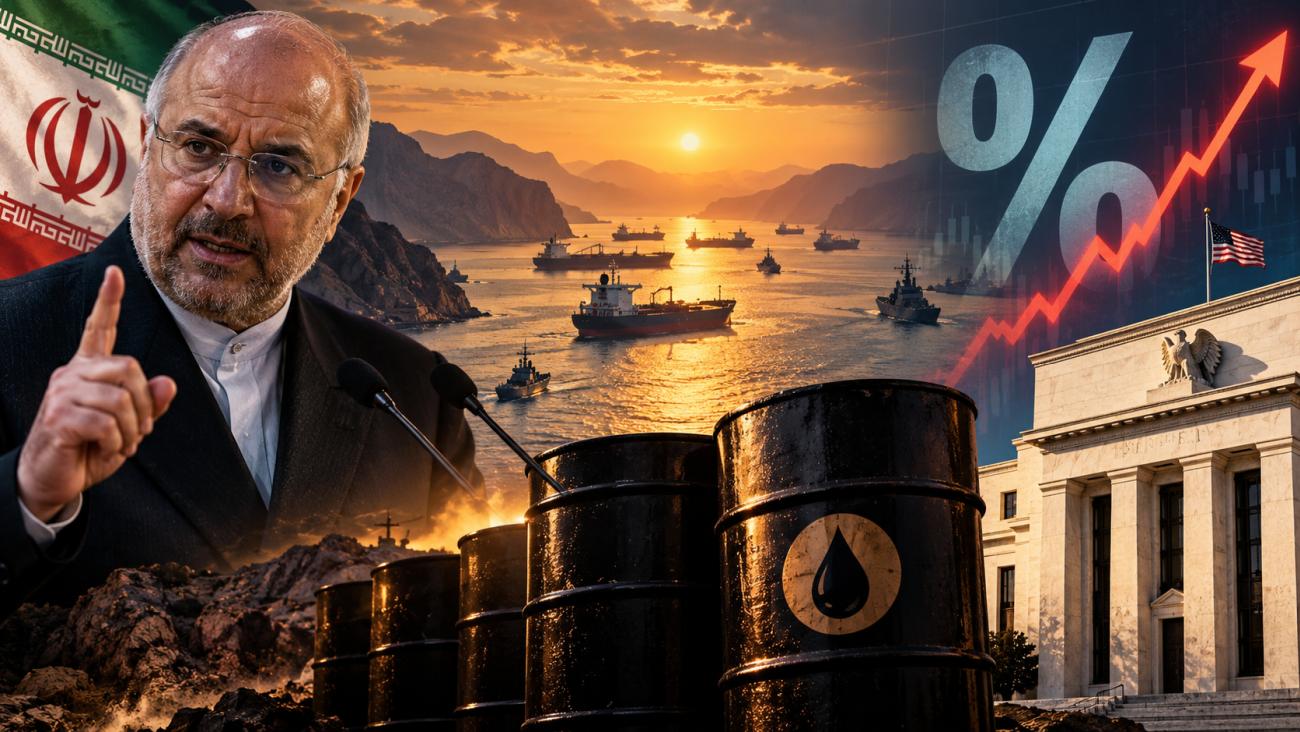
On the morning the Federal Reserve was due to announce its September decision, Mohammad Bagher Ghalibaf, the speaker of Iran’s parliament, posted an equation to X. It looked like something lifted from a first-year monetary economics exam, and that was the point. Ghalibaf had taken the Taylor rule, the formula central bankers and bond traders have leaned on since the 1990s as a rough guide to where interest rates ought to sit, and bolted on two extra terms: one for the Strait of Hormuz and one for Bab el-Mandeb.
Hours later the Fed raised its benchmark rate by a quarter point to a range of 3.75% to 4%, its first hike since 2023, and signaled that another was likely before year-end. Ghalibaf had already delivered his verdict on that move in six words: “You can’t 25bp a chokepoint.”
It is easy to dismiss this as wartime trolling. It was trolling. But it was also a fairly precise description of the trap the Fed now finds itself in, and investors who laugh it off risk missing what it says about bonds, mortgages and the energy trade over the next twelve months. On closer inspection, it is also only half right. The half that is wrong matters just as much.
The original rule, published by Stanford economist John Taylor in 1993, is simple. Start from a neutral interest rate. Add a penalty when inflation runs above target and a smaller one when output runs above potential. If both are running hot, rates go up. If both are cold, rates come down.
Ghalibaf kept every piece of that and added two new terms, each measuring how far shipping through a chokepoint has been disrupted relative to normal, each carrying a positive coefficient. The full post, as reproduced by Benzinga, closes with his claim that America’s so-called neutral rate is contaminated by a Hormuz risk premium that Iran itself controls.
Strip away the sarcasm and the argument runs like this. If the Fed mechanically answers higher prices with higher rates, and Iran can push prices higher by threatening tankers, then Tehran has a finger on the dial of American borrowing costs. Every attack in the run-up to a Fed meeting becomes, in effect, a vote on the decision.
Rate hikes work on demand. They make credit dearer, which slows borrowing, spending and hiring, which eventually cools prices. None of that does anything for a barrel of crude that cannot get out of the Persian Gulf.
The inflation the Fed is fighting is visibly supply-driven. US retail diesel peaked at $6.53 a gallon on 21 September, the highest level in the 32 years the Energy Information Administration has tracked it and 89% above the January low. Diesel moves the bulk of American freight, runs farm equipment through the harvest and seeps into the price of almost everything on a supermarket shelf. Headline inflation was running at 3.4% going into the September meeting.
The textbook response to a pure supply shock is to look through it, because tightening into an oil spike tends to deliver the worst of both worlds: slower growth with little relief on prices. The Fed under Kevin Warsh chose not to look through it, presumably because a year of elevated energy costs risks loosening the public’s inflation expectations. Ghalibaf’s sign-off, urging Americans to stay unanchored, shows he understands that fear perfectly well.
Then comes the transmission to households. Freddie Mac’s weekly survey showed the 30-year fixed mortgage at 7.03% on 24 September, the first reading above 7% since January 2025, and the following week it climbed to 7.28%. In late February, just before the war began, the same rate had dipped to 5.98%. On a $400,000 loan, that move lifts the monthly payment from roughly $2,393 to about $2,737, or more than $4,100 a year for exactly the same house.
Here is where a contrarian reading starts. Ghalibaf’s formula assumes Iran sets the marginal price of the inflation the Fed is reacting to. The data suggest otherwise.
Diesel set its record in the same week that benchmark crude slid to a two-week low. The gap was the crack spread, the margin between crude and refined product, which the EIA expects to stay above $2 a gallon through November. That is a refining and distillate shortage, made worse by Russia’s diesel export ban after Ukrainian drone strikes on its refineries, a light autumn maintenance season and peak harvest demand. Hormuz is a large part of the story. It is not the whole story, and Iran does not control the rest of it.
This is the same split we flagged when Wall Street’s models were struggling to price the Iran war and the diesel market was already showing what they missed. Product markets have been the better guide to this conflict from the start, and the record print in September only reinforced that.
The same applies to the bond market. The 10-year Treasury yield pushed above 5% in September, its highest level since 2007, and mortgages track that yield far more closely than they track the Fed funds rate. The 10-year is being driven at least as much by Washington’s own arithmetic as by Tehran’s. Through the first eleven months of fiscal 2026, annual federal interest costs crossed $1 trillion for the first time, making debt service the second-largest line in the budget after Social Security. The deficit is close to $2 trillion, and most of it has nothing to do with the war.
Historian Niall Ferguson has argued that a great power which spends more servicing its debt than defending itself is on a well-trodden road to decline, pointing to Habsburg Spain, pre-revolutionary France, the late Ottoman Empire and interwar Britain. By his measure the United States has already crossed that line, as Fortune reported earlier this year. Iran did not cause that. At most, it is leaning on a door that was already ajar.
If Iran’s lever is the price of risk, America’s lever is volume. The United States produced more crude than any other country in 2025, and the war has turned that output into leverage. According to the EIA, US petroleum exports hit a record 13.6 million barrels a day in April, with crude alone averaging 5.6 million barrels a day, 21% above the previous high.
The most telling sign is Qatar. With Ras Laffan damaged early in the conflict and its exports through Hormuz halted, QatarEnergy bought 33 spot cargoes of US LNG this year to keep its Asian customers supplied, compared with just four the year before. One of the world’s great gas exporters is now reselling American gas, and is reportedly looking for multi-year US supply running to 2031.
Then there is Venezuela. After the January operation that removed Nicolás Maduro, the interim government granted a US-backed company 100-year concessions over 17 oil fields holding roughly 65 billion barrels of proven reserves, with up to $100 billion of investment planned.
Put together, the strategy is plain even if nobody in Washington spells it out: get the world’s buyers to sign long-term contracts for American and American-aligned energy while Gulf supply is impaired, and the chokepoints lose their power to frighten anyone.
This produces an odd alignment of interests. Iran wants oil expensive for as long as possible, because every month of high energy prices is another month of tight Fed policy on a government carrying more than $40 trillion of debt. Washington, whatever it says in public, also benefits from expensive oil in the short run, because high prices and knocked-out rivals push buyers into American contracts.
The difference is duration. The US only needs the squeeze to last long enough to lock customers in. After that, it wants cheap oil, lower inflation and lower rates to shrink the interest bill. Treasury Secretary Scott Bessent described that end state in August, predicting that within two years at least half the energy now crossing Hormuz would move by pipeline instead, leaving the strait strategically irrelevant.
Investors should treat that timeline with suspicion. Energy analysts told NPR the prediction is overstated, since most Gulf oil and LNG infrastructure was built to load ships inside the Gulf, and pipelines on that scale take years to plan, finance and build. If Bessent’s clock runs slow, Ghalibaf’s runs longer.
One more reality check. Much of the commentary around this story says to watch the Gulf ahead of the Fed’s 28 October decision. That is sensible advice, but the market does not expect a hike that day. Prediction markets currently put the odds of an October move at well under one in five, while assigning much higher odds to a December hike. Futures imply the funds rate drifting towards 4.7% over the next year.
In other words, traders already assume the Fed stays on a tightening path, with or without a fresh tanker attack. A strike in the Gulf before 28 October would shift the odds. It would not create a new regime.
For investors, the useful question is not whether Iran controls the Fed. It doesn’t, at least not on its own. The question is which assets win and which lose while energy supply remains the swing factor in US monetary policy.
Long-duration bonds are the obvious casualty. A Fed that reacts to supply shocks, combined with a Treasury refinancing a growing pile of debt at higher yields, is a poor backdrop for anyone locking in 30-year paper at today’s levels, unless they are confident the energy shock is close to peaking.
Rate-sensitive housing stays under pressure while mortgages sit above 7%, and that pressure compounds as homeowners holding cheap legacy mortgages refuse to sell and give them up.
On the other side of the ledger sit the beneficiaries of Washington’s energy push: US LNG exporters signing long-term contracts, Gulf Coast export infrastructure and refiners earning record crack spreads. Contrarians should note the risk there as well. These trades are crowded, and the very pipeline build-out Bessent describes would eventually erode the premium they are earning.
The single most useful indicator may be the diesel crack spread rather than the Brent price. If refined product margins fall while crude stays high, the inflation impulse is fading and the Fed has room to pause. If both stay elevated into the northern winter heating season, Ghalibaf’s joke keeps working.
The Straits Taylor Rule is propaganda, but effective propaganda always contains a true observation. The Fed cannot reopen a strait, and every quarter point it adds in response to an oil shock lands on American borrowers and on a federal balance sheet that already pays more in interest than it spends on defense. Where Ghalibaf overreaches is in claiming that Iran sets the price. Refining bottlenecks, Russian export bans and Washington’s own deficits are doing at least as much of the work.
The real contest is between two timelines: how quickly America can sign the world onto its energy, and how long the Fed and the Treasury can tolerate the cost of capital that high energy prices are imposing. Investors who only watch the Gulf will miss half the board.