Physical Address
304 North Cardinal St.
Dorchester Center, MA 02124
Physical Address
304 North Cardinal St.
Dorchester Center, MA 02124

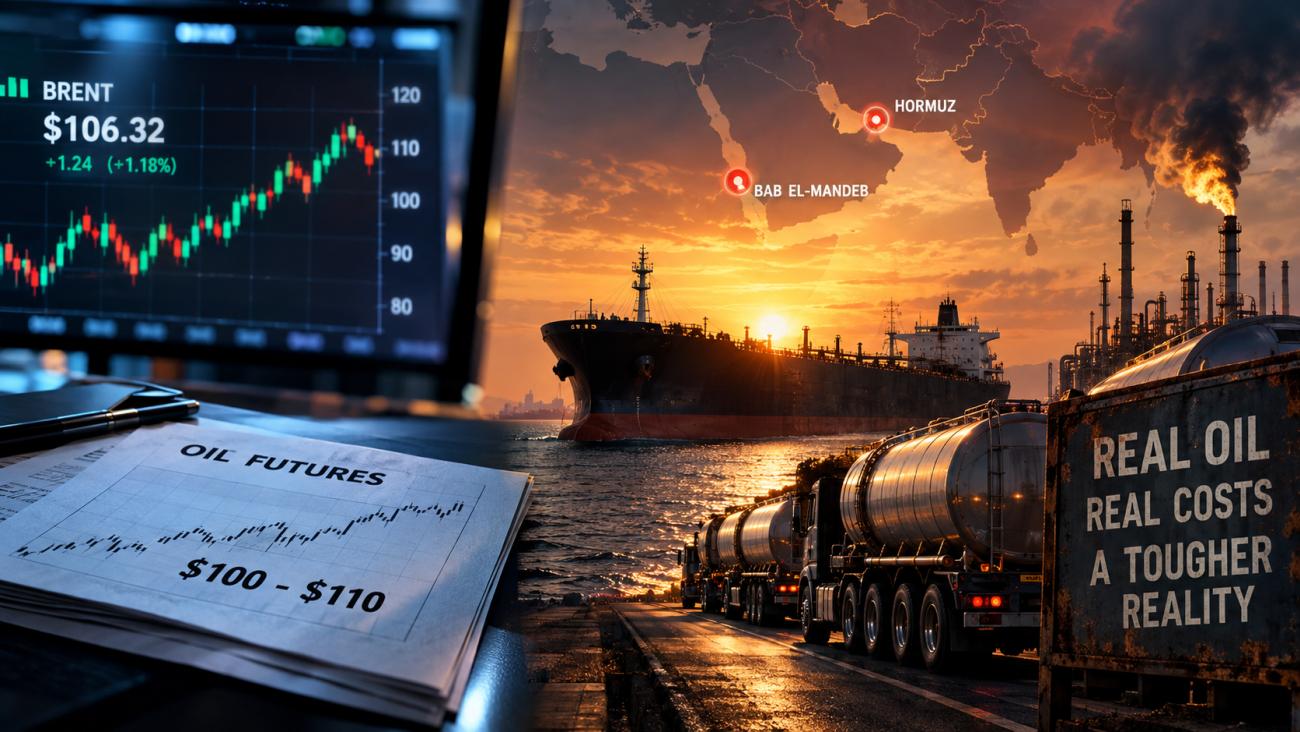
Anyone tracking the energy crisis through the Brent futures ticker could be forgiven for thinking the worst is contained. Front-month Brent has spent most of September trading somewhere between $100 and $110 a barrel. That hurts, but it hardly looks like a historic emergency. Step away from the screen and look at what refiners are actually paying for physical cargoes, or what truckers are paying at the pump, and the story changes completely.
For much of the summer, the pain sat mostly downstream. Crude was elevated rather than extreme, and the real stress showed up in diesel and jet fuel margins. That distinction has now collapsed. The last fortnight has taken out the remaining safety valves, and the gap between paper prices and physical prices has become the single most important signal in the market.
Brent futures are a financial contract. They capture where speculators, hedgers and funds expect oil to settle over the coming months, and that expectation still bakes in a meaningful probability of de-escalation. A refinery manager with a plant to keep running cannot hedge against empty storage tanks with optimism. They need crude delivered, and they are paying whatever it takes to secure it.
Physical grades from the Gulf, such as UAE Murban and Oman crude, have been changing hands well above $120, and Dated Brent (the price for North Sea cargoes actually loading) has sat far above the futures curve. The dispersion has become extraordinary: OilPrice.com reports that the spread between crude grades has blown out beyond $40 a barrel, with one Australian blend almost doubling since late February and sanctioned Russian ESPO crude trading at a premium to Brent as Chinese refiners scrambled for replacement barrels.
When the paper price and the physical price diverge this sharply, one of them is wrong. Historically, it tends to be the paper price that eventually moves.
Hormuz has been effectively shut to normal tanker traffic since March. For months, the damage was cushioned by Saudi Arabia’s East-West pipeline, which carries crude across the kingdom to Red Sea terminals and bypasses the strait entirely. According to Kpler’s analysis of the Saudi supply buffer, that pipeline had been moving roughly 4 million barrels a day before drone strikes knocked it out, and inventories at the Yanbu export terminal had dropped below 15 million barrels, leaving only days of export cover.
Almost simultaneously, Houthi forces took Mayun Island (also known as Perim), which sits in the middle of the Bab el-Mandeb strait at the southern mouth of the Red Sea. Al Jazeera explains why the island matters: it splits the waterway into two channels and gives the group a fixed position over one of the world’s key chokepoints, with Saudi-linked shipping explicitly targeted.
The result is that Saudi Arabia’s main export corridor is blocked and its fallback is badly compromised. Cargoes rerouting around the Cape add weeks to each voyage, absorb more tanker capacity, and pay sharply higher war-risk premiums, which is why freight rates for large crude carriers have exploded. Chokepoint disruption works through probability as much as damage. A handful of successful strikes is enough to reprice every hull that follows.
Even where crude is available, turning it into diesel and jet fuel has become the binding constraint. Ukrainian drone campaigns have hit Russian refineries repeatedly, and Gulf refining capacity has also been damaged. Valero’s chief operating officer told CNBC that the wars have taken around 5 million barrels a day of refining capacity offline, and Moscow has restricted its own diesel exports to protect domestic supply.
This is why American diesel crossed $6 a gallon for the first time on record. CNN notes that diesel has climbed more than 55% since the Iran war began, comfortably outpacing gasoline. If you add crack spreads to the physical crude price, the effective cost of a refined barrel is now approaching levels that would have seemed absurd at the start of the year.
The capacity gap will not close quickly. Refineries are multi-decade assets costing billions, and capital allocators are understandably reluctant to fund plants whose payback period stretches into an era of shrinking fuel demand. That logic is why Europe and the UK have spent years closing sites rather than opening them. It made sense in a calm market. In a crisis, it leaves almost no slack.
In July, this site argued that the oil market was telling two different stories and one of them was wrong. The warning was specific: the US strategic reserve was approaching its operational floor, China’s stockpiles could not be drawn down forever, and an autumn squeeze was likely if both cushions disappeared at once. That scenario is now unfolding.
Beijing, the largest crude importer on the planet, spent months living off inventories instead of buying. There are now signs it has resumed purchases of Gulf crude, and that returning demand lands on a market that has already spent its emergency stocks. The EIA expects US distillate inventories to fall below 100 million barrels and stay under the five-year low well into 2027. Meanwhile, the Red Sea bypass that carried so much Saudi crude through the spring is compromised.
Higher output from the Americas has helped plug some of the hole. But crude is not a single commodity. Light shale barrels and heavier Canadian grades do not slot neatly into refineries configured around medium sour Gulf crude, particularly those tuned to maximise diesel yield.
Energy crises rarely stay confined to energy. Jet fuel tracks diesel closely, so airfares have climbed. European natural gas prices have risen steeply this year, which is a serious problem for a region whose heavy industry still runs largely on gas and whose storage position is thin heading into winter.
Less obvious is sulfur. Sulfur is recovered as a byproduct of oil and gas processing, and the Gulf is a dominant exporter. The Fertilizer Institute has warned that more than half of traded sulfur normally passes through Hormuz, and with Russia also banning exports, two of the three largest supply sources are offline. Kpler traces how the shortage cascades through sulfuric acid into phosphate fertiliser, copper and nickel processing. Higher fertiliser costs and higher diesel costs both feed into food prices with a lag, which makes this inflation stickier than a simple fuel spike.
That leaves monetary policy in an awkward spot. Supply-driven inflation does not respond to the usual medicine, because a higher policy rate cannot conjure barrels or repair a refinery. Tightening only works here by suppressing demand across the entire economy, and several major markets have already begun pricing in hikes despite that painful tradeoff.
A contrarian lens is useful here because the market is split into two camps, and each has a blind spot.
The paper-market optimists are underpricing duration. Even a ceasefire would not flip supply back on overnight. Damaged pipelines, pumping stations and refineries need repair, insurers need confidence, and shipping schedules need time to normalise. Gas liquefaction facilities in the Gulf are particularly slow to restart.
The doom camp has its own blind spots. Start with the self-correcting mechanisms. Sustained high prices eventually ration demand, and nobody can say precisely where that threshold sits, but it exists. The economic pain also falls heavily on the producers of this crisis: Iran’s currency has collapsed, which raises the pressure for a negotiated exit. There are early signs of improvisation too, with reports of Saudi crude moving through ship-to-ship transfers and Aramco aiming to restore part of the pipeline’s flow. Then consider scale. The NPR analysis of diesel prices shows that the 2008 and 2022 diesel peaks were higher than today’s price once adjusted for inflation, and modern economies burn far less oil per dollar of output than they did a generation ago.
It is also worth remembering that the year began with forecasters warning of an oil glut. The EIA’s latest outlook still expects Brent to ease toward the mid-$70s in 2027 as flows recover. Those glut conditions have not disappeared. They have been suspended.
This is not investment advice, but a few principles stand out.
Watch spreads, not headlines. The gap between physical and futures prices, and the steepness of the backwardation along the curve, tell you far more about real scarcity than the front-month Brent quote on the evening news.
Be wary of chasing the obvious trade late. Energy equities and refiners have already rerated. The asymmetric risk now is a political breakthrough that collapses the risk premium quickly, even if physical tightness lingers for months.
Consider second-order effects. Fertiliser, food, freight, airlines and gas-dependent European industry are all exposed, in different directions, to how long this lasts.
Finally, think about what this does to long-term capital allocation. Price spikes of this magnitude push governments and consumers toward electrification and renewables faster than any subsidy programme could. That same dynamic further discourages new refining investment, which means the next supply disruption may find the system just as brittle as this one.
The headline Brent quote is flattering a market that is short of both crude and refined product. Physical buyers are paying far more than the futures market suggests, the buffers that absorbed the spring disruption are largely used up, and the effects are spreading into gas, fertiliser and food. At the same time, real prices remain below past peaks, demand destruction and diplomacy both act as ceilings, and the pre-war glut is waiting in the wings. For investors, the discipline is to respect the physical market’s warning without assuming that today’s extreme will last forever.