Physical Address
304 North Cardinal St.
Dorchester Center, MA 02124
Physical Address
304 North Cardinal St.
Dorchester Center, MA 02124

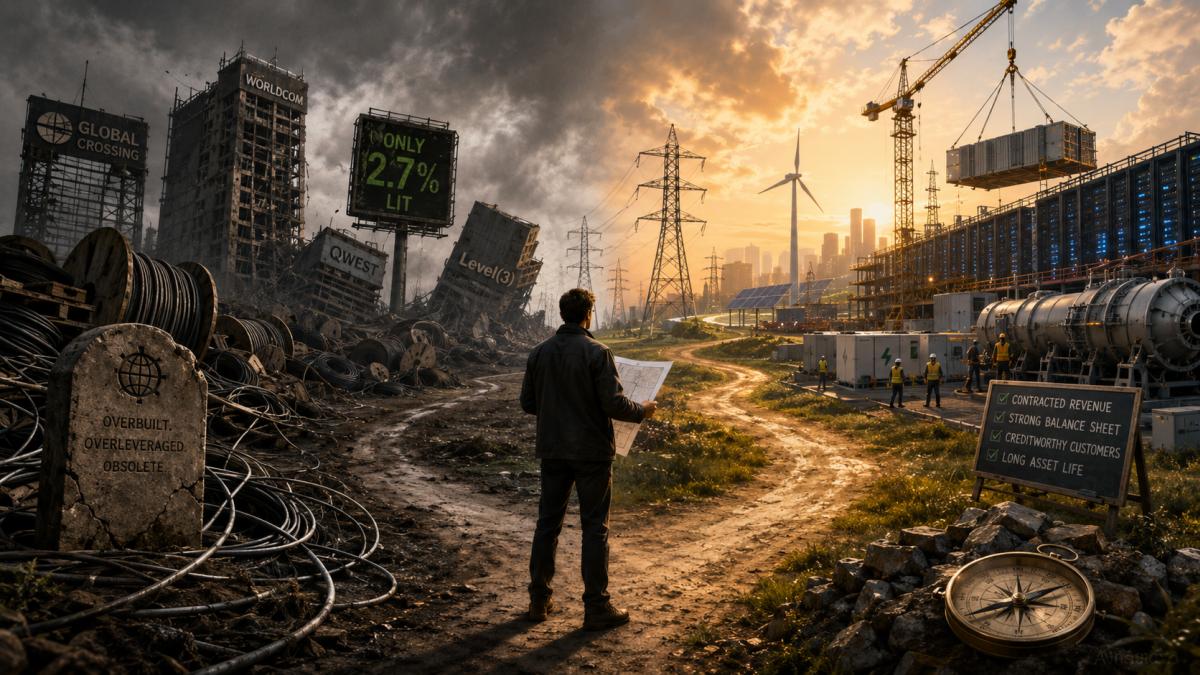
There is a thesis making the rounds in every investment forum, every analyst note, and every infrastructure fund pitch deck right now, and it goes like this: the real AI trade is not chips, it is electrons. Data centres are devouring power. Grids cannot keep up. Therefore, buy everything that generates, transmits, or stores electricity, and wait.
There is a thesis making the rounds in every investment forum, every analyst note, and every infrastructure fund pitch deck right now, and it goes like this: the real AI trade is not chips, it is electrons. Data centres are devouring power. Grids cannot keep up. Therefore, buy everything that generates, transmits, or stores electricity, and wait.
The frustrating thing about this thesis is that it is correct. The numbers behind it are real, the physics is real, and the capital is already moving. The IEA’s Energy and AI report projects global data centre electricity consumption more than doubling from roughly 415 TWh in 2024 to around 945 TWh by 2030, which is slightly more than Japan consumes today. In the United States, Lawrence Berkeley National Laboratory projects data centres climbing from 4.4% of national electricity consumption to somewhere between 6.7% and 12% by 2028. Hyperscalers have committed capital expenditure measured in trillions. Interconnection queues stretch for years. The bottleneck genuinely has moved from silicon to substations.
So why is this article a warning rather than a buy list?
Because we have run this exact experiment before, with the same setup, the same logic, and the same crowd conviction. The thesis was right that time too. The investors still lost almost everything.
Cast your mind back to the late 1990s. Internet traffic was genuinely exploding. The demand forecasts that justified the telecom build-out were, in broad strokes, accurate: data usage really would grow relentlessly for the next twenty-five years. Anyone who said the internet was a fad was wrong, and the market knew it.
Telecom operators responded the way capital always responds to an obvious thesis. Companies like Global Crossing, WorldCom, Qwest, and Level 3 borrowed tens of billions of dollars and laid somewhere between 80 and 90 million miles of fibre optic cable, treating each new route as a claim on the inevitable future. Laying fibre was framed as national progress, the railway boom of the information age.
Then the future arrived, and it did not need that much glass. By 2002, estimates compiled from Wall Street Journal reporting suggested that only about 2.7% of the fibre laid during the boom was actually lit and carrying traffic. The analyst Craig Moffett later calculated that industry capacity had increased roughly 186,000 times over seven years, against demand that was merely doubling annually. Demand doubling annually is extraordinary growth. It was still nowhere near enough.
The wreckage was proportional to the conviction. Global Crossing went bankrupt in 2002 carrying $12.4 billion in debt. WorldCom followed in what was then the largest bankruptcy in American history. Between 2000 and 2002, global telecom stocks surrendered more than $2 trillion in market value. Equipment suppliers fared no better: Corning rode its stock from $12 to over $100 and back down to roughly $2, while Lucent and Nortel fell by around 99% each.
Here is the part that matters most. The fibre did not go to waste. It sat dark for years and then became the physical substrate of the cloud economy, streaming video, and eventually AI itself. The infrastructure thesis was vindicated completely. The people who financed the infrastructure were simply no longer holding the securities when vindication arrived. Being right about the trend and being right about the trade turned out to be two entirely different skills.
If the AI power boom rhymes with the fibre boom, it is worth asking which role each of today’s market darlings is auditioning for. Three tiers suggest themselves.
The first tier is the picks-and-shovels survivors. In the telecom bust, the companies that lived were the ones with diversified revenue, real customers, and balance sheets that could absorb an 80% drawdown without triggering insolvency. Corning survived; Global Crossing did not. Today’s equivalents are the businesses selling into the power build-out with contracted order books: grid equipment manufacturers with multi-year backlogs, Tier 1 storage integrators with signed utility offtake agreements, turbine makers whose customers are regulated utilities rather than press releases. These names can still fall a long way if the cycle turns, but they will exist on the other side.
The second tier is the capacity speculators. These are the pre-profit storage and generation names whose investment case rests on a total addressable market slide rather than an income statement. The pattern to watch for is structural rather than personal: persistent operating losses funded by repeated equity issuance, revenue projections anchored to “pipeline” and “memoranda of understanding” rather than binding contracts, and a stock that trades on announcements. This is precisely the financial architecture of the 1999 overbuilders, who sold capacity that did not yet have customers to fund the construction of more capacity that did not yet have customers. Some of these companies will become the Level 3 of the storage era, surviving long enough to matter. Most will not, and there is no reliable way to know in advance which is which. That uncertainty is not a side issue. It is the entire risk.
The third tier is the pivot stories, and they deserve special scepticism. A cohort of former Bitcoin miners has rebranded as AI and high-performance-computing hosts, marketing their power contracts and land as the scarce asset of the new era. The framing is seductive: they already own the megawatts everyone else is queueing for. But the late telecom bubble had its own version of this, in which the same capacity was counted multiple times across swap agreements until nobody could say what real demand existed. When a single megawatt appears in a miner’s pipeline, a GPU lessor’s projections, and a hyperscaler’s optionality slide simultaneously, the aggregate forecasts stop describing reality. And there is one way today’s overbuild is structurally worse than 1999: fibre in the ground holds value for decades, while a GPU depreciates toward obsolescence in three to five years. This bubble’s stranded assets will rot faster than the last one’s.
The mechanism that destroyed telecom investors was not a demand shortfall. Demand grew enormously throughout the bust. The mechanism was that supply responds to an obvious thesis from every direction at once, while every participant watches demand and nobody watches aggregate supply.
That is happening now. Utilities are filing record generation plans. Independent power producers are announcing co-located campuses. Battery cell capacity, particularly in China, is expanding on a scale that recalls the fibre-drawing towers of 1999, with cell prices falling accordingly. Small modular reactor startups, gas turbine order books, and behind-the-meter generation schemes are all responding to the same signal. Each project is individually rational. The sum is not obligated to be.
Even the demand side carries more uncertainty than the consensus admits. The IEA’s own scenario work includes a Headwinds Case in which data centre consumption reaches only around 790 TWh by 2030, roughly 40% below its base case, driven by slower AI adoption and efficiency gains. Almost no one in the energy-infrastructure trade is positioned for that outcome, which historically is exactly the kind of outcome that finds positioning.
None of this argues for avoiding the sector. The build-out is real and the electricity will be consumed. The argument is for buying the way the survivors were built, not the way the casualties were marketed.
The survivor checklist from the telecom wreckage is short and brutal. Recurring contracted revenue rather than speculative capacity sales. Modest leverage, or the demonstrated capacity to reduce it without dilution spirals. Customers who are themselves creditworthy, meaning hyperscalers and regulated utilities rather than other speculators. And assets with economic lives long enough to outlast a multi-year demand pause. Apply those four tests honestly to the AI-power names in your watchlist and notice how many fail three of them.
There is also a second trade hiding inside the first, and it rewards nothing but patience. The best returns of the fibre era did not go to the builders. They went to the buyers of distressed assets after 2002, who acquired networks for cents on the dollar of construction cost and waited for demand to grow into them. If the storage and generation overbuild materialises, the equivalent opportunity will appear, and it will be available only to investors who kept liquidity and discipline while the crowd was fully invested in the obvious.
The infrastructure will get built. It will eventually be used, probably for things nobody has imagined yet, just as dark fibre was. The only question that matters for your portfolio is whether your entry price assumed perfection. In 1999, the consensus was right about everything except the part where they made money. The consensus today is welcome to repeat the experiment. You are not obligated to join them.
This article reflects the author’s analysis and opinions and is not financial advice. Always conduct your own research before making investment decisions.