Physical Address
304 North Cardinal St.
Dorchester Center, MA 02124
Physical Address
304 North Cardinal St.
Dorchester Center, MA 02124

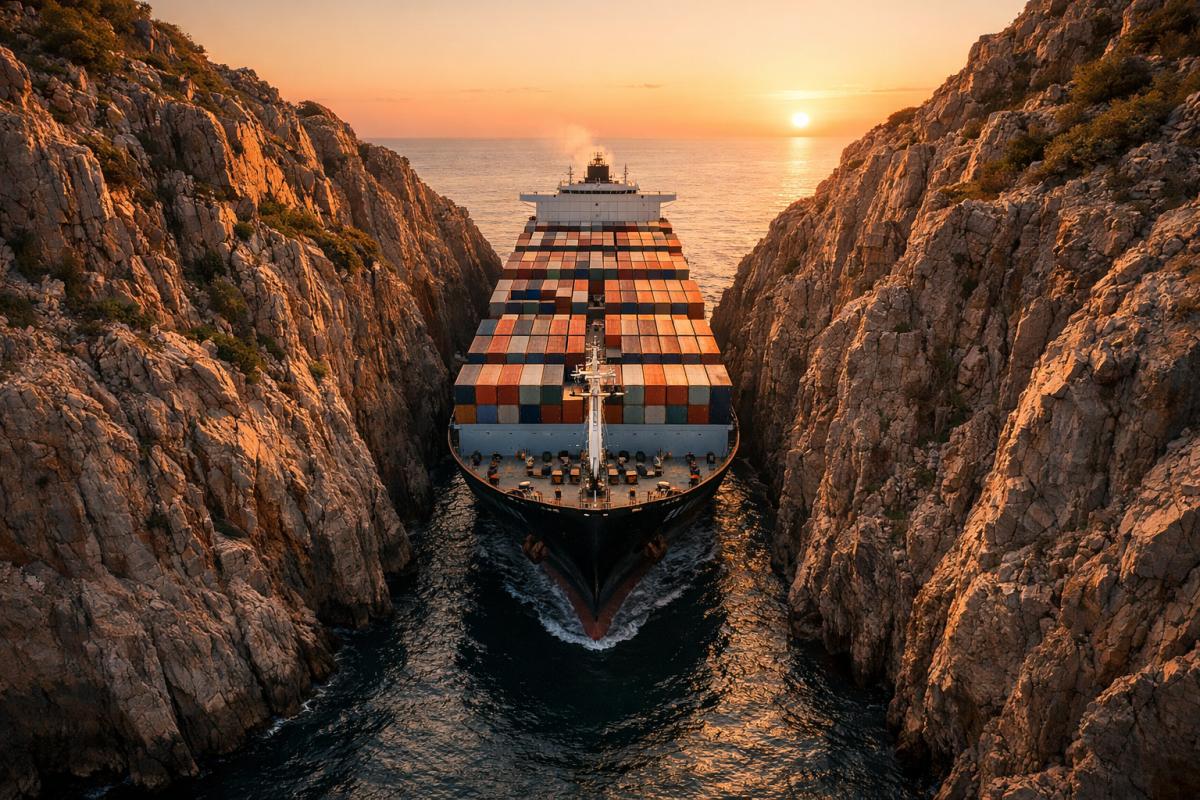
There is an old thought experiment in risk management called the single point of failure. Engineers obsess over it. Investors should too. The idea is simple: a system that depends on one node to function is not a system at all. It is a trap waiting to spring. Right now, the global food system has a single point of failure. It is 21 kilometres wide. It sits between Iran and Oman. And the entity currently deciding who passes through it is not a multinational institution, a trade body, or a neutral arbitrator. It is a nation that has been bombed for weeks and has every incentive to make the world feel the cost.
There is an old thought experiment in risk management called the single point of failure. Engineers obsess over it. Investors should too. The idea is simple: a system that depends on one node to function is not a system at all. It is a trap waiting to spring.
Right now, the global food system has a single point of failure. It is 21 kilometres wide. It sits between Iran and Oman. And the entity currently deciding who passes through it is not a multinational institution, a trade body, or a neutral arbitrator. It is a nation that has been bombed for weeks and has every incentive to make the world feel the cost.
Most market commentary is framing the Iran conflict as an oil story. That framing is not wrong. It is just embarrassingly incomplete. The real story is not at the pump. It is at the dinner table. And the financial implications of getting this wrong are not a portfolio drawdown. They are civilisational.
Pop quiz for investors: what single commodity, if its supply fell by 30 percent tomorrow, would halt semiconductor manufacturing across South Korea within months, crash memory chip availability globally, and send the price of every electronic device skyward with no available substitute?
The answer is not lithium. It is not cobalt. It is helium.
Helium is the class nerd of the periodic table: inert, invisible, and taken completely for granted until it is gone. Around 30 percent of the world’s supply comes from a gas field straddling the Saudi-Iranian side of the Gulf. South Korea, which fabricates roughly two thirds of the world’s memory chips, sources approximately 65 percent of its helium from that region. The South Korean government has already launched an emergency investigation into supply security. The mainstream financial press has barely noticed.
Here is what makes helium uniquely dangerous as a supply shock: you cannot stockpile it. Helium is so light that it slowly permeates through container walls and escapes into the upper atmosphere, where it is effectively lost forever. There are no strategic helium reserves the way there are strategic petroleum reserves. Once the tap is closed, fabrication lines stop. Full stop.
The markets have not priced a sustained helium shortage into memory chip producers, consumer electronics manufacturers, or the data centre buildout that every AI growth thesis currently depends on. That gap between risk and pricing is where contrarian opportunity lives. It is also where catastrophic loss lives if you are on the wrong side of it. The US Geological Survey’s helium commodity page is one of the few places tracking global supply data with any rigour.
Here is a number that should be on every investor’s radar: two billion. That is the rough estimate of how many people the planet could feed without synthetic fertilizer. The current population is eight billion. The difference between those two numbers is the Haber-Bosch process, a chemical reaction discovered in the early twentieth century that fixes atmospheric nitrogen into a form plants can absorb.
The raw inputs for that process, along with the finished fertilizer itself, pass through the Strait of Hormuz in significant volumes. Around 20 to 30 percent of global fertilizer supply flows through that chokepoint. A sustained closure does not produce an agricultural slowdown. It produces a famine, not in a decade, not in a generation, but within a single growing cycle in the most import-dependent nations.
India is the most immediately exposed large economy. Its population, its agricultural scale, and its fertilizer import dependency combine into a vulnerability that its government almost certainly war-games but does not publicly discuss. A fertilizer shock arriving in the wrong month relative to planting season is not recoverable within a year.
[Also see: The Harvest that Won’t Happen]
For investors, this creates a set of signals worth tracking. Potash and phosphate producers outside the Hormuz corridor, particularly those operating in Canada, Russia, and Morocco, may find themselves in structurally stronger pricing positions than their current valuations reflect. Agricultural land with access to non-imported nutrient sources, and food producers with diversified input geographies, deserve a relook. The FAO Food Price Index is updated monthly and is currently the clearest leading indicator of food system stress available to retail investors.
Set aside geopolitics for a moment and think purely about market mechanics. There is a president who has demonstrated, repeatedly and in public, that he understands his statements move markets. He has expressed personal enthusiasm for rising oil prices, framed as profit opportunities. His administration has financial entanglements in the energy sector that have not been fully disclosed. And the cadence of his Iran-related announcements follows a pattern that is almost too clean to be accidental.
Escalation. Spike. Pause. Fall. Escalation. Spike. Pause. Fall.
This is not analysis. It is a rhythm. The same rhythm appeared during the 2025 tariff cycle, where threats and retreats arrived with a regularity that rewarded those positioned ahead of each move. The Iran conflict has replicated that pattern almost note for note.
There is a reasonable debate about whether this constitutes intentional market manipulation or whether it is simply the predictable behaviour of a transactional negotiator who always needs to look like he is winning. From a trading standpoint, the distinction is largely academic. The behaviour is observable. The timing is traceable. Sunday nights and Monday mornings before US market open have become the highest-probability windows for a market-moving Iran announcement, positive or negative.
The contrarian read here is not to trade the announcement itself. It is to position for the volatility compression that follows when the conflict eventually de-escalates for real, rather than performing the latest cycle of the inflate-and-release routine. Energy markets that have been artificially elevated by geopolitical theatre have historically mean-reverted sharply when the theatre ends. The US Commodity Futures Trading Commission’s market surveillance data is publicly available and worth cross-referencing with announcement timelines for anyone building a serious thesis here.
Mainstream economists treat energy as one input among many, substitutable and priceable at the margin. Researchers who have actually studied the empirical relationship between energy consumption and economic output know this is wrong. Forty years of data shows a near-perfect correlation: energy up, GDP up. Energy down, GDP down. The magnitudes match.
A 10 to 20 percent reduction in Gulf energy and gas supply is not a headwind. It is a direct hit to gross world product of roughly equivalent magnitude. And unlike demand-side recessions, which central banks have tools to address, a supply-side energy shock of this scale cannot be fixed with rate cuts. You cannot print a barrel of oil. You cannot quantitatively ease a tonne of liquefied natural gas.
The IEA’s oil market reports model Hormuz closure scenarios, though their published baselines tend toward optimism for political reasons. The more instructive data point is Australia, which holds approximately 30 days of oil reserves. When those run out, food cannot move from farms to cities. Supply chain failure is not metaphorical in that scenario. It is literal and rapid.
The honest answer is that there is no clean hedge for a scenario this large. Gold has already been bid up. Bitcoin is behaving like a risk asset rather than a safe haven. Cash preserves optionality but earns nothing against the food inflation that is already beginning to bite in import-dependent markets.
The more interesting question is structural. This conflict is making visible a set of vulnerabilities that were always there but priced as negligible. Single-region helium dependency. Single-chokepoint fertilizer supply. A US administration that appears to conflate market volatility with personal profit. None of these were secrets before the bombs started falling. All of them were ignored.
Markets that ignore known risks until a trigger event forces recognition tend to reprice violently. The trigger events in the Hormuz story are not hypothetical. They are occurring. The repricing has barely begun.
The investors who will look clearest in hindsight are not those who predicted the conflict. They are those who mapped the supply chains, identified the non-substitutable inputs, found the producers sitting outside the blast radius, and positioned before the consensus caught up. That window is narrowing but has not closed.
The World Bank’s commodity markets outlook publishes quarterly data useful for identifying which commodity categories are most sensitive to Gulf disruption. Cross-reference it with the FAO index and the IEA reports and you have the rough shape of a monitoring framework that most retail investors are not running.
The world’s pantry has one door. Someone else currently holds the key. That is not a geopolitical opinion. It is a supply chain fact. And supply chain facts, eventually, become market facts. The only question is whether you are positioned when they do.
This article draws on public economic analysis and commodity supply data. It does not constitute financial advice. Always conduct your own due diligence before making investment decisions.