Physical Address
304 North Cardinal St.
Dorchester Center, MA 02124
Physical Address
304 North Cardinal St.
Dorchester Center, MA 02124

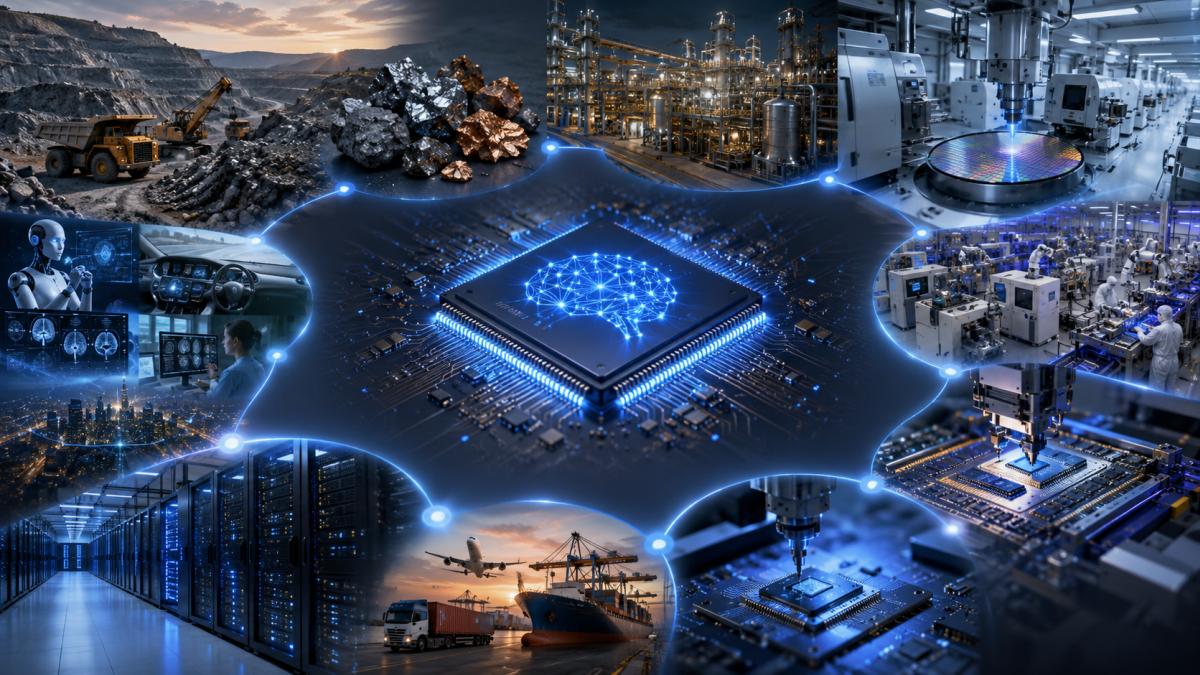
Everyone knows the AI boom is real. The argument worth having now is not whether it continues but where the most durable returns are hiding inside it. And right now, the data points somewhere most retail portfolios are systematically underweight: the semiconductor supply chain below the headline GPU names.
Everyone knows the AI boom is real. The argument worth having now is not whether it continues but where the most durable returns are hiding inside it. And right now, the data points somewhere most retail portfolios are systematically underweight: the semiconductor supply chain below the headline GPU names.
Micron’s fiscal Q3 2026 results, released after the close today, made the case in numbers. Revenue came in at $41.46 billion against analyst expectations of around $35.84 billion, with adjusted earnings of $25.11 per share against a $20.78 consensus. Operating cash flow hit $25.39 billion. The stock jumped 15% in after-hours trading. For a company generating $9.3 billion in the same quarter a year ago, the trajectory is not subtle.
The underlying force is High Bandwidth Memory — the specialised chip architecture that sits between a GPU and its data, functioning as the critical working memory for every major AI accelerator on the market. Without adequate HBM supply, even the most advanced GPU cannot perform at capacity. That makes the three companies that produce it at commercial scale — SK Hynix, Samsung, and Micron — something closer to infrastructure than semiconductors in the traditional sense.
SK Hynix currently holds roughly 57 to 62 percent of the global HBM market, with its HBM3E chips sold out through at least Q3 2026. Micron has confirmed it cannot fulfil even two-thirds of medium-term demand from some customers. Samsung, the third player, is racing to close a yield-rate gap with SK Hynix. These are not companies managing demand carefully; they are companies rationing supply to the largest technology organisations in the world. That dynamic tends to show up in margins. SK Hynix’s full-year 2025 operating margin expanded to 49 percent for the year and reached 58 percent in Q4. Micron guided for gross margins of approximately 81 percent in Q3.
Underpinning all of this is the commitment from cloud infrastructure operators. TrendForce projects combined capital expenditure from the top eight cloud providers at over $710 billion in 2026, a substantial portion of which flows into memory procurement through long-term supply agreements. Hyperscalers are now stationing dedicated memory procurement executives at fabs and reserving capacity 12 to 24 months in advance. That is not speculative demand. That is contracted backlog.
While the memory suppliers in Korea and the US attract most of the attention, the strongest equity returns this cycle have been in the Japanese semiconductor supply chain — a network of equipment manufacturers, materials suppliers, and component makers that powers fabrication globally regardless of which AI application wins the marketplace.
The Nikkei 225 has hit successive record highs this year, with year-to-date gains surpassing 22 percent. The rally has been concentrated in companies like Tokyo Electron, whose first-half 2026 guidance came in at 1.57 trillion yen in sales — up 33 percent year-over-year — with operating profit surging 42 percent. Advantest, which supplies chip testing equipment, jumped over 11 percent on today’s session alone. Kioxia, Japan’s largest memory chipmaker, gained more than 8 percent.
What makes Japanese semiconductor exposure structurally interesting is its neutrality. Companies like Lasertec hold 100 percent global market share in defect detection for EUV masks — the critical step in manufacturing the most advanced AI chips. Tokyo Electron captures roughly 40 percent of its total sales from AI chip demand flowing through Samsung, SK Hynix, and TSMC. These companies do not need to pick the winning AI application, the winning GPU architecture, or even the winning hyperscaler. They supply the equipment that everyone building at the frontier must use. It is a picks-and-shovels position in the most literal sense.
The thesis is reinforced by the macro backdrop. Yen weakness lowers the effective cost of Japanese equity for international investors, and foreign capital has net purchased 5.69 trillion yen in Japanese equities year-to-date, far exceeding the total of the prior two years combined.
Micron CEO Sanjay Mehrotra has described memory as becoming “a strategic asset” in the AI era. That framing is accurate and underappreciated. The HBM market is projected to grow from $35 billion in 2025 to $100 billion by 2028 — two years earlier than Micron’s previous forecast. The global semiconductor market is approaching $975 billion in 2026 on 25 percent year-over-year growth, with memory expanding at 30 percent.
Contract DRAM prices rose approximately 15 to 20 percent quarter-over-quarter in Q1 2026, following similar gains in Q4 2025. Enterprise SSD pricing is up over 25 percent sequentially as data centres scramble to secure AI storage supply. Both Samsung and SK Hynix have warned that significant memory shortages are expected to persist through at least 2027, with customers already reserving supply years in advance.
For investors, this is a distinct thesis from buying Nvidia or any consumer-facing AI application. The memory supercycle is broad-based demand from every major cloud provider and chip designer simultaneously, rather than a bet on a single platform.
The contrarian case here requires acknowledging the risks embedded in the bull story.
The first is cycle risk. Memory has historically been among the most cyclical of all industries, moving from severe shortage to glut within two to three years as new capacity comes online. Harvard Business School professor Willy Shih, who has tracked semiconductor cycles since the 1980s, told Fortune that the AI memory boom follows the same pattern as every other memory cycle — just larger in scale. “Anytime people show me these curves that just go to the sky with no end,” he noted, “that never continues forever.”
The second risk is concentration. The Nikkei 225’s record run has been driven by a remarkably narrow group of stocks — only 17 percent of TSE Prime Market stocks advanced during the index’s historic 60,000 breach, while 78 percent declined. Broad index exposure is not the same as semiconductor exposure.
The third risk is rate sensitivity. Semiconductor stocks increasingly trade like long-duration assets because so much of the cash flow is back-loaded into the AI capex cycle. A meaningful hawkish turn from central banks, or any disruption to private AI infrastructure financing, could compress multiples quickly even if underlying demand remains intact.
The fourth risk is quality divergence inside the supply chain itself. As Samsung races to close its HBM yield gap with SK Hynix, analysts have flagged the possibility of lower-quality HBM3E product entering Nvidia server deployments, introducing reliability risks. A high-profile failure at the component level would reprice the entire segment.
The consensus AI semiconductor portfolio is concentrated in the largest, most visible names: Nvidia, TSMC, ASML, Broadcom, AMD. These companies are legitimate winners, but they already trade at valuations reflecting AI dominance. The asymmetric returns in this cycle are more likely to emerge from the sub-segments that the consensus has not yet fully priced.
Advanced packaging is one such segment. TSMC’s CoWoS (chip-on-wafer-on-substrate) packaging enables AI chip architectures that would be physically impossible through conventional manufacturing — integrating GPU dies with HBM memory stacks in a configuration that the traditional supply chain simply cannot replicate. TSMC doubled CoWoS capacity to 70,000 wafers monthly and still cannot meet demand, prompting a further 30 percent expansion for 2026.
Optical interconnect is another. Nvidia has made simultaneous investments in Coherent, Lumentum, and Marvell to lock up EML laser capacity for co-packaged optical work — the same playbook it ran before the previous supply constraint emerged. Companies positioned in that next chokepoint before institutional coverage formalises the theme tend to capture the most significant repricing.
Testing equipment is a third. KLA and Teradyne showed 48 percent growth in 2025, driven by the increasing complexity of AI chip verification, while institutional attention remained focused further downstream on chip designers.
AI infrastructure spending is real, contracted, and accelerating. The memory subsystem has become the binding constraint on how fast that infrastructure can be built. Three companies control 90-plus percent of the relevant market and cannot keep pace with demand. The supply chain enabling their fabrication — concentrated in Japan and across specialised equipment and materials manufacturers globally — benefits regardless of which specific AI applications succeed commercially.
The most interesting positions in this cycle are not the most obvious ones. Nvidia and TSMC have already priced a great deal of the story. The supply chain one or two steps upstream from the finished chip — equipment, materials, packaging, testing, optical interconnect — carries more embedded optionality at current valuations than the headline names, with the caveat that memory cycles do eventually turn, and positioning accordingly matters as much as identifying the trend.
Market Mind Investor is an independent international investment analysis blog. Nothing published here constitutes financial advice or a recommendation to buy or sell any security.