Physical Address
304 North Cardinal St.
Dorchester Center, MA 02124
Physical Address
304 North Cardinal St.
Dorchester Center, MA 02124


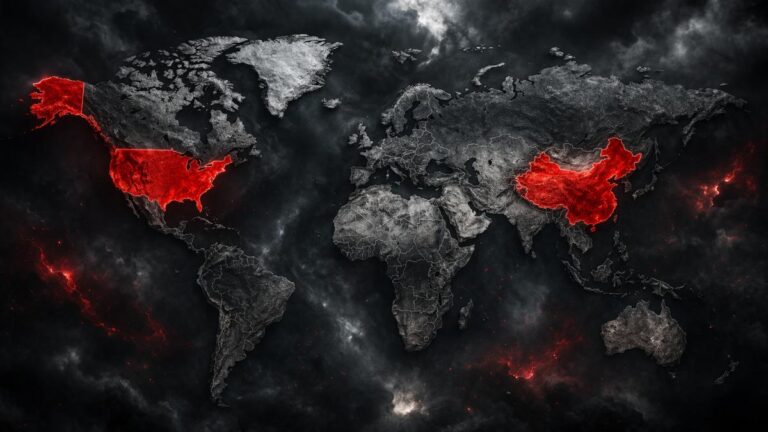
For the better part of eight decades, a quiet arrangement underpinned global stability. The United States provided the security umbrella. Allies sheltered beneath it, built export-driven economies, kept defence budgets lean, and grew wealthy. It was, by historical standards, an extraordinary deal. That deal is fraying. Not all at once, not dramatically, but structurally and irreversibly. The signals are everywhere: transactional diplomacy, tariff aggression directed at allies, wavering commitments to NATO Article 5, and a domestic political mood that views overseas obligations as subsidies to freeloaders. Whether one reads this as strategic repositioning or imperial fatigue, the consequence for Washington's vassal states is identical. They must now think for themselves.
When the empire wobbles, its clients scramble. Here is where the smart money watches.
For the better part of eight decades, a quiet arrangement underpinned global stability. The United States provided the security umbrella. Allies sheltered beneath it, built export-driven economies, kept defence budgets lean, and grew wealthy. It was, by historical standards, an extraordinary deal.
That deal is fraying. Not all at once, not dramatically, but structurally and irreversibly. The signals are everywhere: transactional diplomacy, tariff aggression directed at allies, wavering commitments to NATO Article 5, and a domestic political mood that views overseas obligations as subsidies to freeloaders. Whether one reads this as strategic repositioning or imperial fatigue, the consequence for Washington’s vassal states is identical. They must now think for themselves.
For investors, this is not a geopolitical footnote. It is a decade-long repricing event. Defence budgets are going to surge. Trade alliances are going to redraw. Currencies are going to diversify away from the dollar. The countries most exposed to this shift are also some of the world’s most important economies. Knowing which ones, and what they will do next, is the contrarian edge.
South Korea sits 35 miles from one of the most heavily armed borders on earth. Its security has rested, for seventy years, on the presence of roughly 28,500 American troops and an implicit nuclear guarantee. That arrangement is now openly transactional. Senior American officials have floated troop withdrawal unless Seoul pays substantially more. The threat is no longer theoretical.
What happens when South Korea internalises that the cavalry may not come? Seoul is already accelerating its own defence industrial complex. It is now one of the world’s top ten arms exporters, selling K2 tanks and K9 howitzers to Poland and Australia. Its defence budget is climbing toward three percent of GDP. More quietly, Korean strategists are debating the previously taboo question of indigenous nuclear capability. The 2025 Asan Institute poll recorded an all-time high of 76.2 percent of South Koreans supporting the development of domestic nuclear weapons, up from 70.9 percent the year before. Confidence that the United States would actually use nuclear weapons to defend South Korea has slipped to just 48.9 percent.
This is not abstract polling data. Several presidential candidates have openly endorsed nuclear armament or nuclear hedging strategies. The domestic political space for going nuclear is widening in a way that would have been unthinkable a decade ago.
The investment read: South Korean defence contractors, Hanwha Aerospace and Hyundai Rotem among them, are in a sustained growth cycle. The geopolitical uncertainty also compresses valuation multiples on Korean equities broadly, creating opportunity for patient investors willing to look past the noise.
Japan’s postwar settlement was explicit. In exchange for American protection, Japan would forswear military power and host US bases. It worked. Japan became the world’s second-largest economy for decades, spending less than one percent of GDP on defence.
That era is over. Japan has now committed to raising defence-related spending to two percent of GDP, the most dramatic military expansion since the Second World War. In December 2025, Japan’s cabinet approved a record defence budget of 9.04 trillion yen for fiscal year 2026, the twelfth consecutive annual record. A supplementary budget brought total security-related spending to the two percent target two years ahead of the original 2027 deadline. Japan is acquiring long-range strike missiles for the first time. It is restructuring its Self-Defence Forces into something that looks considerably more like an offensive capability. It is converting helicopter carriers into platforms capable of operating F-35B stealth fighters.
Japan is also quietly building economic hedges. Its trade relationships with Southeast Asia, India, and Australia are deepening through frameworks that do not require Washington’s blessing. The yen’s role as a safe-haven currency may ironically strengthen as Japan becomes a more self-sufficient security actor.
For investors: Japanese defence stocks are a multi-year story. Mitsubishi Heavy Industries and Kawasaki Heavy Industries are direct beneficiaries. Japanese equities more broadly remain undervalued relative to earnings quality, and a more assertive Japan is a more investable Japan.
Germany’s vassal status was always more economic than military, though NATO’s Article 5 was the bedrock beneath it. The bargain ran deep: Germany would integrate into Western structures, avoid independent military ambition, and the United States would guarantee the rules-based order that made German export dominance possible.
Russia’s invasion of Ukraine cracked this open. The energy shock destroyed Germany’s cheap-input manufacturing model. Now American tariffs threaten its export markets. And Washington’s reliability as a security guarantor is in question. Germany spent 2024 in political crisis. It spent early 2025 electing a government with a mandate to rearm.
Germany has suspended its constitutional debt brake to fund a 500 billion euro defence and infrastructure programme, the largest fiscal expansion in modern German history. This is not a temporary measure. It is a structural pivot in how Europe’s largest economy sees itself in the world. European defence spending is entering a cycle that analysts at multiple institutions expect to persist for at least a decade.
The investment angle is direct: German and European defence contractors, infrastructure companies, and the broader European rearmament trade. Rheinmetall’s share price has been one of the decade’s defining moves, but the repricing of European security capacity has years to run.
Saudi Arabia’s arrangement with America was the original vassal bargain: sell oil in dollars, recycle petrodollar surpluses into US Treasuries, and in return receive American security guarantees and weapons systems. It held for fifty years.
It is now visibly loosening. Saudi Arabia has opened oil trade in currencies other than the dollar. It has deepened ties with China through the Shanghai Cooperation Organisation. It has joined BRICS as a full member, diversifying its geopolitical portfolio in a way that would have been unthinkable during the Cold War era. It is pursuing Vision 2030 with a pragmatism that does not privilege American partners. The Abraham Accords normalisation with Israel, which Washington facilitated, has stalled, and Riyadh is showing it will move at its own pace.
None of this means Saudi Arabia is abandoning the West. It means it is building optionality. For a country sitting atop the world’s largest conventional oil reserves, optionality is leverage. The kingdom is investing hundreds of billions into non-oil economic diversification, sovereign wealth expansion, and diplomatic relationships that give it bargaining power with every major bloc simultaneously.
For investors: Saudi Arabia’s pivot accelerates the slow erosion of petrodollar hegemony. This is a long-run headwind for the US dollar and a tailwind for gold, commodities priced in alternative currencies, and emerging market assets less tethered to dollar liquidity cycles. If you want to understand the mechanics of how dollar dominance unwinds and what it means for your portfolio, our earlier analysis on the chain reaction connecting Japanese debt, Gulf infrastructure, and US Treasuries maps the transmission channels in detail.
No vassal state faces higher stakes than Taiwan. Its entire existence as a de facto independent entity rests on the belief that the United States would intervene militarily if China moved against it. That belief, never formalised, always assumed, is now being tested.
American officials have sent mixed signals. Taiwan is responding. Its defence budget is rising. It is extending conscription. It is accelerating domestic weapons production. But Taiwan’s options are fundamentally constrained in a way Korea and Japan’s are not. It cannot build nuclear weapons quietly. It cannot pivot to a new patron. Its leverage is economic. TSMC’s dominance of advanced semiconductor manufacturing is Taiwan’s most powerful deterrent, because destroying Taiwan’s chip capacity would be catastrophic for the global economy, including China’s.
The investor implication is the most complex of the five. Semiconductor supply chain diversification, including TSMC fabs in Arizona and Japan, Samsung expansion, and Intel’s foundry ambitions, is partly a bet that this deterrence eventually fails. The timeline is unpredictable, the stakes are asymmetric, and most portfolios are woefully underprepared for a Taiwan disruption scenario. The premium investors should demand for Taiwan exposure is rising, and those who ignore it are implicitly betting on the status quo holding indefinitely.
The common thread across all five cases is the same: the cost of security is being internalised by countries that previously outsourced it. That means defence spending globally is in a structural bull cycle that has at least a decade to run. It means trade relationships are being rebuilt around new centres of gravity. And it means the dollar-denominated, American-guaranteed order that has priced assets since 1945 is being slowly discounted.
The practical portfolio implications are clear. Defence equities across multiple geographies offer sustained growth, not a one-quarter trade. Gold and hard assets benefit from the slow de-dollarisation trend. Emerging market assets gain relative attractiveness as capital flows diversify. And the premium for geopolitical risk in exposed regions like East Asia needs to be priced explicitly rather than treated as background noise.
Most portfolios still price in American primacy as a permanent condition. History suggests that is the kind of assumption that gets punished slowly, then all at once.
The vassal states are not waiting. Neither should you.
The information in this article is for educational and informational purposes only and does not constitute financial advice. Always conduct your own research before making investment decisions.