Physical Address
304 North Cardinal St.
Dorchester Center, MA 02124
Physical Address
304 North Cardinal St.
Dorchester Center, MA 02124

In Part 1 of this series for Market Mind Investor (MMI), we analyzed the architectural foundations of modern banking, from the deceptive fractional reserve creation pioneered by early goldsmiths to the three-pillar financial triad perfected by the Dutch Republic and imperial Britain. That model rested upon a central bank guarantor, a public equity market to privatize commercial profits, and a sovereign bond market to socialize public debt. Yet, as history repeatedly demonstrates, financial empires are never permanent. When imperial debts mount, domestic resources are depleted, and foreign conflicts become unmanageable, capital does not disappear; it migrates to a newer, more formidable host.
During the first half of the twentieth century, this institutional architecture crossed the Atlantic Ocean. The devastating attrition of World War I and World War II dismantled the British Empire, leaving European treasuries insolvent and transferring the supreme monetary levers to the United States. However, this global transition was neither accidental nor purely a byproduct of industrial manufacturing. As former investment banker Simon Dixon argues in his forensic analysis of macroeconomic flows, the ascent of the American Empire was engineered through precise monetary maneuvers: the creation of the Federal Reserve in 1913, the systematic accumulation of global gold reserves in Fort Knox, the institutionalization of the US dollar at Bretton Woods in 1944, and the eventual creation of the Petrodollar framework in the 1970s.
For modern macro investors, understanding this twentieth-century evolution is vital. The global economic architecture we navigate today, characterized by persistent fiscal deficits, perpetual sovereign debt rollover, military spending cycles, and volatile energy markets, is the direct structural offspring of the monetary arrangements established between 1913 and 1974. In this second installment, we trace how physical gold was centralized, how the dollar was weaponized into the world’s reserve currency, and how global oil flows were harnessed to perpetually fund the greatest debt expansion in human history.
Prior to 1913, the United States operated without a permanent central bank, having witnessed fierce political battles over the First and Second Banks of the United States. Presidents such as Andrew Jackson vehemently opposed central banking interests, recognizing that an unelected banking cartel possessing the power to issue currency would inevitably subordinate democratic government to private creditors. For decades, American monetary policy was contested between agrarian interests favoring hard silver and gold currency and East Coast financiers seeking an elastic, credit-based money supply.
That resistance was dismantled in December 1913, when President Woodrow Wilson signed the Federal Reserve Act, establishing the third iteration of an American central bank. Structured as twelve regional reserve banks to present a facade of decentralization, the system’s regional banks were owned by their private commercial member banks, which also elected most of their directors. The institutional architects of the Fed created a private-public syndicate that mirrored the Bank of England. One of its chief architects, Paul Warburg, sat on the first Federal Reserve Board and served as its vice governor from 1916 to 1918. He maintained direct familial ties to European banking leadership through his brother Max Warburg, head of the family bank in Hamburg, who later sat on the governing council of Germany’s Reichsbank. This transatlantic banking network ensured that private financial interests held governing influence across the major western capitals.
The timing of the Federal Reserve’s creation proved decisive. Within a year, Europe plunged into World War I (1914-1918). As Britain, France, Russia, and Germany engaged in industrialized slaughter, their domestic treasuries were rapidly exhausted. European sovereigns could not fund the war through taxation alone; they were forced to take on massive debts and purchase armaments, raw materials, and agricultural goods from the United States. Because American exporters and financiers demanded payment in real commodity money, European nations bled physical gold reserves across the Atlantic.
Following the 1919 Treaty of Versailles, the victorious Allied powers imposed crushing war reparations on Germany. To manage these astronomical repayments, the Bank for International Settlements (BIS) was established in Basel, Switzerland, in 1930. The BIS functioned as a supranational bank for central bankers, coordinating reparations settlements and gold transfers between national central banks. When economic distress deepened across Europe during the Great Depression, the flow of gold toward American vaults accelerated.
Inside the United States, sovereign monetary control was consolidated through force of law. In April 1933, President Franklin D. Roosevelt signed Executive Order 6102, requiring American citizens to surrender most of their gold coin, bullion, and certificates under threat of a $10,000 fine and up to ten years in prison. Citizens were coerced into handing their physical gold to the Federal Reserve in exchange for paper currency at the statutory rate of $20.67 per ounce. Shortly thereafter, the Gold Reserve Act of 1934 revalued gold to $35 per ounce, handing the state an immediate, unearned windfall while debasing the purchasing power of the paper notes held by the public. By the late 1940s, the United States had amassed close to 20,000 tonnes of gold, much of it in secure facilities like Fort Knox, representing roughly three-quarters of the world’s official monetary gold reserves.
By 1944, World War II had decimated European industrial capacity, pulverized Asian manufacturing hubs, and left the British Empire functionally bankrupt. The British East India Company had long been dissolved, imperial colonial holdings were demanding independence, and London was drowning in war debt owed to Washington. The stage was set for a fundamental reset of the global monetary order.
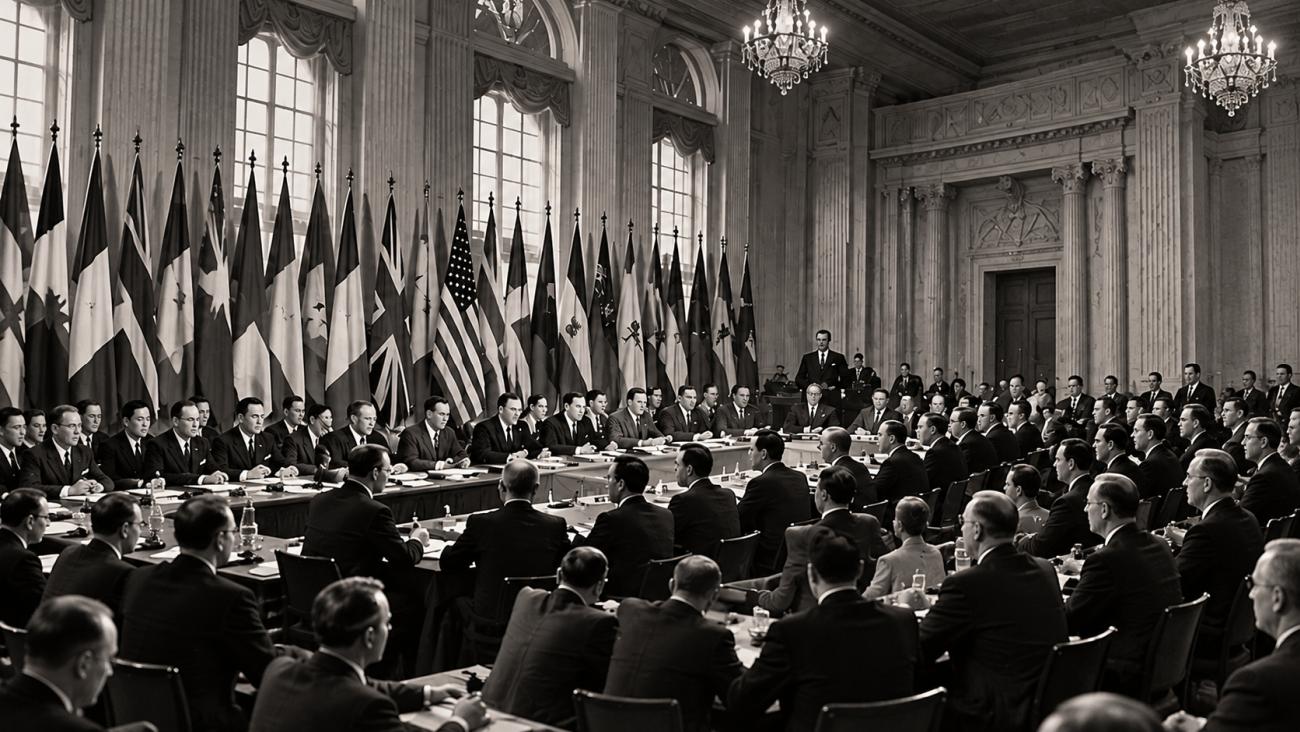
In July 1944, delegates from 44 Allied nations convened at the Mount Washington Hotel in Bretton Woods, New Hampshire, to establish a unified postwar monetary framework. The conference witnessed a profound clash of visions between British economist John Maynard Keynes and US Treasury official Harry Dexter White. Keynes, representing an indebted and declining British Empire, advocated for an international clearing union and a synthetic global reserve unit named “Bancor.” Keynes argued that Bancor would prevent any single nation from exploiting its domestic currency to extract unilateral trade advantages or export chronic balance-of-payments deficits onto the rest of the world.
The United States, holding the dominant manufacturing base, undisputed naval supremacy, and three-quarters of the planet’s monetary gold, rejected Keynes’s proposal. Under White’s design, the US dollar was elevated as the sole anchor of international commerce. The Bretton Woods agreement established a two-tiered monetary architecture.
The dollar tier. The US dollar was directly pegged to physical gold at the fixed statutory price of $35 per ounce, with foreign central banks granted the exclusive privilege to redeem their dollar reserves for physical gold from the US Treasury upon demand.
The member tier. All other member nations agreed to abandon their domestic gold standards, fix their national currencies at exchange rates pegged directly to the US dollar, and settle international trade imbalances in dollars.
To enforce this new financial hierarchy, two multilateral institutions were chartered: the International Monetary Fund (IMF) and the International Bank for Reconstruction and Development (the World Bank). While marketed as benevolent development agencies designed to assist war-torn nations, Dixon highlights their deeper structural purpose within the global capital structure. The IMF operated as an international enforcer, ensuring that member nations maintained open capital accounts, established central banking frameworks linked to the BIS, and settled sovereign trade in US dollars. The World Bank extended large, dollar-denominated development loans to sovereign nations, ensuring that foreign infrastructure was financed through Western banking cartels and that developing states were permanently integrated into the dollar debt ecosystem.
Any lingering illusions of British imperial parity were permanently shattered during the 1956 Suez Crisis. When Egyptian President Gamal Abdel Nasser nationalized the Suez Canal to reclaim sovereign control over domestic trade and strategic waterways, Britain, France, and Israel launched a coordinated military invasion. Washington responded not with military confrontation, but with monetary warfare. As sterling came under heavy selling, the US Treasury refused to back the IMF support Britain needed to defend the pound until it complied with the United Nations, and the Eisenhower administration was widely reported to have threatened to sell its holdings of British sterling bonds. The British government was forced into a humiliating and immediate military retreat. The Suez debacle marked the definitive end of Pax Britannica, confirming that global hegemony had fully transferred to the American dollar imperium.
The Bretton Woods arrangement contained a lethal, built-in contradiction known to monetary economists as Triffin’s Dilemma. To facilitate expanding global trade and provide adequate liquidity for postwar reconstruction, the United States was required to export a continuous supply of dollars to foreign nations. However, exporting dollars required the US to run chronic balance-of-payments deficits. As the quantity of paper dollars circulating internationally multiplied, it inevitably outpaced the physical supply of gold resting in Fort Knox.
Throughout the 1950s and 1960s, Washington dramatically accelerated the creation of unbacked paper credit. The federal government ran ballooning fiscal deficits to finance both domestic entitlement expansions (“The Great Society”) and overseas military engagements, most notably the Korean War and the protracted disaster of the Vietnam War. European central banks, observing that the volume of offshore dollar claims far exceeded America’s gold stock, grew increasingly skeptical of Washington’s solvency.
The crisis built through the mid and late 1960s, led by French President Charles de Gaulle. De Gaulle’s finance minister, Valéry Giscard d’Estaing, famously described the Bretton Woods system as granting the United States an “exorbitant privilege”: the ability to purchase foreign goods, raw materials, and sovereign assets simply by printing paper currency that foreign nations were obligated to hold. Recognizing that Washington was abusing this privilege to finance foreign wars with unbacked credit, France began systematically presenting paper dollars to the US Treasury and demanding physical gold in return. In a widely retold display of sovereign distrust, de Gaulle is said to have dispatched a French naval vessel to New York to carry the gold home.
Other foreign central banks, including West Germany’s Bundesbank and the Bank of England, prepared to follow suit. The United States faced an immediate, systemic run on Fort Knox. If Washington honored its obligations under the Bretton Woods agreement, America’s remaining gold reserves would have been wiped out within months.
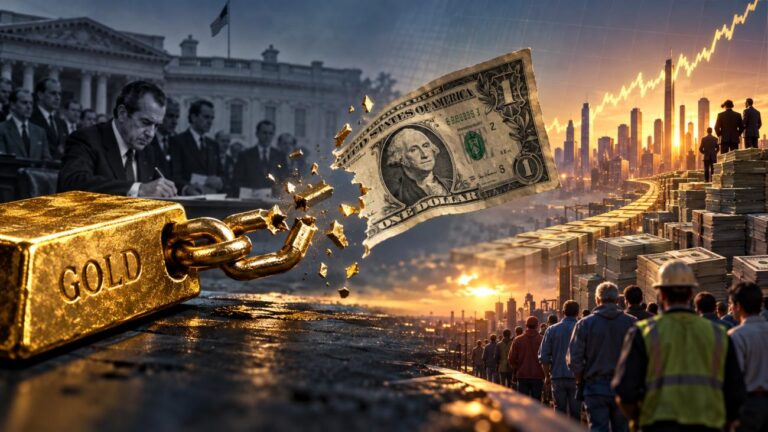
On Sunday evening, August 15, 1971, President Richard Nixon addressed the nation on live television. In a unilateral declaration, Nixon announced that he was “temporarily” suspending the convertibility of the US dollar into gold. With that single executive act, the United States defaulted on its international obligations and shattered the Bretton Woods system.
For the first time in history, the entire global financial order was detached from any physical commodity anchor. The dollar became pure unbacked fiat currency, a legal construct whose value was determined solely by government decree and market confidence. Without the discipline of gold redemption, the mathematical limits on debt expansion were permanently dismantled, clearing the path for an era of unprecedented monetary inflation.
The Nixon Shock solved Washington’s immediate gold run, but it created an existential crisis for the American empire. If foreign nations could no longer exchange their surplus dollars for physical gold, why should they continue holding dollars as reserve assets? Why should sovereign governments accept rapidly depreciating US paper in exchange for real oil, industrial goods, and raw materials? Between 1971 and 1973, the dollar plummeted on international currency exchanges, threatening to unravel American monetary hegemony.
The solution emerged from the geopolitical crucible of the Middle East. Following the October 1973 Yom Kippur War, Arab members of the Organization of the Petroleum Exporting Countries (OPEC) enacted a sweeping oil embargo against the United States and other nations that supported Israel, with Saudi Arabia’s King Faisal among its leading figures. Global oil prices quadrupled within months, triggering catastrophic stagflation, surging living costs, and industrial paralysis across Western economies.
Rather than viewing the energy shock purely as an economic disaster, American strategists recognized a historic opportunity to re-anchor the global dollar standard. The architect of this counter-strategy was US Secretary of State Henry Kissinger, working alongside Treasury Secretary William Simon. Between 1974 and 1975, the Nixon and Ford administrations negotiated a set of largely secret arrangements with the House of Saud that would govern the geopolitical landscape for the next half-century, now commonly known as the Petrodollar Accord.
The mechanics of the Petrodollar arrangement were brilliantly simple and ruthlessly effective.
Dollar pricing. Saudi Arabia continued to price and settle its international crude oil exports in US dollars rather than in gold, sterling, deutsche marks, or any other currency. As the dominant leader of OPEC, Saudi Arabia leveraged its cartel influence to ensure that the other major oil-producing nations followed the same rule.
Debt recycling. Saudi Arabia agreed to take its massive surplus dollar revenues, the “petrodollars” accumulated from selling oil at elevated prices, and funnel them directly back into the United States. Rather than simply holding the money in commercial bank deposits, Saudi Arabia agreed to purchase billions of dollars in US Treasury bonds, effectively lending its oil profits directly back to the US federal government to finance fiscal deficits.
Military protection. In exchange for pricing oil in dollars and recycling capital into US Treasuries, the United States provided the House of Saud with sweeping security guarantees. Washington pledged to sell advanced military hardware to the Saudi kingdom, build a lasting US military presence across the Persian Gulf, protect oil extraction infrastructure, and guarantee the political survival of the Saudi monarchy against internal rebellions and regional adversaries.
Through this arrangement, the United States effectively substituted gold backing with oil backing. Every industrialized nation on earth required crude oil to power factories, operate transportation grids, and maintain modern civilization. Because oil was priced and settled in US dollars, every sovereign government was forced to acquire, hold, and transact in dollars. Nations had to export their manufactured goods and natural resources to the United States to earn the dollars necessary to purchase essential energy supplies.
Furthermore, the petrodollar system solved the fundamental mathematical defect of the debt-based monetary model analyzed in Part 1. By requiring oil producers to continuously recycle their dollar surpluses into US sovereign debt, the Petrodollar Accord created a guaranteed, captive global buyer for US Treasury bonds. The US government could run astronomical fiscal deficits, fund perpetual foreign military deployments, and export domestic inflation abroad, fully aware that the global demand for energy would force foreign central banks to absorb American debt paper indefinitely.
The petrodollar architecture transformed American foreign policy in the Middle East from conventional diplomatic alliance-building into an aggressive management system designed to enforce monetary compliance. Within this framework, national defense, intelligence agencies, and corporate finance coalesced into what Simon Dixon identifies as the Military-Industrial Complex (MIC) working in tight coordination with the Financial-Industrial Complex (FIC).
Under this dynamic, sovereign nations that fully complied with the petrodollar structure, such as Saudi Arabia, the United Arab Emirates, and Kuwait, were granted Western security umbrellas, access to advanced armaments, and immunity from diplomatic scrutiny regarding civil liberties or governance models. Conversely, nations that dared to assert monetary sovereignty, nationalize their energy reserves, or bypass the dollar trade were systematically marked for regime change, economic sanctions, or direct military invasion.
The historical timeline demonstrates this extraction loop with chilling precision.
Iran (1953 and 1979). In 1953, the CIA and British intelligence orchestrated Operation Ajax to overthrow the democratically elected Iranian Prime Minister Mohammad Mossadegh, who had nationalized the British-run Anglo-Iranian Oil Company in 1951, replacing him with the pro-Western rule of the Shah. Following the 1979 Iranian Revolution, which expelled Western oil interests and established a sovereign theocratic republic, Iran was placed under Western sanctions and designated as a primary geopolitical adversary.
Iraq (2000-2003). In November 2000, Iraq began selling its oil under the United Nations Oil-for-Food program in euros rather than US dollars. By pricing oil in euros, Saddam Hussein directly challenged the core premise of the petrodollar monopoly. Less than three years later, the United States invaded Iraq on weapons of mass destruction claims that later proved false, deposed the regime, and promptly reverted Iraqi oil sales to US dollar settlement.
Libya (2011). Libyan leader Muammar Gaddafi long championed African monetary independence and was reported to be pursuing a pan-African gold-backed currency, a modern gold dinar designed to let African and Arab oil producers trade energy and raw materials independently of Western fiat rails. In 2011, NATO forces intervened in Libya. Gaddafi was captured and killed by rebel fighters after NATO aircraft struck his convoy, the Libyan state collapsed, and the gold currency initiative died with him.
As Dixon forensically details, these military interventions serve a dual financial objective. On the front end, armed conflict generates trillions of dollars in defense contracts for major aerospace and weapons manufacturers (such as Lockheed Martin, General Dynamics, and RTX), financed through sovereign debt issues that expand the balance sheet of the US Treasury and provide lucrative yields to institutional bondholders. On the back end, the destruction of sovereign infrastructure sets the stage for astronomical reconstruction contracts, managed by multinational engineering and asset management firms and funded through dollar loans extended by the IMF and World Bank.
War is not an interruption of the global financial system; it is the ultimate stimulus program for the debt-based financial apparatus. It simultaneously creates sovereign debt, generates corporate equity appreciation, enforces currency compliance, and concentrates asset ownership in the hands of the global financial elite.
The transition from the 1913 Federal Reserve Act to the Petrodollar Accord reveals a profound macro reality: the global financial order was deliberately engineered to maintain artificial demand for unbacked US paper currency by tethering it to global energy flows and military force.
For the modern investor, this historical context provides crucial diagnostic clarity.
Fiat currency has no inherent anchor. All fiat currencies exist as debt instruments issued by banking cartels, maintained through legal coercion and institutional agreements rather than physical scarcity.
Sovereign debt must continuously expand. The US Treasury cannot pay off its debt; doing so would mathematically destroy the money supply. The system depends entirely on perpetual debt rollover and captive international buyers.
Geopolitics is a function of capital flows. Modern geopolitical conflicts are not philosophical battles between democracy and authoritarianism; they are high-stakes negotiations over currency settlement rails, resource extraction rights, and the balance sheets of sovereign wealth funds.
In Part 3 of this Market Mind Investor series, we will examine the unraveling of this 50-year-old petrodollar framework. We will analyze the emergence of the multipolar world order, the weaponization of SWIFT, the rise of sovereign wealth funds in the Gulf and China, the institutional dominance of mega-asset managers like BlackRock, and the impending transition toward Central Bank Digital Currencies (CBDCs) and algorithmic financial control.