Physical Address
304 North Cardinal St.
Dorchester Center, MA 02124
Physical Address
304 North Cardinal St.
Dorchester Center, MA 02124

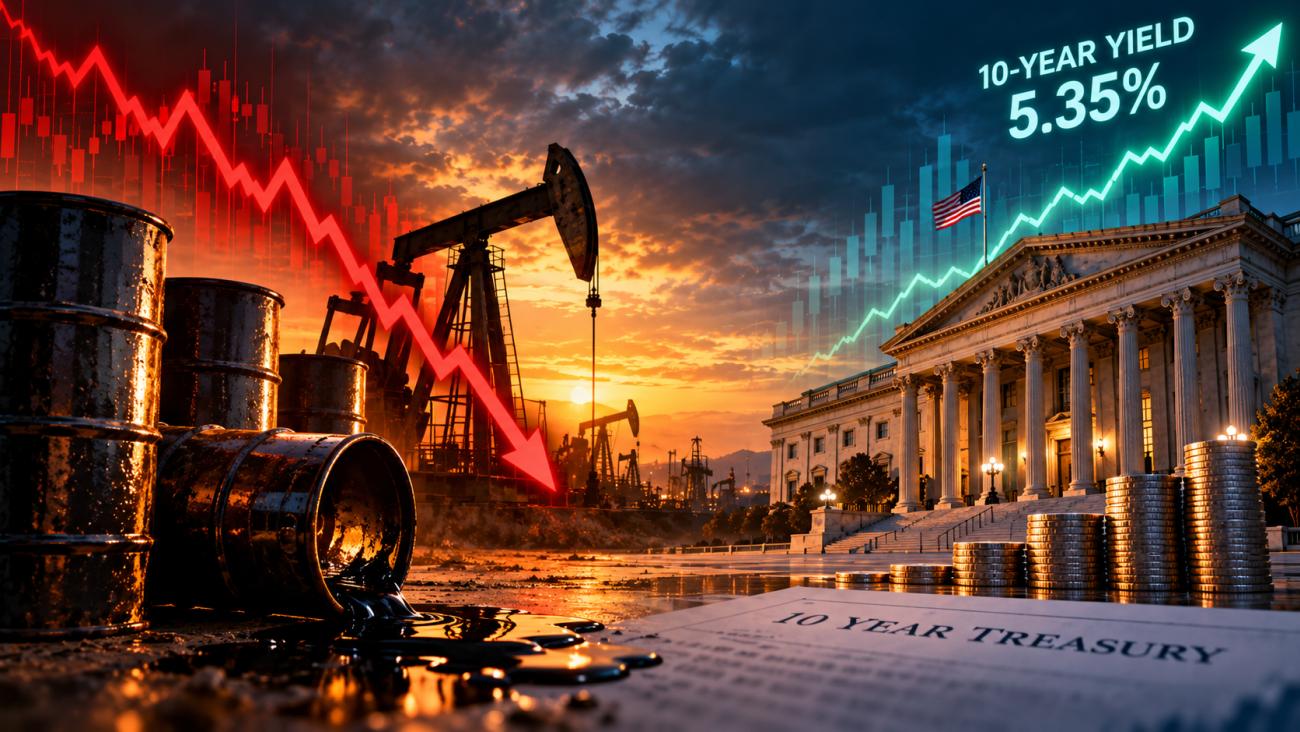
For most of this year the bond market has followed a simple rule: when oil jumps, yields climb. The rule held through the summer, and it held in mid-September, when Brent touched $131 a barrel on September 15 and the 10-year Treasury yield pushed up to about 5%. Then the rule began to fray. Brent has since slid back toward $100, close to a quarter below that spike, yet this week the 10-year reached a 24-year high near 5.35%.
Gareth Soloway of Verified Investing has a tidy explanation, which he laid out in a recent interview with David Lin. Above 5%, he argues, yields slow the economy, a slower economy burns less oil, and so the bond market no longer needs crude to push it higher. It is an appealing story, and part of it is true. But the data suggest oil demand is falling for a different reason, and that the divergence has a more ordinary cause.
On the way up, oil and yields moved together. In mid-September, analysts attributed the push toward 5% partly to elevated oil prices and the inflation risk they carry. On the way down, the link weakened but did not disappear. On October 2 the 10-year fell to 5.23% as oil retreated on reports that European countries were discussing reserve releases. On October 7 it climbed back to 5.32% as oil resumed its rise, then eased to 5.28% when crude swung lower during the session. By Friday it was hovering near 5.23% after oil eased on comments from President Trump about talks with Iran.
So oil still decides the mood of a given day. What has changed is the baseline. Crude is down by nearly a quarter from its September peak, while the 10-year now sits more than 30 basis points above where it stood at that peak. Oil is still the switch that flips sentiment. It no longer sets the level.
Soloway is right that higher borrowing costs are leaving marks, and the clearest evidence is in housing. In the week ending October 2, the Mortgage Bankers Association reported that the average 30-year fixed rate rose to 7.49% from 7.3% a week earlier, that refinancing applications were down 56% from a year ago and at their lowest since 2025, and that purchase applications were 15% lower than a year earlier. That is the yield channel working in plain sight.
[Also Read: Paper Oil vs Real Oil]
Oil demand is softening too. The Energy Information Administration’s October outlook has world liquid fuels consumption averaging 102.4 million barrels a day in 2026, down from 104.4 million in 2025, a drop of nearly 2 million barrels a day. US consumption is forecast to edge down to 20.6 million from 20.7 million. If you wanted proof that demand is weakening, there it is.
The trouble with crediting yields is the timing and the price tag. The same EIA report shows Brent averaging $114 in September, with the 2026 average forecast at $96 against $69 last year. US retail diesel averaged $6.29 a gallon in September, and the AAA national diesel average hit a record $6.52 on September 22. Households and businesses cut back when fuel costs roughly 40% more than it did a year ago and sometimes cannot be found at any price.
The EIA data also show global consumption already running roughly 4% below the prior year in the second quarter, when the 10-year yield was still well below 5%. The agency estimates that crude production shut-ins averaged 4.8 million barrels a day in September, down from a peak of 10.9 million in May. Demand fell first because fuel became scarce and expensive. Higher yields may deepen that slowdown from here, but the causal arrow starts with oil, not with the bond market.
If demand is not the main reason crude has eased, supply and policy are. Kpler data show that non-Iranian crude from the Gulf and Iraq flowed through the Strait of Hormuz at an average of 13.5 million barrels a day between September 22 and 28, a pace described as comparable to pre-war levels. The Saudi port of Yanbu shipped 9.5 million barrels in a single day, its highest since the conflict began. According to ING, flows on Saudi Arabia’s East-West pipeline have recovered to more than 80% of capacity, Riyadh cut its November crude price to Asia by $3 a barrel, and speculators trimmed their Brent bets to the smallest net long since early August.
Then came policy. On October 2 the G7 announced it would release up to 100 million barrels from strategic reserves over four months, with a large share of diesel front-loaded into the first 20 days. Spread over roughly 120 days, that works out to about 0.8 million barrels a day, only around a sixth of the 4.8 million still shut in. It helps at the margin without solving the shortage. Headline futures can also mislead about how tight physical barrels really are, a gap we explored in Paper Oil vs Real Oil.
The official forecast is not convinced the dip lasts. The EIA expects Brent to average $105 in the fourth quarter, $14 higher than its previous estimate, before falling to $84 next year. Its model was finalized on October 1, before the G7 announcement, so some relief may be missing from the numbers. Even so, Soloway’s target of $78 crude by early November would sit a long way below that outlook and would assume the Strait keeps reopening without incident.
If tight money were already suffocating the real economy, diesel is where you would expect weakness to show early, because trucking, farming and construction all run on it. Instead, US diesel inventories hit a record low of 107.9 million barrels on September 11, and the EIA still expects retail diesel above $6 a gallon through October, with East Coast distillate stocks running about a third below their five-year average. ING notes that the gasoil crack spread has narrowed from roughly $85 a barrel to about $70 since the G7 deal, which is welcome but still far from normal.
That is a physical shortage, not a demand collapse. Readers who want the supply-side view in more depth can start with Diesel’s Real Hedge Isn’t in a Reserve Tank.
If oil is not the dial, something else is. The most obvious candidate is the Fed. The central bank unanimously raised rates to 3.75% to 4% in September, and the minutes show that most participants judged another increase likely by year end. Officials said inflation risks were tilted to the upside, that the AI investment buildout continues to surprise on the high side, and that staff do not see inflation returning to 2% until 2029. Some participants worried that five years above target could start to change how workers and firms set wages and prices.
Markets have taken the message on board. After this week’s minutes and comments from Governor Waller, traders were pricing roughly an 82% chance of no move this month but about an 81% chance of a hike in December. With the 10-year around 5.25%, the long end sits more than a full percentage point above the top of the policy range. That gap reflects more than oil. It prices persistent inflation, strong growth, widening deficits and heavy corporate borrowing, all of which analysts cite as pressures on long yields.
Crucially, this is not a buyer strike. This week’s 10-year auction stopped through its pre-auction level, and the 30-year sale was well received. Investors are willing to own duration. They simply want a higher price for it. For a related look at how energy shocks feed into the Fed’s reaction, see Iran’s Straits Taylor Rule: A Joke With a Serious Punchline for Bond Investors.
Three tests will show which story is closer to the truth.
First, watch what happens if Brent falls decisively below $90 while the 10-year stays above 5.2%. That would confirm the oil link has weakened and that the Fed and the term premium now call the tune.
Second, watch demand. If crude hovers near $100 while mortgage applications and the EIA’s consumption estimates keep sliding, the damage is coming from the price of energy, and rising yields are an amplifier rather than a cause.
Third, watch policy. The next FOMC meeting is on October 27 and 28, and next week’s inflation report arrives before it. A softer reading would give the committee room to pause. A hot one would make a December hike look even more likely, whatever oil is doing.
Soloway is right that something has changed. The mistake is to assume that cheaper crude will rescue bondholders. Oil can still flip the switch on a given morning, but the dial that sets the level of yields is now held by the central bank and by investors demanding to be paid for inflation risk. Anyone waiting for falling oil to bring yields back to 4% may be waiting for the wrong signal.