Physical Address
304 North Cardinal St.
Dorchester Center, MA 02124
Physical Address
304 North Cardinal St.
Dorchester Center, MA 02124

Last month we asked whether the AI bubble debate was missing the point on both sides. That article was about price: concentration, circular financing, and the gap between valuations and cash flows. The weeks since have handed the market something more fundamental to chew on. A set of leaked, audited financials
Last month we asked whether the AI bubble debate was missing the point on both sides. That article was about price: concentration, circular financing, and the gap between valuations and cash flows. The weeks since have handed the market something more fundamental to chew on. A set of leaked, audited financials, a formal new financing scheme from Nvidia, and a risk disclosure buried in Oracle’s annual report together point at a problem that sits underneath every valuation argument. The problem is not what investors are paying for AI. The problem is what AI companies earn, or fail to earn, every single time a customer uses the product.
Traditional software carries an economic property that no other industry has ever matched. The cost of building the product is enormous and paid once. The cost of selling the next copy is close to zero. A spreadsheet application developed two decades ago can be licensed to a millionth customer without the vendor spending anything meaningful to serve them. Revenue climbs while costs stay flat, and the widening space between those two lines is pure margin. That single property explains why software companies came to dominate the list of the most valuable businesses on the planet, and why equity investors spent thirty years being trained to pay premium multiples for anything that resembled it.
Generative AI looks like software. It ships through a browser, it bills through a subscription, it lives in a data center. But it does not behave like software where it counts. Every query a user sends to a large language model consumes electricity, occupies expensive accelerator hardware, and physically degrades silicon that must eventually be replaced. The marginal cost of serving the next customer is not zero. It is a real, recurring, per-use expense that scales roughly in line with usage. The closer analogy is a restaurant, where every plate served requires ingredients to be bought again. Except this particular restaurant loses money on every meal, and its stated recovery plan is to serve dramatically more meals.
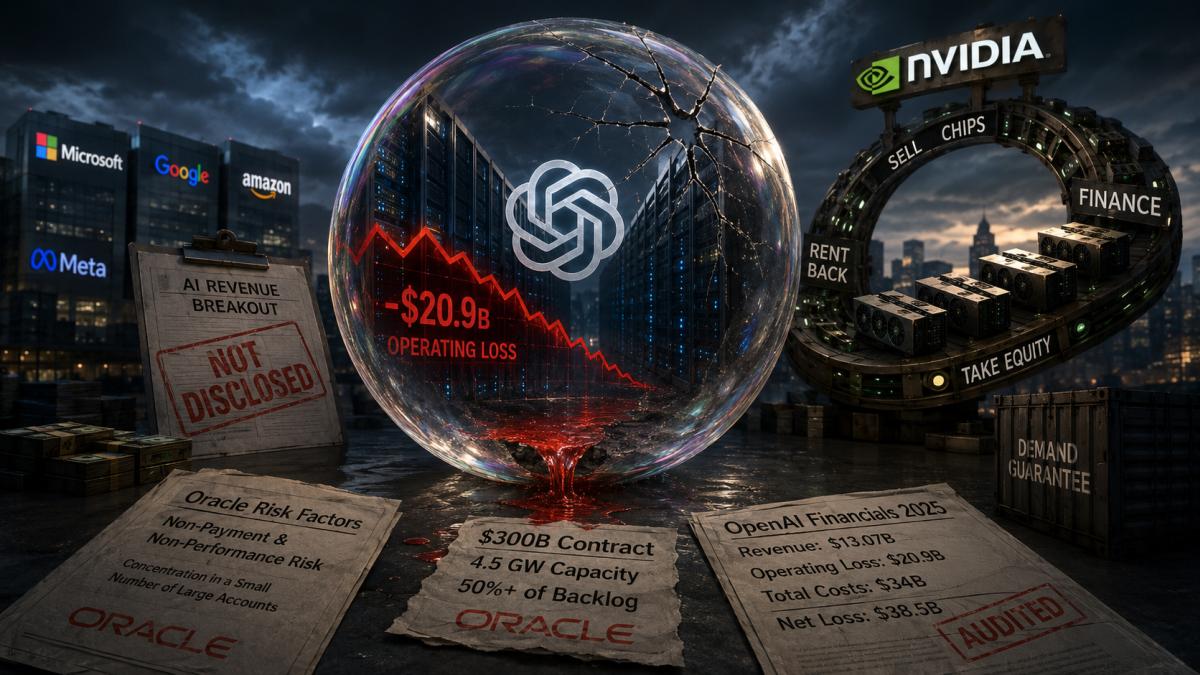
For years this was a theoretical objection. In June it acquired audited numbers. Financial documents obtained by journalist Ed Zitron and independently verified by the Financial Times showed that OpenAI recorded a $20.9 billion operating loss in 2025, on revenue of $13.07 billion against total costs of $34 billion. The headline net loss attributable to the company reached $38.5 billion, inflated by a large non-cash charge tied to its conversion to a for-profit structure, but the operating figure is the one that matters for the business model question. It more than doubled from roughly $8.8 billion the year before, even as revenue tripled.
Defenders point out that the ratio improved. Fortune’s read of the leaked statements notes the company spent $1.60 for every dollar of revenue in 2025, down from $2.37 in 2024. That is progress of a kind. It is also a very long way from the economics that justify software multiples. A conventional software firm at this revenue scale would be printing gross margins north of 80 percent. OpenAI paid $17.2 billion to Microsoft alone during the year, largely for the compute that trains and serves its models. When your single largest expense line is the cost of running the product for the customers you already have, more customers do not automatically mean more profit. They can simply mean more cost.
The pattern is not unique to one company. Every frontier lab shows the same signature: each new model generation costs more to train and more to serve than the one before it. The industry keeps promising that specialized silicon and the next hardware cycle will bend the cost curve. So far the curve has not bent, and the market has started pricing the doubt.
Nothing captured that doubt more cleanly than what happened to the most anticipated listing in market history. OpenAI filed confidentially with the SEC in early June, with a debut originally sketched for late 2026 at a valuation of up to $1 trillion. Within three weeks, advisers were presenting management with an uncomfortable choice, and the company began leaning toward pushing the listing into 2027 rather than accept a lower number. The chief executive reportedly treated any reduction of the trillion-dollar target as out of the question, while the chief financial officer argued internally for the delay, pointing to roughly $600 billion in infrastructure commitments stretching to 2030 and the burden of public reporting on a compressed timeline.
The context made the hesitation easy to read. SpaceX’s June debut had surged and then given back roughly 30 percent from its peak within two weeks, a live demonstration that public-market appetite for richly priced technology stories has limits. A company confident in its unit economics does not fear an S-1 becoming public. A company losing twenty billion dollars a year on operations has every reason to wait for a friendlier mood.
While the demand side wobbled, the supply side quietly formalized something remarkable. In early July, Nvidia unveiled a financing vehicle under which it acts as a financial backstop for its neocloud customers, agreeing to rent back unused GPUs at a fixed rate in exchange for a share of the cloud revenue those chips generate. The arrangement makes explicit what had been assembled piecemeal through earlier deals, including a multibillion-dollar capacity backstop for CoreWeave and demand guarantees that helped smaller operators raise debt against GPU collateral.
Sit with the structure for a moment. The chipmaker sells hardware to a customer, helps that customer borrow the money to pay for it, takes equity in the customer, and then commits to renting the hardware back if end demand fails to materialize. Every leg of that loop gets reported as revenue and as demand. Analysts tracking the sector have documented how the financing relationships between Nvidia and the largest neoclouds are anything but arm’s-length, with hyperscaler commitments to these firms running at an order of magnitude above their current revenues. An industry with deep, diverse, organic end demand does not need its dominant supplier to underwrite its customers’ utilization risk. This is what it looks like when the seller starts manufacturing its own buyers.
Our June article treated Oracle as the cautionary tale of the cycle, and the company has since confirmed the thesis in its own filings. The fiscal 2026 annual report warns, in unusually plain language, that some customers may be highly leveraged and that Oracle faces genuine non-payment and non-performance risk concentrated in a small number of large accounts. The account everyone understands it to mean is OpenAI, whose five-year, $300 billion cloud agreement requires Oracle to stand up roughly 4.5 gigawatts of capacity and underpins more than half of the company’s $638 billion contracted backlog, according to Bank of America analysis of the earnings picture. Oracle burned through $23.7 billion of negative free cash flow over the trailing year building data centers for a counterparty that has never earned a profit. The stock lost a quarter of its value in the first half of 2026. Equity investors are no longer waiting for the credit market to warn them. The company is doing it directly, in its own risk factors.
Which brings us to the giants funding the bulk of the buildout. Microsoft, Alphabet, Amazon, and Meta will spend a combined sum in the hundreds of billions on AI infrastructure this year, with Microsoft alone guiding to roughly $190 billion in capital investment. These are companies that disclose everything. Cloud revenue, advertising revenue, subscription revenue, segment margins, backlog. Yet not one of them reports a clean AI revenue line. Microsoft folds Azure AI into a broader cloud figure without a dollar breakout. Meta describes AI benefits as embedded in its advertising engine. Growth in the legacy businesses gets conflated, quarter after quarter, with returns on the AI spend, and the market is invited to assume the two are the same thing.
Public companies volunteer good news. That is close to a law of nature. When four of the most sophisticated disclosure machines on earth all decline to isolate the revenue attached to their largest capital program in history, the most parsimonious explanation is that the number, shown on its own, would not support the spending. Patience with that arrangement rests on one final assumption: that whenever the profits do arrive, American firms will collect them because the world has nowhere else to go. Chinese labs releasing open-weight models at a fraction of the serving cost are the direct challenge to that assumption, and they deserve an article of their own.
The bubble question asked whether prices were too high. The business model question is harder. It asks whether the thing being priced works at all. Until someone demonstrates a frontier AI business where the next customer costs less than they pay, the honest answer remains: not yet proven.