Physical Address
304 North Cardinal St.
Dorchester Center, MA 02124
Physical Address
304 North Cardinal St.
Dorchester Center, MA 02124

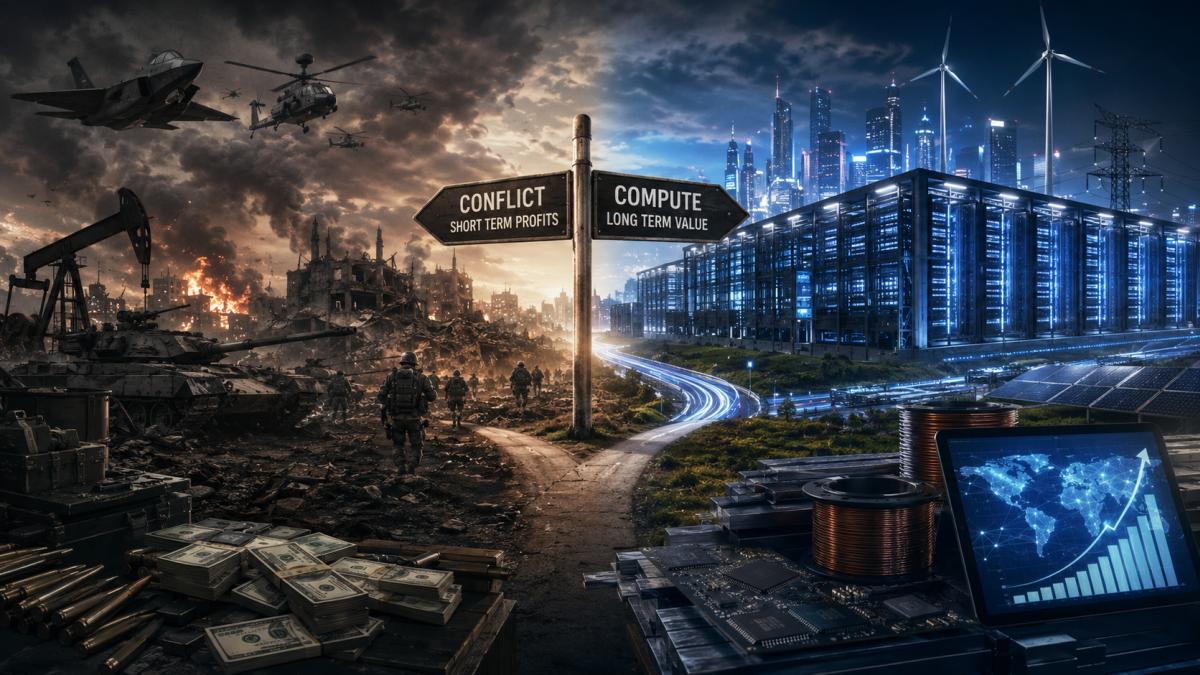
For most of the last eighty years, the single most reliable business model on the planet was conflict. Wars created demand for weapons, justified ever-larger defence budgets, and turned every flattened city into a reconstruction contract. The product was instability itself, and it never ran short of customers. That model is now showing...
For most of the last eighty years, the single most reliable business model on the planet was conflict. Wars created demand for weapons, justified ever-larger defence budgets, and turned every flattened city into a reconstruction contract. The product was instability itself, and it never ran short of customers. That model is now showing signs of strain, and the reason has almost nothing to do with morality and almost everything to do with where the next pool of trillion-dollar returns is being built.
The new money is going into compute. Cloud providers are on track to spend roughly $600 billion on AI infrastructure in 2026 alone, double their 2024 outlay. That is not an incremental upgrade to an existing industry. It is a phase change in where the largest concentrations of capital expect to compound over the next thirty years. And it creates a problem that the people moving that money are only beginning to talk about openly: the asset they are building cannot tolerate the conditions that the old model required to function.
A data centre is not a tank. A tank thrives on chaos. A data centre needs the precise opposite of chaos. It needs uninterrupted grid power, functioning supply chains, open shipping lanes, and stable energy markets. You cannot pour hundreds of billions into long-lived physical infrastructure in a region that might be on fire when the project finishes. The construction timelines alone make instability an existential threat to the investment thesis.
This is the central tension worth watching in markets right now. The war economy and the compute economy are factions of the same capital machine, and they want structurally incompatible environments. One needs the world unsettled enough that defence demand never lapses. The other needs the world calm enough that twenty-year infrastructure bets pay off. When two parts of the same system pull in opposite directions, the friction shows up as policy whiplash, sudden shifts in media narrative, and the kind of geopolitical reversals that look irrational until you map them onto the underlying money.
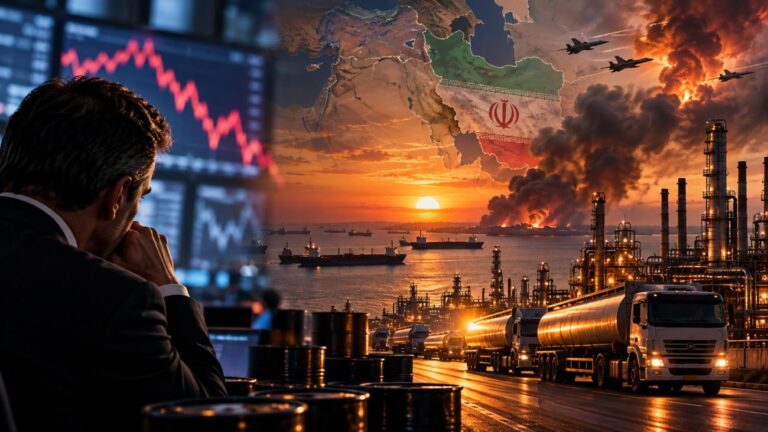
The clearest illustration of the conflict is playing out around the world’s most important oil chokepoint. Since late February, traffic through the Strait of Hormuz has been largely blocked following the outbreak of war between Iran and the US-Israel coalition, choking off a waterway that normally carries around a fifth of global oil supply. The International Energy Agency described it as the largest supply disruption in the history of the oil market.
What followed is instructive for anyone trying to read where the leverage actually sits. Even after a ceasefire was reached in April, shipping stayed far below pre-war levels, and a memorandum of understanding was signed in mid-June intended to formally end the conflict within sixty days. The agreement repeatedly wobbled on the question of whether energy would flow freely again. Iran does not need to win a conventional military exchange to hold enormous bargaining power. It controls the geography, and the threat of a closed strait is enough to put the entire global economy on edge. Iranian forces even struck several Amazon and Oracle data centres in the Gulf during the war, then declared eighteen major technology firms legitimate military targets, an unmistakable signal that the new infrastructure is now treated as an extension of national power.
That detail matters more than it first appears. When a regional adversary starts targeting server farms rather than just refineries, it confirms that the centre of strategic gravity has already begun to move. The thing worth defending is no longer only the oil. It is increasingly the compute.
It helps to stop thinking of this as nations versus nations and start thinking of it as capital factions deciding which future to underwrite. On one side sits the established war economy: defence contractors, the weapons lobby, and the donor networks built around perpetual military engagement. On the other sits a coalition with far deeper pockets and a longer time horizon. Gulf sovereign wealth funds need somewhere to deploy trillions. The Western financial system can package anything stable into bonds, loans, and infrastructure yield. And the technology investors who bankrolled the current administration want to build out data centres, chips, energy, and surveillance systems.
The federal spending data shows where the gravity is pulling. The US Defense Department’s potential AI contract value rose more than 1,600 percent between 2024 and 2026 to over $90 billion, which now represents close to ninety-nine percent of all federal AI spending. The war budget is not disappearing. It is being quietly rerouted into the digital build-out, with the same contractors and the same agencies increasingly betting on compute rather than conventional hardware. The military-industrial complex and the AI build-out are converging into a single industrial base that draws on the same copper, the same kilowatts, and the same strained supply of critical materials that markets, left alone, do not allocate toward military readiness.
Every capital rotation needs a political vehicle, and the technology faction has an obvious candidate. JD Vance’s career was effectively launched by a single backer: Peter Thiel donated a record $15 million to Vance’s 2022 Senate campaign, the largest single gift to a Senate candidate on record, after employing him and introducing him to Trump’s orbit. Vance is the clearest political embodiment of the technology sector currently sitting inside the executive branch, and his positioning heading toward 2028 lines up neatly with a system that wants to distance its next standard-bearer from the forever-war model and attach him to the build-out instead.
None of this requires a conspiracy. It only requires following incentives. When a system’s most profitable product is changing, its narratives, its public faces, and its alliances change to match. The coordinated shift in tone toward longtime strategic partners, the sudden willingness of establishment figures to criticise positions that were untouchable a year ago, and the elevation of technology-aligned politicians are all consistent with one underlying movement: money rotating out of conflict and into compute.
The contrarian read here is that the headlines about war are increasingly a lagging indicator. The forward-looking signal is the capital expenditure. War as a service is being replaced by infrastructure and AI as a service, because ownership and rebuilding now generate far better returns than destruction does. You can only bomb a port once. If you finance it, insure the ships, control the payment rails, run the data centres, and collect interest for three decades, the economics are simply superior.
For investors, the implication is to weight exposure toward the parts of the system that benefit from stability rather than chaos: energy infrastructure, the power grid build-out, compute and the materials that feed it, and the financial plumbing that turns all of it into yield. The old model will keep generating noise, and that noise will keep producing volatility worth trading around. But the durable trend is the rotation itself. The smart money is no longer betting on the world staying on fire. It is betting on the grid that needs the fire put out.