Physical Address
304 North Cardinal St.
Dorchester Center, MA 02124
Physical Address
304 North Cardinal St.
Dorchester Center, MA 02124

On 5 May 2026, sitting on stage at the Milken Institute Global Conference in Beverly Hills, right next to Michael Milken himself, BlackRock CEO Larry Fink stopped talking about Gulf state markets long enough to say something his audience was not expecting to hear in plain language. He was discussing the new wave of one gigawatt data centers, the kind that cost $50 billion to $75 billion to build. He noted that drone warfare had changed how the industry had to think about physical security in the Gulf Cooperation Council region. And then he kept going. "Right now we're looking at it internationally," he said, "but you know, one of my concerns is could it be a domestic terrorism using a $3,000 drone?"
On 5 May 2026, sitting on stage at the Milken Institute Global Conference in Beverly Hills, right next to Michael Milken himself, BlackRock CEO Larry Fink stopped talking about Gulf state markets long enough to say something his audience was not expecting to hear in plain language.
He was discussing the new wave of one gigawatt data centers, the kind that cost $50 billion to $75 billion to build. He noted that drone warfare had changed how the industry had to think about physical security in the Gulf Cooperation Council region. And then he kept going.
“Right now we’re looking at it internationally,” he said, “but you know, one of my concerns is could it be a domestic terrorism using a $3,000 drone?”
He was not asked about Iran. He was not asked about Hezbollah. He was not asked about foreign state actors. He named the threat he is actually worried about, and it was American citizens with hobby grade hardware.
That is the tell. The most powerful asset manager on the planet, more than $11 trillion in assets under management, co-chairman of the World Economic Forum, sat down at Milken’s own conference and admitted on the record that his nightmare scenario is not a foreign adversary. It is his customers’ neighbours.
Tucker Carlson, in commentary that subsequently went viral via the Jimmy Dore Show, made an observation that the boardroom analysts missed entirely. The United States has had electrical infrastructure for more than a hundred years. There are over 11,000 power plants spread across the country. People do not bomb them.
So why would data centers be different?
The answer Fink could not say in front of Milken’s audience is that data centers are not infrastructure in the way power plants are. A power plant distributes electricity to everyone connected to the grid. A data center concentrates advantage. It is the physical location where the AI surveillance capacity, the trading edge, the risk analytics, and the productivity capture of the next economic cycle physically reside. It returns very little to the community it sits in. It draws enormous volumes of water and power out of regional grids that residents now find priced out of reach.
A power plant is shared infrastructure. A data center is somebody else’s extraction site, sitting inside your county lines, paying lower property tax than your house, hiring almost nobody, and pricing your water and power up the curve.
That is a different category. Fink knows it. The room knew it. The cameras caught him saying so out loud.
This is the part the consensus capex models do not flag. The opposition Fink is reading is not internet noise. It has receipts, and the receipts are stacking up faster than the build pipeline can absorb them.
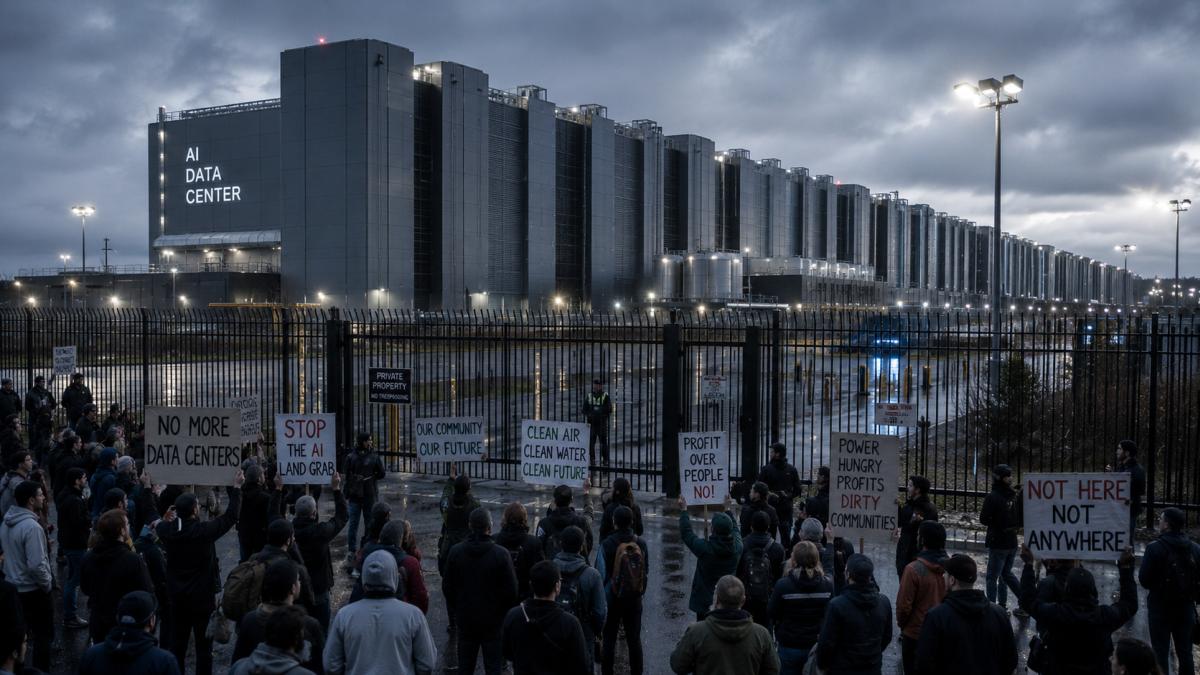
According to a recent analysis by Robert Bryce, US communities blocked or restricted more than 70 data center projects in just the first four months of 2026, already eclipsing the total for all of 2025. That is a rejection rate accelerating into the right side of the chart, not flattening.
Per Data Center Watch, the cumulative dollar value of data center projects blocked or delayed across the United States already exceeds $64 billion, with documented cancellations including Tract’s $14 billion plan in Goodyear and Buckeye, Arizona, Diode Ventures’ $1.5 billion proposal in Peculiar, Missouri, and Provident Realty Advisors’ $1.3 billion site in Chesterton, Indiana. Each one of these was a project the consensus capex modelling did not flag as at risk.
In Pennsylvania, where more than fifty data centers are queued for permitting, grassroots groups have organised across party lines in opposition that veterans of the anti fracking fights are calling unprecedented in its breadth. State lawmakers from both major parties are now drafting moratorium legislation.
At the national level, more than 230 state and local groups signed a December 2025 letter to Congress demanding a federal moratorium on data center construction, citing the same triad of grievances every time: power bills, water draws, and the absence of any meaningful local economic return.
The opposition is not red. It is not blue. It is not coastal elite. It is people who turned on their tap and found the pressure was lower. It is people who opened their power bill and the number was higher than the month before. It is people who watched the only growing employer in their region replace ten workers with two engineers and a Slack channel.
That is the population Fink is afraid of. He named them in Beverly Hills. He just used the wrong noun.
The other half of the picture is concentration, and Fink is the architect.
The AI Infrastructure Partnership, formed in September 2024 by BlackRock, its infrastructure arm Global Infrastructure Partners, Microsoft, Nvidia, and the Abu Dhabi backed MGX fund, has since added xAI, the Kuwait Investment Authority, and Temasek. In October 2025 the coalition closed its first acquisition, paying $40 billion for Aligned Data Centers, one of the largest data center transactions ever recorded.
Look at who sits around that table. Three sovereign wealth funds. Two of the most valuable listed companies in the world. The world’s largest passive asset manager. One privately held AI lab founded by the wealthiest individual on the planet. The capital is concentrated. The siting is concentrated, with Virginia, Texas, Arizona, and Pennsylvania bearing most of the new build. The political risk surface, accordingly, is also concentrated.
A $3,000 consumer quadcopter is not more dangerous than it was three years ago. The target has just become enormously more legible, sitting in more politically isolated locations, owned by a more identifiable handful of names. Fink and his coalition partners have, through their own success, manufactured the asymmetry he is now describing as a security crisis.
The asymmetry is not theoretical. In March 2026, drone and missile strikes during the Iran conflict hit AI data centers in the United Arab Emirates and Bahrain, disrupting cloud infrastructure and knocking critical digital services offline. American hyperscalers’ Gulf positioning, sold to investors as politically anchored by US security guarantees, took a verifiable physical hit on the front page of every wire service in the world.
That is the international template Fink referenced before pivoting to the domestic question. He has the data. The asymmetry between attacker cost and asset value is now the most extreme in modern infrastructure history. A few thousand dollars of consumer hardware can degrade an asset class measured in tens of billions. And every defending operator is now permanently aware of it.
The structural hedge was put in place a year before the Milken comments. In July 2025, President Trump signed Executive Order 14318, redesignating commercial data centers as “military installations” within the national security perimeter. The legal mechanics matter. An attack on one now triggers federal terrorism statutes and Department of Defense involvement, not state level vandalism or trespass charges.
That converts physical site protection into an implicit public subsidy. The asset stays private. The cash flows stay private. The protection cost gets socialised across the federal taxpayer base, with all the surveillance, prosecution, and force projection apparatus that brings to bear. Fink’s Milken comment is the public facing edge of a positioning that was finalised twelve months earlier.
If that read sounds cynical, the framing is not the contrarian’s invention. It is on the public record. The executive order is published. The deal coalition is named in BlackRock’s own press releases. The numbers on community opposition are tracked in real time. The casual observer can connect the dots without any conspiracy.
For the portfolio reader, the implications are not subtle.
Permitting risk is now a real line item. Consensus AI infrastructure capex guidance for 2026 and 2027 was built on extrapolated approval rates that the 2025 to 2026 rejection sequence does not support. Watch for quiet revisions in second half 2026 earnings calls, particularly from Microsoft, Meta, and Alphabet on their data center pipeline footnotes. The first hyperscaler that lowers a build guide and points to local opposition as the cause will mark the inflection.
Insurance is the second underpriced exposure. Property and casualty coverage for data center facilities was historically quiet, low loss line business. It is now exposed to a domestic terrorism risk with no actuarial history and no precedent loss curve. Reinsurers will move first. Specialty lines will follow. The premium increase will land in operating expense lines that hyperscalers have, until now, taken entirely for granted.
Counter drone names are the obvious long. The category is small in pure play public market terms but large inside the order books of the defence primes. The interesting question is which previously sleepy security integrator gets repriced when the first credible domestic incident clears a news cycle.
Water rich and power rich jurisdictions outside the consensus build zones will see scarcity premiums widen. Site selection has been a back of the envelope exercise for a decade. It is about to become a competitive moat. Watch the smaller regional data center REITs that already hold approved sites in friendly counties.
And the AIP coalition itself bears watching. If the long side is hedging quietly, it will show up first in inventory disclosure and pipeline guidance footnotes, not in the press release. Read the quarterlies carefully.
Strip away the politics. Strip away the populism. Strip away the Tucker Carlson amplification, the Jimmy Dore framing, the substack chorus. What is left is one of the most influential capital allocators in history, sitting next to the man whose name is on the conference, telling a room full of people who can actually move money that he is scared of the citizens whose communities his portfolio is reshaping.
Fink does not tell on a trade unless he is already on the other side of the position. That has been the entire career. The Milken comment was not an off the cuff worry. It was the visible part of a hedge.
The contrarian question is not whether somebody will fly a drone into an Aligned facility this year. The contrarian question is what it means that the smartest long in the room felt compelled to say it out loud, on the record, at the conference his rival hosts.
When Fink confesses, listen carefully to who he is confessing to. It is never the public. It is always the next allocator down the table.