Physical Address
304 North Cardinal St.
Dorchester Center, MA 02124
Physical Address
304 North Cardinal St.
Dorchester Center, MA 02124

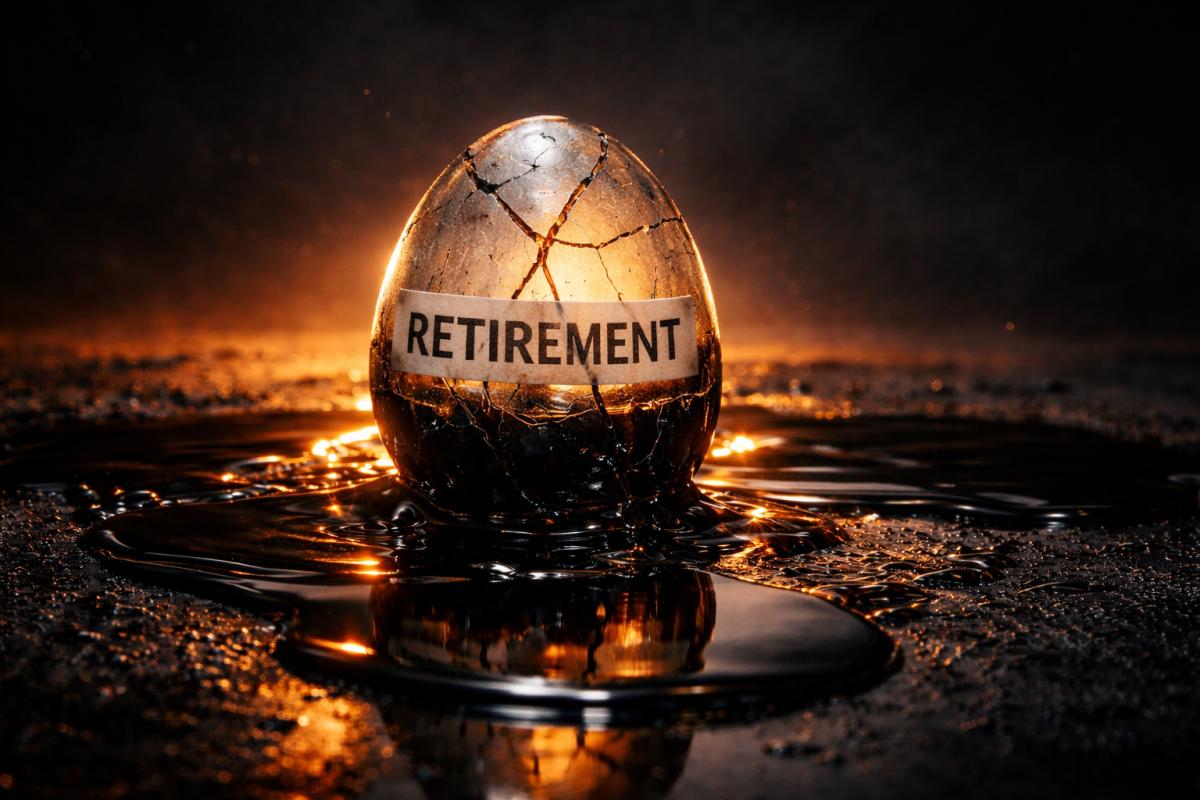
Most people treat Middle East conflict as background noise. A tragic headline that scrolls past between sports scores and stock tickers. Something geopolitically significant, but practically distant from the real business of managing a retirement portfolio, keeping up with inflation, and making sure your income lasts longer than you do. That assumption is exactly what gets retirees into trouble.
Most people treat Middle East conflict as background noise. A tragic headline that scrolls past between sports scores and stock tickers. Something geopolitically significant, but practically distant from the real business of managing a retirement portfolio, keeping up with inflation, and making sure your income lasts longer than you do.
That assumption is exactly what gets retirees into trouble.
The current conflict involving Iran has already stopped being a foreign policy story and started being a financial one. Brent crude surged sharply as fighting widened and markets began pricing in the risk of a sustained disruption to the Strait of Hormuz, the narrow waterway through which approximately one-fifth of global oil and gas trade normally flows. When that chokepoint comes under threat, the effects do not stay in the Persian Gulf. They travel through energy prices, inflation, interest rate expectations, currency markets and eventually your retirement account.
The war in Iran is not distant news. For retirees and pre-retirees, it has become a direct planning problem.
The first thing to understand is that oil is not simply the cost of filling up your car. It is an input price that runs through almost every sector of the economy. When crude rises sharply, the costs of transport, logistics, food distribution, manufacturing and travel all move in the same direction, eventually.
This is why an oil shock creates a specific threat to retirement income that goes beyond what most investors initially expect. The higher fuel price is just the opening act. What follows is a broader, slower erosion of purchasing power across dozens of categories of spending.
BlackRock’s Larry Fink warned in early 2026 that oil sustained at $150 per barrel could trigger a global recession. Barclays estimated that a prolonged Strait of Hormuz closure could remove 13 to 14 million barrels per day from global supply. These are not figures to trade on recklessly, but they define the outer edge of the risk range that retirement plans now have to be stress-tested against.
If you are drawing income in retirement, you are not just managing your portfolio. You are managing your purchasing power against an inflation environment that an oil shock can rewrite very quickly.
Most retirees do not blow up their plans through one dramatic mistake. They get hurt by quieter forces.
An oil shock works like this: fuel costs rise first. Then food distribution costs follow. Then travel, logistics, goods and services gradually become more expensive across the board. A retiree who was comfortably living within their income six months ago may find that same income now buys measurably less. The shortfall feels small at first. Then it compounds.
If the response to that shortfall is to draw more aggressively from a retirement account during a period of elevated market volatility, the long-term damage can far exceed what the original oil headline suggested. The spending need rises at exactly the moment the portfolio is under pressure. That combination is where real retirement plans break down.
This is what financial planners sometimes call the sequence of returns problem, and it is one of the most underappreciated risks in retirement finance.
For someone still in the accumulation phase, a volatile year is uncomfortable but recoverable. You keep contributing, prices are lower, and time does the healing work. For someone already retired and drawing down, the arithmetic is completely different.
Research published by the Journal of Financial Planning has consistently shown that negative or volatile returns in the early years of retirement, while withdrawals are ongoing, can cause lasting damage that a later recovery cannot fully repair. The withdrawals lock in the losses. The portfolio never gets the full benefit of the rebound because it is smaller than it should have been when the rebound arrives.
The Iran conflict has already contributed to sharp repricing across energy markets, currencies and broader risk assets. That is meaningful for anyone in or near retirement who is drawing income from a portfolio that is simultaneously absorbing those fluctuations. A higher drawdown rate, combined with higher inflation, combined with an unstable market, is exactly the sequence that accelerates long-term decline in a retirement portfolio.
This is not a theoretical risk. It is the current environment.
Every time geopolitical tension rises, the same question floods financial media: where is the safe haven?
The honest answer, in a complex modern conflict with global supply chain implications, is that traditional safe havens do not always behave as expected. Gold has historically benefited from uncertainty, and that relationship has held to some extent in the current environment. But liquidity across some asset classes has deteriorated, forced selling has created unusual dislocations, and assets that normally provide refuge have at times moved in unexpected directions.
Chasing the latest safe haven trade is rarely the right answer for retirees. The right answer is to have built a retirement structure that did not require calm conditions to function.
As Howard Marks of Oaktree Capital has long argued, the job of serious investors is not to predict what will happen next. It is to position portfolios so that a wide range of outcomes, including the uncomfortable ones, can be survived without catastrophic damage. That principle applies with even greater force in retirement, when the margin for error is narrower and the ability to recover from large losses is structurally limited.
The Iran conflict is a useful forcing function for an honest review of retirement positioning. Not a reason to panic, and not a reason to make dramatic tactical changes, but a genuine prompt to ask some harder questions about whether the current plan was built for the world that actually exists.
The right questions are not about the next oil price move. They are about structure and resilience.
Is your current income level sustainable if inflation runs hotter for longer than expected? Are you drawing too aggressively from growth assets in a volatile period? Do you hold enough in liquid, lower-volatility reserves to avoid being forced to sell at the wrong time? If conditions deteriorate significantly over the next twelve months, does your plan have enough flexibility to absorb that without permanent damage?
We covered the broader strategic framing of this in an earlier piece: With Oil Fields Burning Across the Middle East, Is Now the Time to Rethink Your Retirement Portfolio? The core argument there still holds. Geopolitical shocks of this nature do not resolve quickly, and the portfolios that survive them best are not the ones that made the cleverest short-term trade. They are the ones that were already structured for disruption before the disruption arrived.
There is a persistent myth in personal finance that good retirement planning is really about forecasting markets correctly. Get the next recession right, position defensively before the crash, rotate back into equities at the bottom, and retirement security follows.
This is not how retirement planning actually works for the vast majority of people.
Vanguard’s research on retirement income sustainability consistently points to the same conclusions: the variables that actually determine retirement outcomes are not market timing calls. They are drawdown rates, inflation management, spending flexibility, asset allocation discipline over time, and the behavioral capacity to not make panicked decisions during volatile periods.
A geopolitical oil shock like the current Iran conflict does not change that framework. It tests it.
The retirees who come through this period in the best shape will not be those who correctly predicted oil prices. They will be those who already had a diversified income structure, a realistic drawdown rate, sufficient liquidity buffers, and the discipline not to make large portfolio moves based on frightening headlines.
War in Iran may or may not escalate further from its current position. Oil may stabilize or push higher. Markets may recover faster than feared, or the disruption may drag through a significant portion of the year. Certainty is not on offer.
What is already clear is that a conflict thousands of miles away has become a direct retirement planning issue for millions of people who had not factored anything like this into their assumptions six months ago. The inflation pathway, the interest rate pathway, the market volatility pathway, they are all now live.
Good retirement planning was always supposed to account for exactly this kind of disruption. If yours was built on the assumption that conditions would remain reasonably stable, now is the time to find out how much flexibility actually exists in the structure.
The real danger of the Iran war is not only what it does to oil prices. It is what it can do to inflation, spending power, portfolio stability and retirement income discipline over a multi-year period, quietly and without a single dramatic moment that triggers the response it deserves.
The content on MarketMindInvestor.com is for informational and educational purposes only and does not constitute financial advice. Always consult a qualified financial advisor before making investment or retirement planning decisions.