Physical Address
304 North Cardinal St.
Dorchester Center, MA 02124
Physical Address
304 North Cardinal St.
Dorchester Center, MA 02124

The world is watching what looks like an energy crisis unfold. Emergency meetings across Europe and Asia. Oil prices surging past $100 a barrel. Shipping lanes choked off by military conflict. And all of it traces back to one narrow strip of water between Iran and Oman that handles roughly 20% of global petroleum liquids consumption every single day. The Strait of Hormuz is the single most important energy chokepoint on the planet. But the story most people are telling about it is incomplete. Because what is happening in the strait right now is not simply a supply disruption. It is an asymmetric geopolitical event, and understanding who it hurts versus who it helps changes the entire picture.
The world is watching what looks like an energy crisis unfold. Emergency meetings across Europe and Asia. Oil prices surging past $100 a barrel. Shipping lanes choked off by military conflict. And all of it traces back to one narrow strip of water between Iran and Oman that handles roughly 20% of global petroleum liquids consumption every single day.
The Strait of Hormuz is the single most important energy chokepoint on the planet. But the story most people are telling about it is incomplete. Because what is happening in the strait right now is not simply a supply disruption. It is an asymmetric geopolitical event, and understanding who it hurts versus who it helps changes the entire picture.
For decades, the standard playbook looked like this. Instability in the Middle East disrupts oil supply. Oil prices spike. The United States economy takes the hit. Inflation surges, growth stalls, and consumer confidence collapses.
Twenty years ago, that narrative made sense. The United States was importing roughly 60% of its petroleum consumption from foreign sources. Any disruption in global supply rippled directly into American petrol stations, factory floors, and household budgets. The relationship was linear and brutal.
But that version of the world no longer exists. Over the past two decades, the shale revolution transformed American energy production from the ground up. Horizontal drilling and hydraulic fracturing unlocked massive domestic reserves, and output boomed. The United States went from being a net energy importer to becoming the largest oil producer on the planet, pumping approximately 13.6 million barrels per day in 2026. That is more than Saudi Arabia. More than Russia.
The old playbook is dead. And anyone still running it is working with outdated maps.
When Iran effectively closed the Strait of Hormuz in late February 2026 following the outbreak of military conflict with the United States and Israel, the immediate reaction was global panic. The International Energy Agency confirmed that the closure blocked exports equivalent to roughly a fifth of global oil consumption. Brent crude surged above $90 per barrel and kept climbing. The Federal Reserve Bank of Dallas described the event as the largest oil supply disruption driven by geopolitical events since at least the 1970s.
But here is the critical distinction that most analysis glosses over. This shock does not land equally across the global economy.
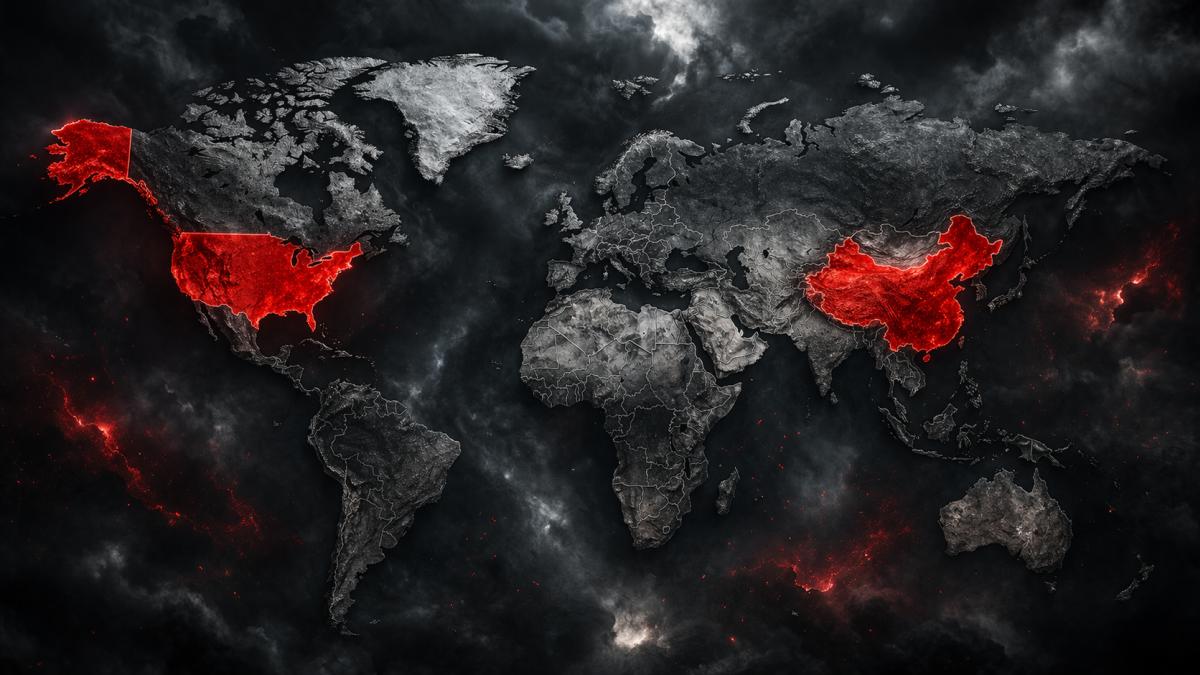
Only about 2.5% of the crude oil flowing through the Strait of Hormuz is destined for the United States. In contrast, Asian markets collectively receive close to 89% of those flows. China alone accounts for nearly 38% of all crude oil and condensate transiting the strait. India takes another 15%. South Korea and Japan together absorb roughly 23%.
So when analysts say a disruption here shocks the global economy, they are technically correct. Oil is priced on a global benchmark, so a supply squeeze anywhere pushes prices up everywhere. But there is a crucial distinction between paying more for energy and not being able to get it at all. For the United States, elevated oil prices squeeze margins and pinch consumers at the pump. It hurts, but the economy keeps functioning. For China, India, Japan, and South Korea, a physical cutoff from their primary crude source is an entirely different category of risk. Manufacturing lines go idle. Electricity grids face rationing decisions. Export capacity contracts. The economic damage is not proportional. It is exponential.
One disruption, many completely different realities.
When supply tightens and prices rise, the economics of energy production shift dramatically. Higher prices generate enormous revenue for producers, exporters, and the companies that operate the infrastructure connecting wells to global markets. And the United States just happens to sit at the centre of all three.
At current production levels, every $1 increase in the per barrel price of oil translates to roughly $13.6 million in additional daily gross revenue for American producers. The EIA revised its WTI forecast upward by $21 per barrel for 2026, representing an annual revenue windfall exceeding $100 billion for the domestic industry. Permian Basin tax revenues alone hit $24.5 billion recently, funding schools, roads, and hospitals across Texas and New Mexico.
But crude oil is only part of the story.
The Strait of Hormuz is not just an oil corridor. It is also a critical artery for liquefied natural gas. Roughly [20% of global LNG trade transits the strait](https://www.iea.org/about/oil-security-and-emergency-response/strait-of-hormuz), almost entirely from Qatar and the United Arab Emirates. Qatar, the world’s second largest LNG exporter, sends the overwhelming majority of its output through this single chokepoint. When Iran declared the strait closed and QatarEnergy halted all LNG production at the Ras Laffan facility in March 2026, it was not a minor disruption. It was a supply shock that the IEA estimated at over 300 million cubic metres per day of lost LNG capacity, more than double the average volume that once flowed through the Nord Stream pipeline.
And once again, the United States is positioned on the right side of this disruption.
Over the past decade, the US has transformed from a negligible LNG player into the world’s largest LNG exporter. Exports surged from 0.5 billion cubic feet per day in 2016 to over 16 billion cubic feet per day in 2026. New facilities like Plaquemines LNG and Golden Pass LNG have come online. The Department of Energy has approved more than 18.6 Bcf/d of export authorisations. And the country is on track to roughly double its LNG export capacity by 2029.
The pattern mirrors what is happening in crude oil. When a major supplier goes offline, the buyers do not simply wait. They scramble for alternatives, and the country with the most spare export capacity captures the premium. That country, in both oil and gas, is the United States.
Most commentary focuses narrowly on crude oil and LNG. But the Strait of Hormuz carries far more than hydrocarbons. The Persian Gulf region accounts for roughly 30% to 35% of global urea exports and 20% to 30% of ammonia shipments. Up to 30% of internationally traded fertilisers normally transit the strait. When those flows stop, the consequences cascade into agriculture, food prices, and the cost of living for billions of people in developing economies.
Petrochemicals, polymers, resins, sulphur, helium, and liquefied petroleum gas are also bottled up inside the Gulf with no way out. Each of these feeds into global supply chains for manufactured goods, packaging, pharmaceuticals, and construction materials. The disruption is not confined to energy. It is bleeding into the real economy through channels that commodity traders track but mainstream media largely ignores.
[Also see: The Harvest that Won’t Happen]
Then there is the insurance dimension. War risk premiums for vessels transiting the strait have made the economics of shipping through Hormuz virtually impossible even if the military threat subsides temporarily. When protection and indemnity coverage was pulled in early March 2026, it was not Iranian missiles that stopped the tankers. It was Lloyd’s of London. The insurance market has effectively imposed its own blockade on top of the military one, and restoring coverage will require sustained stability that nobody expects in the near term.
For investors focused exclusively on Brent crude, these secondary effects are easy to miss. But they represent a broader inflationary impulse that extends well beyond the petrol price, hitting food costs, manufacturing inputs, and consumer goods in ways that central banks will struggle to contain.
Beijing saw this risk coming. Chinese strategists have spent years diversifying energy suppliers, expanding imports from Russia, Brazil, and Venezuela, and building strategic petroleum reserves estimated at around one billion barrels. These are meaningful buffers.
But they do not eliminate the exposure.
China remains the largest importer of oil in the world, consuming around 15 to 16 million barrels per day with roughly 11 million of those barrels imported. A huge share of that import volume flows directly from the Middle East through the Strait of Hormuz. The strategic reserves buy time, perhaps a few months of coverage. The diversified suppliers reduce concentration risk. But if the disruption extends beyond the short term, the math starts to break.
China’s economy is not merely a consumer of energy. It is architected around the assumption that cheap, abundant hydrocarbons will always flow. Manufacturing, exports, industrial output, and the logistics networks that connect them all depend on a constant and predictable flow of cheap energy. When that assumption breaks, the consequences ripple through every layer of economic output. Short term, China absorbs the shock. Medium term, reserves start drawing down. Long term, it becomes a structural constraint on growth at exactly the moment Beijing can least afford one.
Zoom out from the energy markets for a moment and look at the broader geopolitical context. Right as tensions around the Strait of Hormuz escalated into open military conflict, the economic relationship between the United States and China was already at a breaking point. Tariffs, technology export restrictions, semiconductor supply chain decoupling, and a broader strategic rivalry had been intensifying for years.
Trade negotiations between the world’s two largest economies have never been purely about tariff schedules or trade balances. They are contests of strategic positioning. And positioning is shaped by who holds the vulnerabilities and who holds the alternatives. Economic coercion does not require explicit threats. It only requires that one party understands the pressure the other is under.
When one country can absorb an energy disruption while the other buckles under it, the disruption itself becomes a negotiating asset that never needs to be stated explicitly. The Strait of Hormuz stops looking purely like an energy story and starts looking like a geopolitical pressure point in the larger competition between Washington and Beijing.
This does not mean the conflict was manufactured for that purpose. Conflicts in the Middle East have their own deep and tangled roots. But the asymmetry of the impact is not an accident of geography alone. It reflects decades of deliberate energy policy in the United States, the shale revolution, the buildout of LNG export infrastructure, and the strategic reduction of dependence on Middle Eastern crude. Whether by design or by fortunate positioning, the United States enters this crisis holding the stronger hand.
For contrarian investors, the framework here matters more than the daily price moves. The surface level story is volatility, surging oil prices, panicked markets, emergency meetings. But underneath that noise, a structural realignment is taking place.
American energy producers and LNG exporters are direct beneficiaries. Companies like Cheniere Energy, the largest US LNG exporter, and newer players like Venture Global are seeing massive demand increases. Infrastructure operators that move gas from wellhead to export terminal are collecting higher tolls on higher volumes.
Meanwhile, Asian economies face imported inflation, energy rationing risk, and potential slowdowns in manufacturing output. The currencies, equity markets, and bond yields of energy dependent Asian economies are all vulnerable to extended disruption.
The Strait of Hormuz is not just a chokepoint for oil tankers. In 2026, it has become a chokepoint for global power dynamics. And the investors who understand the asymmetry will be far better positioned than those still reading from the old playbook.