Physical Address
304 North Cardinal St.
Dorchester Center, MA 02124
Physical Address
304 North Cardinal St.
Dorchester Center, MA 02124

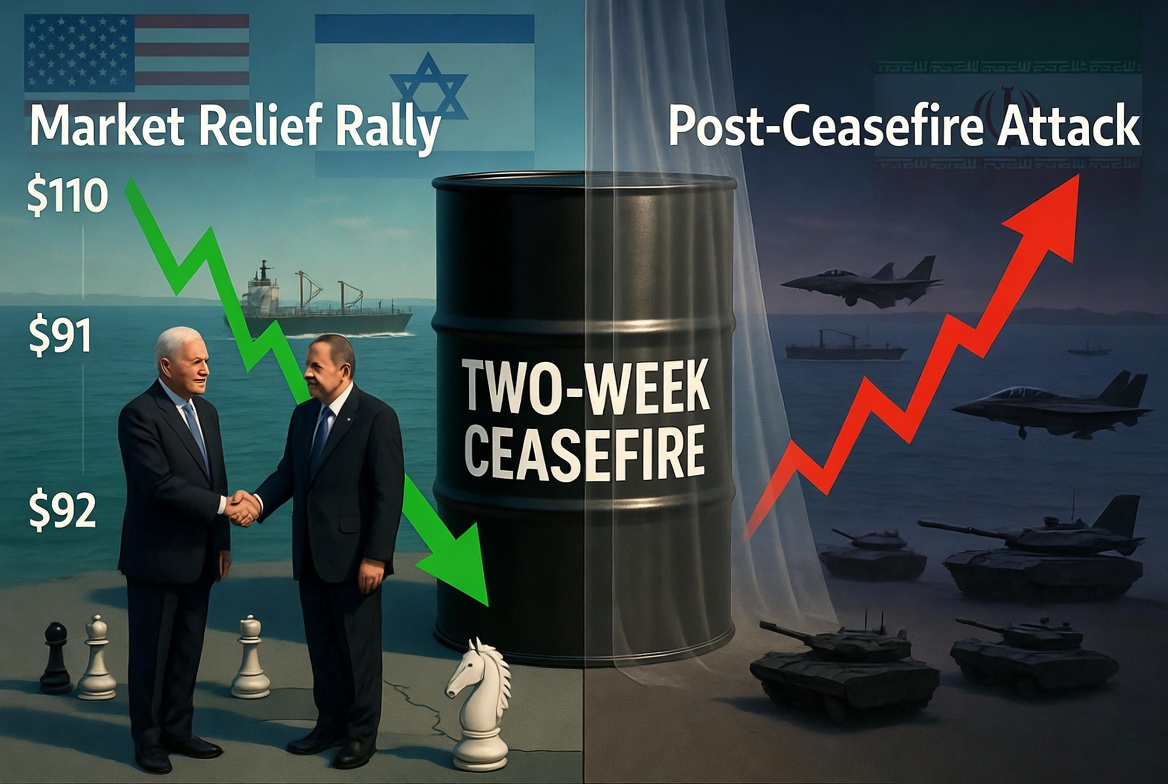
The announcement of a two-week ceasefire between the United States, Israel, and Iran has sent shockwaves through global energy markets. Oil prices dropped sharply, with Brent crude falling more than 15 percent to around 92 dollars per barrel and West Texas Intermediate plunging similarly to near 94 dollars. Stocks rallied on the news, reflecting investor relief over the potential reopening of the Strait of Hormuz. Yet beneath the surface, questions linger about the true intent behind this short-term pause. Could this be a calculated maneuver by America and Israel to reposition forces while engineering a temporary dip in oil prices? Or is it a genuine step toward de-escalation? This analysis explores the probabilities and market implications for investors.
The announcement of a two-week ceasefire between the United States, Israel, and Iran has sent shockwaves through global energy markets. Oil prices dropped sharply, with Brent crude falling more than 15 percent to around 92 dollars per barrel and West Texas Intermediate plunging similarly to near 94 dollars. Stocks rallied on the news, reflecting investor relief over the potential reopening of the Strait of Hormuz. Yet beneath the surface, questions linger about the true intent behind this short-term pause. Could this be a calculated maneuver by America and Israel to reposition forces while engineering a temporary dip in oil prices? Or is it a genuine step toward de-escalation? This analysis explores the probabilities and market implications for investors.
Oil markets reacted instantly to the ceasefire news. On April 8, 2026, benchmarks erased weeks of risk premium built up since the US and Israeli strikes on Iran began in late February. The plunge marked one of the largest single-day declines in recent years, driven by expectations that Iran would allow safe passage through the Strait of Hormuz, a chokepoint carrying roughly one-fifth of global oil supply.
Before the deal, prices had spiked above 110 dollars amid disrupted tanker traffic and Iranian threats. The ceasefire triggered an immediate unwind of that premium. Analysts noted the move aligned with classic geopolitical relief rallies, where uncertainty fades even if only briefly. However, the speed and scale of the drop also fueled speculation that the market had been positioned for precisely this outcome. Some traders viewed it as an orchestrated signal to ease supply fears temporarily, potentially benefiting certain players holding short positions or physical inventories acquired at lower levels earlier in the conflict.
The current tensions trace back to late February 2026, when joint US and Israeli operations targeted Iranian infrastructure. In retaliation, Iran effectively closed the Strait of Hormuz to hostile shipping, choking off exports from the Persian Gulf. This disruption sent oil prices soaring and heightened global inflation concerns. The waterway remains critical for Saudi Arabia, Iraq, the UAE, and other producers.
The two-week ceasefire, announced by President Donald Trump just hours before his self-imposed deadline, hinges on Iran guaranteeing safe passage for tankers. In exchange, the US and Israel agreed to suspend attacks. Iran described the move as a step toward broader talks, while US officials framed it as a pragmatic pause after achieving key military objectives. The short duration stands out. Unlike open-ended truces in past conflicts, this one has a clear expiration, prompting investors to question whether it buys time for diplomacy or preparation.
On paper, the agreement appears constructive. Iran has committed to facilitating oil flows during the window, and both sides have signaled interest in longer-term negotiations. Yet the explicit two-week limit raises red flags for skeptics. Military experts point out that such pauses often serve operational needs rather than strategic breakthroughs. Forces can resupply, reposition assets, and refine targeting data without active combat.
US troop movements in the region over recent weeks included additional deployments to support operations against Iran. A temporary halt would allow these assets to consolidate or shift to more advantageous positions. Israel, meanwhile, continues operations elsewhere in the region, such as against Hezbollah in Lebanon, indicating the ceasefire is narrowly scoped. This selective de-escalation suggests the pause may prioritize tactical flexibility over comprehensive peace.
Several factors support the notion of a strategic fakeout. First, the timing aligns with reported US and Israeli logistical needs. Intelligence assessments earlier in the conflict highlighted the value of a breathing period to replenish munitions depleted in initial strikes. Second, the market impact appears almost too convenient. Oil prices dropped precisely as the announcement hit, potentially allowing allied producers or strategic reserves to adjust inventories at favorable rates.
Third, historical patterns show great powers using short ceasefires to reset battle lines. In this case, the US could use the window to strengthen alliances with Gulf states or prepare for targeted follow-on actions if talks falter. Iran, facing internal pressures and economic strain from the blockade, may have had little choice but to accept terms that favor its adversaries in the short run. Market observers have noted unusual options activity in oil futures leading up to the news, hinting that sophisticated players anticipated the relief rally. While no smoking gun proves coordination, the alignment of military incentives with price action invites scrutiny.
The probability of this being a deliberate market play sits around 40 percent, according to a synthesis of analyst commentary. It would require synchronized signaling between Washington, Jerusalem, and energy desks, but precedents in commodity geopolitics make it plausible. A successful fakeout could see oil dip further before rebounding sharply on renewed hostilities, rewarding those positioned for volatility.
Not all signs point to deception. President Trump has repeatedly emphasized achieving long-term peace in the Middle East, and the ceasefire includes language about ongoing talks in neutral venues like Pakistan. Iran, battered by strikes, may genuinely seek relief to stabilize its economy. Global pressure from China and Russia, major buyers of Iranian oil, also favors de-escalation to restore supply chains.
Moreover, the economic costs of prolonged closure of the Strait of Hormuz have mounted rapidly. Higher energy prices threaten inflation worldwide and could derail growth in import-dependent economies. If both sides view the two weeks as a genuine testing ground for compliance, the pause could evolve into a more durable framework. Markets currently price in roughly a 60 percent chance of extension or full resolution, based on implied volatility in oil options.
Oil markets have seen similar episodes before. During the 1973 Yom Kippur War, short ceasefires preceded renewed fighting and price spikes. The 1991 Gulf War featured pauses that allowed coalition forces to reposition before decisive advances. More recently, temporary halts in Libya and Syria conflicts created brief price dips followed by rebounds when fighting resumed.
These cases illustrate a recurring pattern: short truces often mask preparation rather than signal peace. In each instance, the initial market reaction mirrored today’s plunge, only for risk premiums to return once the pause expired without resolution. Investors who treated the calm as permanent often faced losses when conflict reignited. The current two-week window fits this template, though modern communication and satellite monitoring may limit the scope for outright surprise.
Estimating exact odds remains challenging without classified intelligence, but informed analysis suggests a 35 to 55 percent chance of renewed hostilities within or immediately after the two weeks. Key variables include Iranian compliance with tanker safety, progress in side talks, and domestic political pressures on all parties. If Iran fails to deliver uninterrupted flows or if Israel perceives threats from proxy groups, escalation could follow swiftly.
A fakeout scenario gains traction if US forces use the period for visible repositioning near the Gulf. Conversely, if diplomatic channels show concrete progress, such as sanctions relief discussions, the odds of extension rise. For now, the market’s pricing reflects guarded optimism tempered by awareness of the short timeframe. Traders should prepare for either outcome, as the ceasefire’s design inherently builds in uncertainty.
Energy investors face a binary path over the next 14 days. Those betting on a fakeout can consider short-term long positions in oil futures or call options expiring post-ceasefire, anticipating a snapback if strikes resume. Conversely, bulls on de-escalation might favor diversified exposure through exchange-traded funds tracking broader energy indices while hedging with protective puts.
Portfolio managers should monitor crack spreads for refining margins and tanker rates for physical supply signals. Diversification into renewables or alternative fuels offers a buffer against prolonged volatility. Risk management remains paramount. Position sizing should account for the potential 10 to 20 percent price swing in either direction once the truce clock runs out.
Watch tanker traffic data through the Strait of Hormuz for early signs of compliance or disruption. Satellite imagery and shipping reports will provide real-time clues. Diplomatic readouts from talks in Islamabad or elsewhere could shift sentiment overnight. US military movements, Israeli statements on regional threats, and Iranian rhetoric on sanctions will also serve as leading indicators.
Oil inventory releases from the US Energy Information Administration and comments from OPEC+ members may amplify or dampen price moves. Finally, options implied volatility and futures curve shape will reveal whether the market expects calm or chaos. Investors ignoring these signals risk being caught in the next leg of this volatile cycle.
In summary, the two-week ceasefire has delivered an immediate boon to oil-dependent economies and a sharp correction in prices. Yet the structure of the deal, combined with military realities, leaves room for a tactical fakeout. While a genuine path to peace exists, prudent investors must weigh the substantial chance of renewed conflict. The coming days will clarify whether this pause represents market manipulation for strategic gain or a true turning point. For now, volatility defines the opportunity.