Physical Address
304 North Cardinal St.
Dorchester Center, MA 02124
Physical Address
304 North Cardinal St.
Dorchester Center, MA 02124

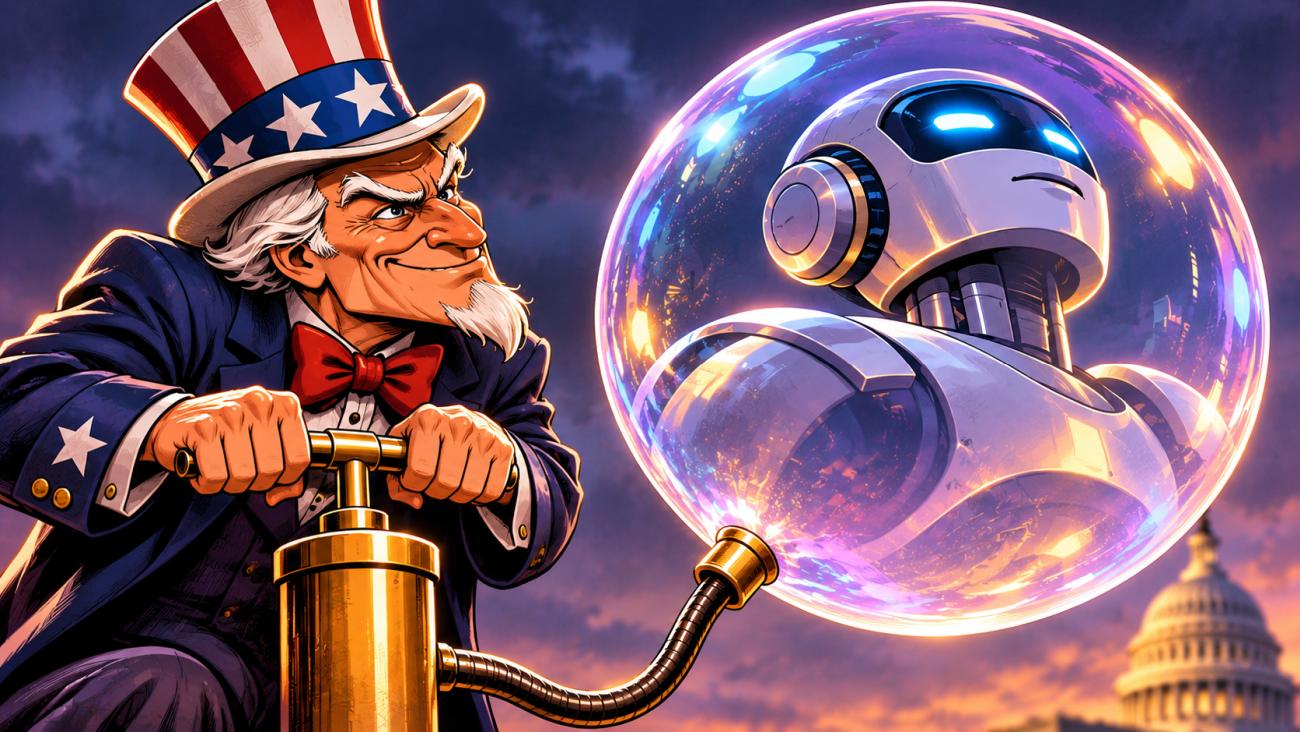
Everyone asks whether an AI crash looks like 2000 or 2008. The bigger risk may be that Washington is now too exposed to let it pop at all, and who pays for that.
Almost every serious piece of AI bubble analysis this year asks the same question: when it bursts, how bad will it be? Will it be a rerun of 2000, where shareholders bleed but the economy shrugs, or a rerun of 2008, where bad debt drags down banks, jobs and houses?
It is the right question for a normal market. It may be the wrong question for this one. There is a scenario that gets far less attention, and it deserves a hard look: the bubble does not pop, because the United States government has quietly arranged its own finances so that it cannot afford to let it.
That sounds like a comfort story. It is not. A bubble that is never allowed to burst produces a very different set of winners and losers from one that does, and most investors are not positioned for it.
The case for calm is laid out well in a recent video from the Finance Stack channel, embedded below. Its argument runs like this. A collapse in AI share prices on its own looks like the dot-com crash: savage for tech investors, mild for everyone else, because the money lost was mostly investors’ own. It only becomes a 2008-style crisis if the borrowed money behind the buildout goes bad and the losses surface inside banks, insurers and pension funds that nobody was watching.
That framework is sound, and the video’s warning signs, such as lenders demanding higher rates from data center builders and private credit funds limiting withdrawals, are worth tracking. We made a related point earlier this month in When the AI Bubble Pops, Who Actually Goes Broke?.
But both 2000 and 2008 share an assumption: that the government stands outside the boom and steps in afterwards to clean up. In 2026 that assumption no longer holds.
Start with the most literal form of exposure. The US government now owns pieces of the AI supply chain directly. According to investingLive’s summary of a Wall Street Journal tally, the administration has struck 43 deals involving equity stakes or warrants since the start of the current term, worth about $30 billion, including 14 in chips and nine in quantum computing. The largest is Intel: roughly $9 billion invested for a 9.9% stake, a position that peaked near $61 billion before falling to around $41 billion.
The government also takes a cut of revenue. In 2025, the President announced that Washington would receive 15% of Nvidia’s revenue from sales of its H20 chips to China, after negotiating down from an initial demand of 20%, as NPR reported.
And the circle may widen to the AI labs themselves. In June, the President floated the idea of the public holding a stake in leading AI developers, a proposal still at a preliminary stage according to Tech Insider. In July, the Financial Times reported that OpenAI had discussed handing the government a 5% stake worth roughly $42.6 billion, with Decrypt noting that other major developers had not signalled any interest and that a deal might need Congress.
A government that owns the stock has a reason to care about the stock price that goes beyond the health of the economy.
The second channel is growth. Estimates vary with the method, but they all point the same way. Pantheon Macroeconomics calculated that AI-linked investment plus the wealth effect from rising tech stocks probably accounted for about a third of US headline GDP growth at the end of 2025, as Fortune reported in February. Household holdings of the largest tech stocks rose by around $3.8 trillion last year, and that paper wealth fed directly into consumer spending.
That second part matters more than it first appears. The data center spending is visible. The wealth effect is not, but it means that a falling Nasdaq does not just hit portfolios. It hits the shopping habits of the households who do a large share of the country’s consumption.
The third channel is revenue. When shares rise, governments collect more in capital gains and income tax from the people who own them. That link is especially visible at state level. California’s tax collections grew strongly late last year on the back of personal income tax tied to stock market gains and the technology sector, including the AI boom, according to Governing’s review of state revenues.
The federal budget has the same exposure in a less concentrated form. Capital gains receipts are notoriously volatile, rising sharply in bull markets and collapsing after crashes. A sustained fall in AI valuations would show up in tax receipts within a year or two, at exactly the moment the government would be asked to spend more.
This is where the pieces lock together. The US is carrying a debt load that only works if the economy keeps growing faster than the interest bill. The Congressional Budget Office projects net interest costs of about $1.0 trillion in 2026, or 3.3% of GDP, taking 18.6% of all federal revenue, and rising toward $2.1 trillion by 2036, as the Peter G. Peterson Foundation summarises.
The official way out of that hole is growth, and the most credible growth story on offer is AI: first the construction boom, then the hoped-for productivity gains. Put the four channels together and the picture is clear. The government owns part of the trade, relies on it for a large share of growth, collects tax on its gains and needs its promised productivity to make the debt sustainable. Its fortunes are now tied to the future of AI in a way that was never true of internet stocks in 2000 or subprime mortgages in 2007.
The official line is firm. When OpenAI’s finance chief raised the idea of a federal backstop for data center financing in late 2025, White House adviser David Sacks replied that there would be no federal bailout for AI, arguing that if one frontier lab failed, others would take its place, as Stocktwits reported. He framed the government’s role as speeding up permitting and power generation rather than writing cheques.
Take that at face value and it still leaves plenty of room. A government does not need to announce a bailout to keep a boom alive. It can fast-track power plants and grid connections, allow companies to deduct the full cost of new equipment immediately, convert grants into equity, lean on the central bank for lower rates, and open export markets in exchange for a cut. None of that is a rescue. All of it lowers the odds of a disorderly collapse.
We looked at what an outright rescue after a crash would and would not do for shareholders in Buying the Bailout. This scenario comes earlier in the story: support that arrives continuously, before anything breaks.
Here is the contrarian part. If you assume the government will not let AI fail, the natural instinct is to treat that as a floor under prices and buy every dip. History suggests that is the wrong lesson.
Governments are good at preventing collapses. They are much worse at preventing stagnation. Japan in the 1990s avoided a banking wipeout by keeping weak lenders and borrowers on life support, and its stock market spent decades below its 1989 peak. China has spent years managing its property bust rather than letting it clear, and property developers have been terrible investments throughout. In both cases the system survived. Shareholders did not prosper.
A protected AI sector could look similar. Prices might never crash the way the Nasdaq did in 2000, but they could grind sideways for years while the economics catch up with the valuations. Meanwhile, the price of protection tends to fall on shareholders in quieter ways:
In other words, the risk does not disappear. It moves from a sudden crash in tech stocks to a slow transfer of value away from cash, bonds and anyone holding dollar-based savings.
None of this means the bubble cannot pop. Governments run out of room, politics change, and markets have a habit of overwhelming policy. But it does mean investors should prepare for more than one outcome, not just the crash everyone is debating.
A few questions are worth asking about any portfolio:
The usual debate asks whether an AI crash would look like 2000 or 2008. There is a third possibility: no crash at all, because Washington has become too exposed to let one happen. That world is not a free ride. It is one where the state shares the upside, politics shapes the returns, and the cost of keeping the boom alive is quietly paid by savers and the dollar. Investors who are only positioned for a pop, or only for a rescue, may be preparing for the wrong ending.
This article is for informational purposes only and does not constitute financial advice. Investing involves risk, and you can lose some or all of your investment.