Physical Address
304 North Cardinal St.
Dorchester Center, MA 02124
Physical Address
304 North Cardinal St.
Dorchester Center, MA 02124

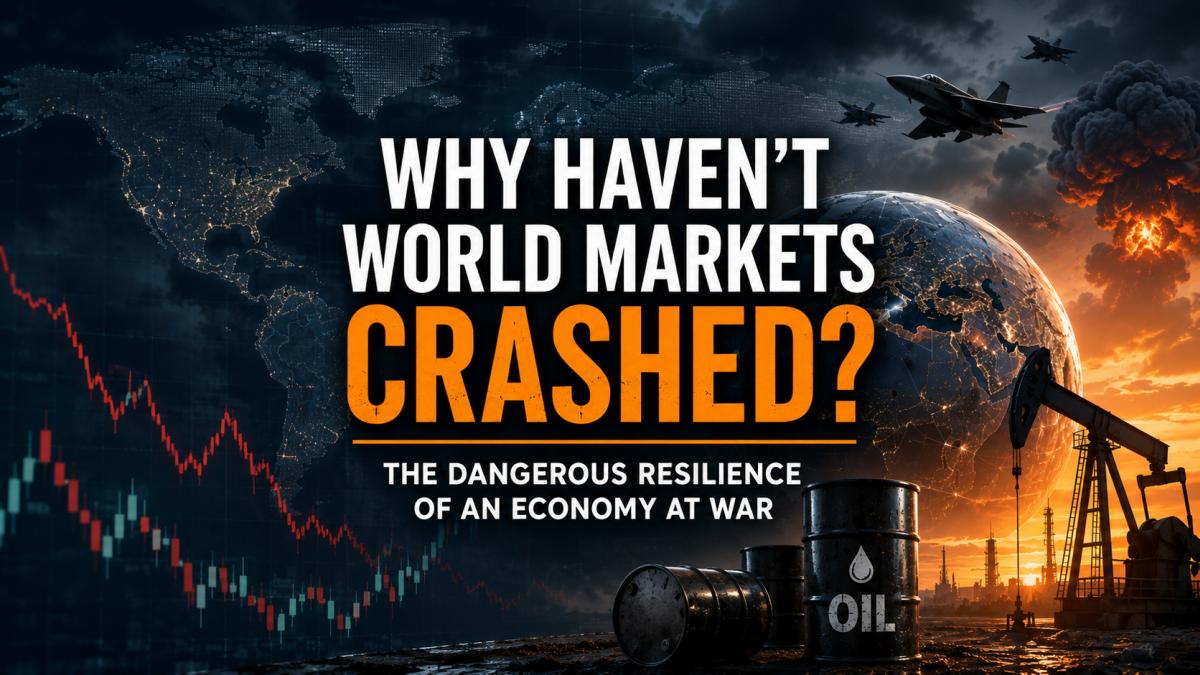
Global financial markets have absorbed one of the most serious geopolitical shocks in decades without the kind of collapse that history would have predicted. A major disruption to Gulf energy supplies, an extended closure of a critical shipping route, elevated inflation, and mounting political uncertainty would once have been almost guaranteed to send oil prices spiraling and tip the world economy into recession.
Global financial markets have absorbed one of the most serious geopolitical shocks in decades without the kind of collapse that history would have predicted. A major disruption to Gulf energy supplies, an extended closure of a critical shipping route, elevated inflation, and mounting political uncertainty would once have been almost guaranteed to send oil prices spiraling and tip the world economy into recession. That is not what happened this time, and the gap between expectation and outcome is exactly where contrarian investors should be looking.
The scale of the disruption was not trivial. Before the current conflict, roughly a fifth of the world’s petroleum liquids moved through the Strait of Hormuz each day, and the EIA’s long-running chokepoint analysis has repeatedly flagged the strait as the single most consequential artery in global energy trade, with no realistic combination of alternative routes able to absorb a full stoppage. The IMF’s April communique on the conflict described the fighting as a major new global shock whose ultimate cost would hinge on how long it lasted and how far it spread.
On paper, that is the recipe for a textbook stagflation scare. Remove a large share of the world’s oil supply, and transportation, manufacturing, agriculture and household budgets all absorb higher costs at once. Central banks are then stuck choosing between fighting inflation and supporting growth, a combination that has historically been far more damaging to markets than an ordinary downturn. What actually followed was messier and less dramatic than that script, and understanding why matters more than simply cheering the fact that stocks didn’t crash.
Energy markets are not static systems waiting to be broken by a single event. When a major route becomes unreliable, producers redirect flows, governments release strategic reserves, refiners adjust sourcing, and consumers cut back. Coverage of the EIA’s assessment of Hormuz flows under threat noted that Saudi Arabia had already been shifting seaborne crude away from the strait toward Red Sea ports well before the latest escalation, giving the system a head start on adaptation.
None of these substitutes are perfect. They are costlier, capacity-constrained, and incapable of replacing every barrel that would otherwise have transited Hormuz. But markets did not need a perfect replacement. They needed enough of a buffer to prevent a marginal shortage from becoming a full-blown catastrophe, and for several months that is roughly what happened. Reporting on the IMF’s July World Economic Outlook update noted that renewable energy capacity and AI-driven investment both helped cushion the blow to global output even as the fund downgraded its overall growth forecast.
There is a broader structural story here beyond the specifics of this one conflict. Modern economies carry more producers, more pipelines, larger strategic inventories, and more flexible trading networks than they did thirty or forty years ago. Falling energy intensity in advanced economies compounds the effect: the same barrel of disrupted oil now threatens a smaller share of total economic activity than it once did.
That does not mean energy has stopped mattering. It means the transmission mechanism has changed. Investors who look at a headline figure like “a fifth of global oil flows disrupted” and assume the economic fallout must scale proportionally are missing the more complicated interaction between lost supply, available inventory, substitute production, demand destruction, and the system’s accumulated capacity to adjust. Redundancy of this kind is one of the most underappreciated forms of economic resilience, and it is a large part of why this shock has not yet produced a synchronized global downturn.
This is where the contrarian argument becomes genuinely interesting. The absence of a market crash does not prove the underlying economy is sound. It only proves the shock has not yet overwhelmed the system’s capacity to absorb it, and those are very different claims. Officials briefing on the IMF’s resilience assessment this July were careful to frame the message as conditional, noting that the global economy had weathered the shock while stressing that uncertainty remained elevated and that energy-dependent economies with limited policy room were still exposed.
A system can keep standing while quietly becoming more fragile. The cost of this shock may not show up first in GDP figures at all. It may show up instead in eroded purchasing power, compressed corporate margins, strained government finances, or a diminished ability for central banks to respond to whatever comes next. Investors who equate resilience with immunity are making a category error that tends to get exposed at the worst possible moment.
One of the easiest mistakes an investor can make is defining a crisis purely by whether share prices have fallen. Inflation can quietly erode wealth without ever producing a dramatic selloff. A portfolio that rises five percent while prices rise six percent has technically grown in nominal terms while shrinking in real purchasing power, and that is precisely the risk this energy shock has created.
Higher energy costs work their way into transport, food production, industrial inputs and services over time. Companies either absorb the hit through thinner margins or pass it on to already-stretched consumers, and neither outcome supports the kind of favorable growth and inflation backdrop that fueled the market gains of the past decade. If geopolitical shocks keep interrupting the return to target inflation, the entire cost-of-capital environment that investors have built their assumptions around may simply be higher for longer, crash or no crash.
Equity investors tend to extrapolate from corporate earnings and stay optimistic for surprisingly long stretches. Bond investors face a harder problem: they must price inflation, sovereign borrowing needs, and the probability that central banks stay restrictive for longer than hoped. A prolonged energy shock creates an awkward bind for policymakers, who may want to support households against higher costs at precisely the moment when doing so risks reinforcing the inflation they are also trying to contain.
That tension is a better gauge of underlying stress than any single day’s move in a major equity index. The more useful question for contrarian investors is not whether stock markets have fallen, but whether the real cost of capital stays elevated long after the conflict itself has faded from the headlines.
Shock absorbers only work while they have capacity left. IMF officials briefing on the oil market’s resilience through mid-2026 framed the situation explicitly as reassurance rather than grounds for complacency, warning that the fund remained on high alert even as energy flows showed signs of stabilizing. Inventories that were drawn down to cushion the initial disruption do not refill themselves automatically, and idle production capacity brought online during the crisis is not infinite.
That distinction changes the calculus for anyone tracking this story. A stable oil price today says less about whether the underlying geopolitical risk has been neutralized than it does about how much spare capacity remains in the system. The more useful questions are how much inventory is left, how much alternative pipeline capacity is still unused, how much additional production could realistically come online, and how long the financial system can keep tolerating elevated energy costs before something gives.
The obvious trade in any energy shock is the first-order one: oil producers benefit, energy-intensive transport and manufacturing suffer. Once that relationship is priced in by everyone, it stops being a source of edge. The more interesting opportunities sit one level deeper, in the businesses with genuine pricing power versus those locked into thin margins, in the sectors carrying too much leverage to absorb a higher-for-longer rate environment, and in the currencies and import bills of economies most exposed to a sustained rise in energy costs. Those distinctions are where a contrarian view separates from the consensus narrative that the crisis has simply passed.
Markets are built to discount the obvious. Everyone already knows there is a war, and everyone has already priced the risk to oil. The more dangerous moment may come later, once the conflict recedes from headlines but its financial residue remains embedded in the system: higher financing costs, larger government deficits, diminished consumer purchasing power, and central banks still reluctant to ease.
The temptation during any prolonged crisis is to assume markets must eventually “wake up” and correct sharply. But markets do not owe anyone a replay of historical precedent. The global economy has changed, the energy system has changed, and the tools available to governments and central banks have changed along with them. The mistake would be concluding that nothing is wrong simply because equities have not cracked. The opposite mistake would be assuming a crash is inevitable purely because history says it should be. The more useful question for investors is not whether the world survived this particular shock. It is whether the system retains enough spare capacity to survive the next one before today’s buffers are fully spent.