Physical Address
304 North Cardinal St.
Dorchester Center, MA 02124
Physical Address
304 North Cardinal St.
Dorchester Center, MA 02124

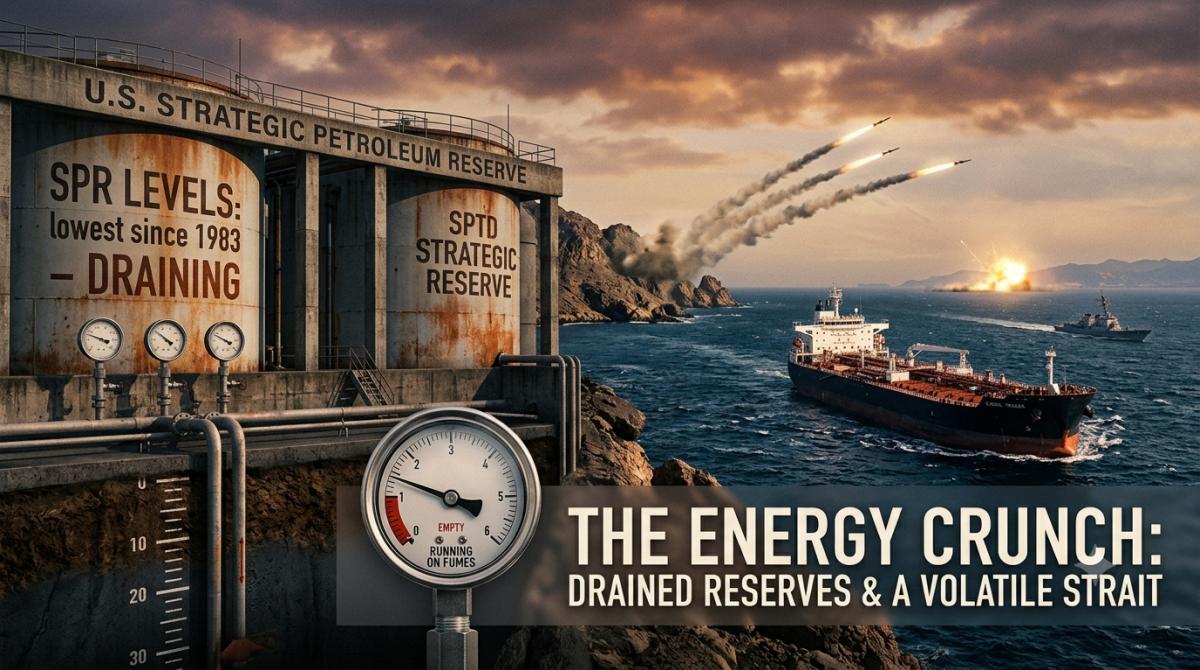
America's emergency oil stockpile has been drained to levels not seen in 43 years. The Strait of Hormuz is once again a shooting gallery. And until this week, crude oil traded as if none of it mattered.
America’s emergency oil stockpile has been drained to levels not seen in 43 years. The Strait of Hormuz is once again a shooting gallery. And until this week, crude oil traded as if none of it mattered.
For most of early July, benchmark crude sat stubbornly around $71 a barrel while tanker traffic through the world’s most important energy chokepoint ground toward a standstill. Wall Street had largely convinced itself that the crisis was ending and a supply glut was coming. Meanwhile, the physical market, the one where refiners actually buy barrels and sell fuel, was screaming the opposite.
Both stories could not be true. This week, we started finding out which one was wrong.
Start with the most alarming number in energy markets right now. Crude stocks in the US Strategic Petroleum Reserve fell to 316.5 million barrels, the lowest level since April 1983, with nearly 99 million barrels drained since the Iran war began in late February. The drawdowns are part of a coordinated release program totaling 172 million barrels, comparable in scale to the entire 2022 release, which itself was the largest in history and was never refilled.
Here is the detail most commentary misses. The SPR is not a tank you can empty to zero. The oil sits in underground salt caverns along the Gulf Coast, and extraction depends on water injection to push crude to the surface. Below a certain physical floor, pumping rates and pressure degrade to the point where the remaining barrels become difficult to access at emergency speed. At the current pace of withdrawals, the reserve approaches that operational floor within a few months.
Washington has strong political incentives to keep draining. Pump prices are a midterm liability, and releasing stored crude is the only lever that works quickly. But every barrel released today is a barrel unavailable for the next shock, and the next shock may already be here. The US now faces any further disruption with the thinnest emergency buffer in four decades, which means future price spikes would arrive faster and run harder, with less ammunition to fight them.
While crude prices drifted lower through late June and early July, something strange was happening one step downstream. The crack spread, the difference between the price of crude oil and the price of the gasoline and diesel refined from it, was blowing out.
The closely watched 3-2-1 crack spread hit an all-time high in early July, turbocharged by Russia’s suspension of diesel exports. Refiners were saying, in the clearest language markets possess, that finished fuel is genuinely scarce even if paper crude is cheap. As one strategist put it, market pricing had likely gotten ahead of the physical reality.
This matters because diesel is the bloodstream of the industrial economy. It moves trucks, trains, ships, tractors and harvesters. When diesel margins rise, the cost feeds into freight, food and manufacturing with a lag of weeks, not quarters. Consumers do not buy crude oil. They buy refined products, and refined products were never confirming the glut narrative that crude futures were pricing.
When the futures market and the physical market disagree this loudly, one of them eventually capitulates. On Monday, after Iranian missiles struck two UAE tankers in the strait and Washington announced it would reimpose its blockade of Iranian ports, Brent surged 9.6% to settle above $83, its biggest single-day gain in over six years. The crack spread called it first. It usually does.
If you want to know who profits from this whiplash, do not look at the wellhead. Look at the trading floor.
The trading arms of BP, Shell and TotalEnergies earned an estimated $3.3 billion to $4.75 billion more in the first quarter than in the final quarter of 2025, riding the extreme volatility unleashed by the war. These desks trade multiples of what the majors actually produce, and their results are deliberately folded inside broader divisional numbers, making the true scale of the windfall opaque even to shareholders.
The pattern reveals something structural. European majors, long unable to match American rivals on raw production, have built their competitive edge on the ability to move and reprice barrels during chaos. Volatility is not a risk to these businesses. It is the product. For investors, the implication is uncomfortable: the market participants with the best real-time information about physical oil flows are the same ones whose profits depend on the rest of us mispricing them.
The single biggest reason crude stayed cheap through a chokepoint crisis is not American diplomacy or Gulf spare capacity. It is Beijing.
When Hormuz seized up, roughly 13 million barrels per day of flows were lost. Increased production elsewhere replaced only a fraction. The bulk of the adjustment came from demand simply vanishing, and most of that vanished demand was China living off its own enormous stockpiles rather than importing. Chinese crude purchases remain roughly a quarter below pre-war levels, and Bloomberg’s Javier Blas argues that China has become the invisible hand of the oil market, the force that quietly stopped prices from reaching $200. His deeper question is the one that should keep bulls and bears equally awake: what if a meaningful share of that demand withdrawal is permanent, driven by electric vehicles, renewables and coal-to-chemicals substitution?
But there is a hard limit to this strategy. Inventories are a savings account, not an income stream. Trading house Mercuria expects China to return to large-scale buying once commercial stocks reach operational minimums, and China built much of its buffer in 2025 by hoovering up roughly a million barrels a day when prices sat near $60. Beijing appears to be waiting for that price again. If crude stays above it, China must eventually pay up anyway to keep refineries running, and at some point it must buy surplus barrels to rebuild the very inventories it just spent. The 6 million barrels of “lost” demand is a loan to the market, not a gift.
Put the pieces together and a specific window of danger emerges.
By autumn, the US can no longer lean on the SPR without breaching its operational floor. China’s commercial inventories approach the point where restocking becomes mandatory rather than optional. If Beijing starts buying just as Washington stops selling, two of the largest artificial supply cushions in the market disappear simultaneously, right as refiners head into seasonal maintenance with gasoline inventories already below the five-year range.
Wall Street’s glut thesis is not crazy. Long-run demand has repeatedly undershot forecasts, the electric transition caps consumption growth, and supply from Brazil, Canada and the US has proven remarkably elastic. On a five-year view, the bearish case for oil remains credible. But the market is not trading the five-year view. It is trading the next two quarters, and the next two quarters feature depleted reserves, record refining margins, a contested strait and a coiled Chinese restocking bid.
The contrarian read is straightforward. When financial markets price hope and physical markets price scarcity, respect the physical market. It handled the barrels. It saw the shortage first. And for governments carrying record debt loads into a fragile disinflation, even a modest energy-driven inflation shock in the fourth quarter would be a policy nightmare arriving at the worst possible time.
We warned three weeks ago that markets had priced a fragile 60-day memorandum as permanent peace. The memo is now in tatters, the tankers are being hit again, and the cushions that absorbed the first shock are close to spent. The second shock lands on a much thinner mattress.