Physical Address
304 North Cardinal St.
Dorchester Center, MA 02124
Physical Address
304 North Cardinal St.
Dorchester Center, MA 02124

There's a particular kind of market moment that only becomes obvious in hindsight: the point at which good news stops lifting prices and starts confirming that everything achievable has already been achieved. We may be living through one of those moments right now — and the clearest tell isn't hiding in an obscure credit spread or a yield curve model. It's sitting in plain sight, wearing a name every investor over forty grew up with: Intel.
There’s a particular kind of market moment that only becomes obvious in hindsight: the point at which good news stops lifting prices and starts confirming that everything achievable has already been achieved. We may be living through one of those moments right now — and the clearest tell isn’t hiding in an obscure credit spread or a yield curve model. It’s sitting in plain sight, wearing a name every investor over forty grew up with: Intel.
Intel’s turnaround under CEO Lip-Bu Tan is real. The 18A process node is finally shipping in volume, Panther Lake processors are out the door, and reports of foundry conversations with Apple and Google gave the stock a strategic-importance halo that Washington’s equity stake only brightened. Nobody serious disputes that the business has improved.
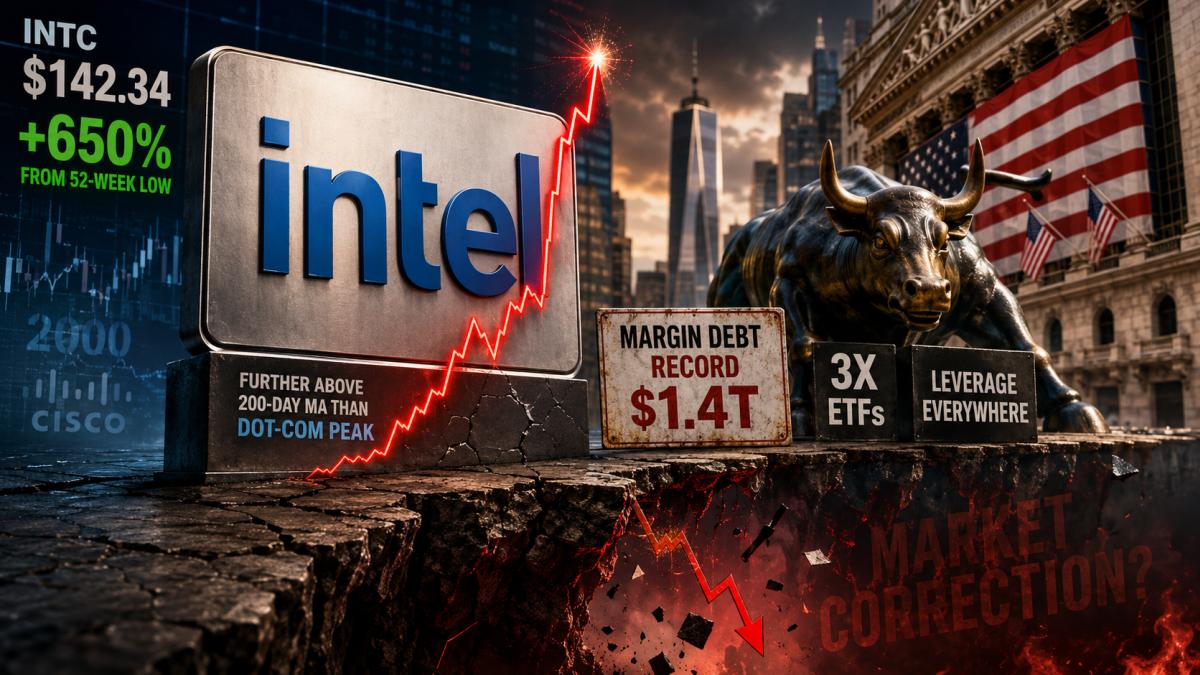
The price is another matter entirely. At its June 30 peak of $142.34, Intel had gained roughly 650% off its 52-week low — a move that pushed the stock further above its 200-day moving average than at any point in its history, exceeding even the extremes of the dot-com bubble. Think about what that sentence contains. Intel existed in March 2000. It was one of the four horsemen of the Nasdaq. And on this measure, the 2026 version of the stock became more stretched than the mania version ever was.
The comparison gets worse the closer you look. Back in May, when Intel was trading around $113 on a forward multiple north of 100x, analysts noted that its valuation profile almost exactly matched Cisco’s on March 27, 2000 — the day Cisco briefly became the most valuable company on Earth, two weeks after the Nasdaq’s top, and arguably the single worst entry point a generation of investors ever bought. Cisco’s business went on to thrive for decades. The people who bought it that day still waited a quarter-century to break even. Great company, wrong price: it’s the oldest lesson in the book, and markets re-learn it every cycle at full tuition.
And here’s the part that should genuinely unsettle the bulls: Intel has already broken. The stock has fallen roughly 25% from its record in little more than a week, caught in a semiconductor selloff that erased something like $1.3 trillion of sector value in days — and even after that drawdown, it remains further above its long-term trend than it was at the dot-com peak. When a stock can lose a quarter of its value and still screen as historically extreme, the problem was never the catalyst. The problem was the altitude.
If Intel were an isolated case of enthusiasm, you could shrug it off as a single crowded trade. It isn’t. It’s the most visible symptom of a market that has been systematically borrowing its way higher.
The Wall Street Journal’s Jack Pitcher recently documented what he called a trillion-dollar borrowing binge lifting the stock market to risky heights: US margin debt surged 54% year over year to a record $1.4 trillion in May, while assets in leveraged ETFs — the double- and triple-daily-move instruments beloved of hedge funds and Robinhood teenagers alike — nearly doubled to around $220 billion. Margin debt growing at half again its prior-year level is not what accumulation by patient capital looks like. It’s what the late innings of a momentum regime look like, when the marginal buyer needs borrowed money to keep the tape moving.
Leverage doesn’t cause corrections. It determines their character. A market carried higher by cash buyers declines; a market carried higher by margin and 3x ETFs deleverages, with forced selling begetting forced selling. The mechanism is symmetrical and merciless: the same borrowed dollars that amplified the ride up guarantee the exit will be crowded on the way down.
Meanwhile the headline indices keep telling a soothing story. The Dow closed above 53,000 for the first time on July 6, fresh off its best first half since 2021, with strategists celebrating a “Great Rotation” out of stretched tech into blue chips and financials. Rotation is being framed as breadth, and breadth as health.
But underneath the record closes, the stealth deterioration is accumulating. Yahoo Finance’s Brian Sozzi flagged three quiet market events that should worry investors: South Korea’s Kospi — this year’s best-performing major market — sliding into a bear market with a 20% plunge from its peak; renewed US–Iran escalation around the Strait of Hormuz spiking crude and reviving inflation fears; and blowout chip earnings that triggered selling rather than buying, because in a market priced to perfection, beating estimates no longer clears the bar.
That last point deserves a moment. When strong results produce derisking, the market is telling you its expectations have detached from anything a company can actually deliver. That is precisely the psychology of late 1999 and early 2000 — and it’s showing up first in the same sector that led the whole advance.
The Korean situation is the most instructive preview of how this ends. The Journal’s Spencer Jakab warned that the world’s hottest market risks a Squid Game ending, and the local coverage of his argument lays out why: Korea’s market rose 165% in a year while volatility-interruption circuit breakers triggered a record 29,357 times in the first half — surpassing even the COVID crash era — as retail investors poured over a trillion won into single-stock leveraged ETFs while foreign investors quietly sold roughly $100 billion. Ordinary people taking enormous leveraged risks, violent price swings, smart money exiting through the side door: the metaphor writes itself, and it doesn’t end well for most players. What happens in the world’s frothiest market rarely stays there. Korea isn’t a sideshow; it’s a stress test of the same leveraged-retail structure now embedded in US markets.
None of this means the optimists are stupid. Fundstrat’s Tom Lee, the most consistently right bull of this cycle, argues that AI is “one of the most important structural stories in our lifetime” and sees easing inflation in the back half of 2026 — core PCE cooling, crude retreating from its April spike above $114 to the low $70s — as fuel for the next leg higher, one that finally broadens beyond the AI complex.
He may be right about the technology. The dot-com bulls were right about the internet, too. That’s the uncomfortable symmetry: transformative technologies and catastrophic entry prices coexist all the time. The internet rewired civilization and the Nasdaq lost 78% over 30 months. Cisco quintupled its revenue over the next 25 years and destroyed the capital of everyone who bought the peak. Being right about the story has never protected anyone from being wrong about the price.
And notice what the bull case now requires. It needs inflation to keep easing while a Hormuz confrontation pushes oil around. It needs hyperscaler capex to stay vertical while chip earnings are already being sold. It needs the record margin debt to unwind gently, the leveraged ETF complex to behave, the Korean deleveraging to stay contained, and companies trading at triple-digit forward multiples to execute flawlessly for years. Each assumption is individually defensible. Stacked together, they describe a market that has priced in the absence of accidents — in a world currently manufacturing accidents at scale.
The contrarian playbook here is not “sell everything and hide in a bunker.” Timing tops is a fool’s errand; markets this leveraged can melt up spectacularly before they break, and the rotation into financials and defensives may well power one more rally — quite possibly the last good one before gravity reasserts itself.
The playbook is about positioning for asymmetry. Trim what leverage-driven flows have inflated most, starting with anything trading multiple standard deviations above its long-term trend. Treat momentum darlings on triple-digit forward multiples as sources of funds, not destinations. Respect that the disinflation-plus-rotation trade Lee describes can work without you needing to own the most stretched names to participate. Keep cash not as a prediction but as an option premium on other people’s forced selling — because when $1.4 trillion of margin debt meets its first real margin call, the buyers who set the bottom will be the ones who didn’t need to sell.
Intel’s July 23 earnings report is the near-term tripwire worth watching. If foundry revenue and 18A progress impress, the leveraged crowd gets one more reprieve. If they don’t, the most historically stretched large-cap in America finds out how long its leash really is.
Every cycle, the market chooses one stock to embody its excess. In 2000 it was Cisco. In 2021 it was the meme complex. In 2026, with a certain poetic cruelty, it appears to be the very company whose collapse from grace defined the post-dot-com decades — now resurrected, celebrated, and priced beyond even its own bubble-era extremes. History doesn’t repeat, but it clearly enjoys casting the same actors.
This article is for informational purposes only and does not constitute financial advice. Always do your own research before making investment decisions.