Physical Address
304 North Cardinal St.
Dorchester Center, MA 02124
Physical Address
304 North Cardinal St.
Dorchester Center, MA 02124

Three weeks ago, this blog argued that the market had priced a 60-day memo as permanent peace. The core claim was simple: crude had stripped out its entire war premium on the strength of an interim ceasefire document that deferred every hard question, while one of the parties was still visibly launching strikes. The metaphor we used was a market that had stopped paying for fire insurance while someone was still walking around the building with a lighter.
Three weeks ago, this blog argued that the market had priced a 60-day memo as permanent peace. The core claim was simple: crude had stripped out its entire war premium on the strength of an interim ceasefire document that deferred every hard question, while one of the parties was still visibly launching strikes. The metaphor we used was a market that had stopped paying for fire insurance while someone was still walking around the building with a lighter.
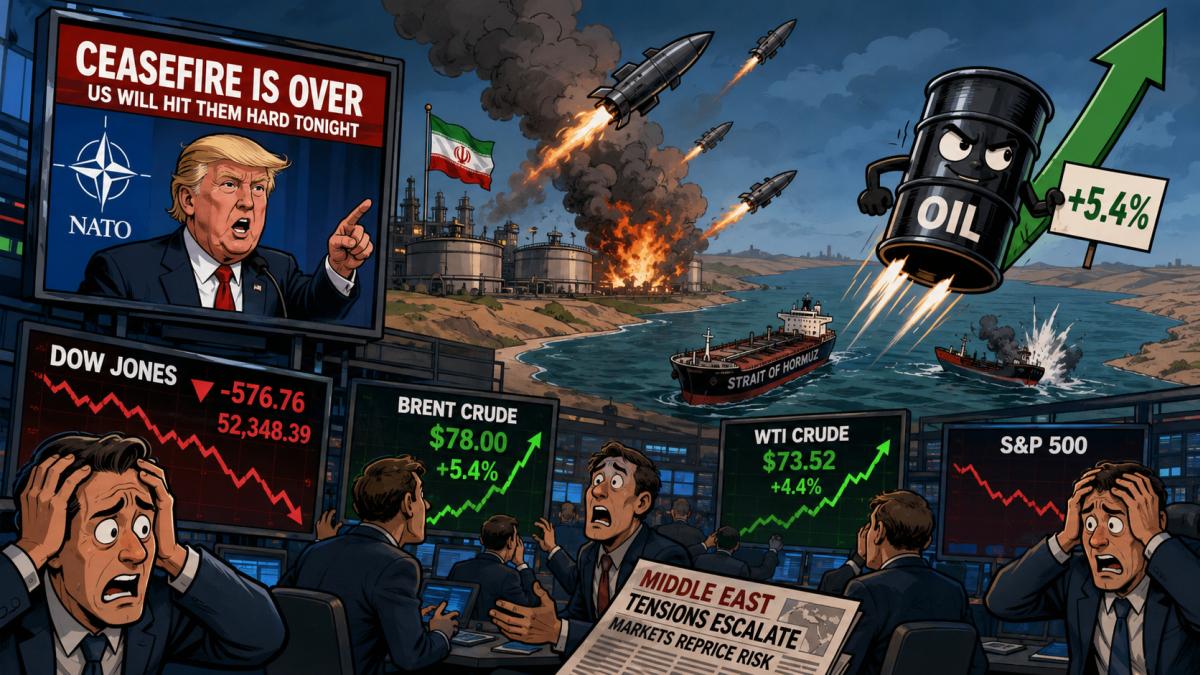
On Wednesday, the lighter came out. The Dow Jones Industrial Average slid more than 570 points, closing down 576.76 points at 52,348.39, after President Trump told the NATO summit in Ankara that the ceasefire with Iran is over and that US forces would, in his words, “hit them hard tonight.” Brent crude jumped 5.4 percent to settle above $78, and West Texas Intermediate popped 4.4 percent to close at $73.52.
None of this required foresight. It required only reading the document the market had chosen not to read. This article is not a victory lap for its own sake. It is a look at what the repricing mechanism actually did on Wednesday, why it moved the way it did, and what the episode teaches about positioning in a market that keeps mistaking pauses for endings.
The sequence matters, because it followed the spoiler script almost line for line. On Tuesday, three commercial vessels were struck near the Strait of Hormuz, an attack Washington attributed to Iran and Tehran declined to claim. The US responded the same day: Treasury revoked the sanctions waiver that had allowed Iranian crude back into the global market, and Central Command launched what it described as a series of powerful strikes against Iranian targets.
By Wednesday morning the president had declared the ceasefire finished and negotiations a waste of time. US crude spiked as high as $76 intraday, its largest single-day move since early June, bringing the two-day gain to more than 7 percent. Global equities followed the script in the other direction. The Stoxx 600 closed nearly 2 percent lower, Germany’s DAX and France’s CAC 40 both lost more than 2 percent, and the only European sector to finish green was oil and gas.
The instructive detail is what did not fall. The Nasdaq actually rose 0.2 percent on the day, while the Dow, loaded with industrials, financials and energy-sensitive multinationals, took the full hit. The market did not panic uniformly. It repriced selectively, punishing exactly the names most exposed to the input cost shock while the AI complex shrugged. That is not resilience. That is a market still refusing to connect the geopolitical risk to its most crowded trade, a point we will return to.
The transmission chain from a threat delivered at a NATO podium to a 570-point index decline runs through a well-worn sequence, and it is worth spelling out because it is the same chain that will fire again on the next headline.
Oil is the first domino. A credible threat to Gulf supply re-embeds the risk premium that had been deleted from the forward curve, and crude gaps higher within minutes. Higher crude flows directly into gasoline, diesel, jet fuel and petrochemical feedstocks, which is why airline stocks sold off 2 to 4 percent on Wednesday while ConocoPhillips and Marathon Petroleum rallied.
The second domino is inflation expectations. Energy is the most visible and fastest-moving component of headline inflation, and a sustained move higher forces the repricing of the entire rate path. The Federal Reserve’s June minutes, released the same day, showed a committee already split on direction, and the market’s read was immediate: a fresh oil shock makes cuts harder to justify and keeps the hiking scenario alive. As Oxford Economics put it in a client note, the ceasefire was always fragile and flare-ups were inevitable; the open question is whether this is a bump or the edge of the storm.
The third domino is equities. Higher discount rates compress valuations, higher input costs compress margins, and the sectors that carry both exposures at once, industrials, consumer discretionary, transport, get sold first. That is the anatomy of Wednesday in three steps, and it took roughly six hours from podium to closing bell.
The most common mistake in reading geopolitical market shocks is treating them as a problem for traders in New York. The pain radiates outward, and it lands hardest on energy-importing economies and the people who live in them.
South Korea offers the cleanest illustration this week. On the same Wednesday the Dow was falling, Korea’s finance minister was convening emergency-adjacent meetings and pledging support for household livelihoods as foreign exchange and financial market volatility persisted despite a record current account surplus. His language is worth noting: the Middle East war is feeding inflationary pressure and slowing employment, and the strain is showing up not in bank balance sheets but in ordinary household budgets. Foreign capital outflows and violent swings in the Kospi were on the same agenda.
That is the second-order move we flagged in June running in reverse. When crude fell 38 percent into the memo, energy importers across Asia and Europe enjoyed a stimulus they did nothing to earn. Now the same mechanism is clawing it back, through weaker currencies, imported inflation and central banks that suddenly have less room to ease. A single sentence at a NATO summit repriced the cost of living for households from Seoul to Frankfurt. That is what it means for a market to have removed its insurance.
Here is the uncomfortable context for Wednesday’s drop: it landed on a market that the sell-side itself had been describing as stretched.
Morgan Stanley’s Global Investment Committee, in a note titled The Rally Is Back, But Risks Are Rising, is still tilted toward equities with a one-year S&P 500 target of 8,300, yet the same piece concedes the economy underneath the rally is unevenly strong, powered by an AI infrastructure spending boom while inflation-adjusted household purchasing power weakens and credit card delinquencies climb. That is a bull case with a visible crack in the foundation.
Bank of America is blunter. Its bear market signposts show speculation hitting extreme levels, with high-multiple stocks gapping up in a pattern that has historically preceded a valuation snapback, and the bank is holding a year-end S&P target of 7,100, roughly 5 percent below current levels. Fortune’s reporting around that call notes chip names up several hundred percent on the year and Korean AI darlings setting records days before suffering historic single-session plunges.
Put the two together and the shape of the risk becomes clear. The market absorbed Wednesday’s shock with the Nasdaq green because the AI trade is treated as immune to geopolitics. It is not. A sustained oil shock feeds inflation, inflation feeds rate hikes, and rate hikes are precisely the solvent that dissolves extreme multiples. The Iran risk and the speculation risk are not two separate stories. One is the plausible trigger for the other.
The June thesis had three legs. First, the memo was a time-boxed de-escalation, not a settlement, with the enrichment question unresolved. Second, an active spoiler meant the probability of an incident in or near the strait was materially above zero while the market priced it at zero. Third, the payoff was asymmetric: little further downside for crude if the consensus proved right, substantial snapback if any live risk fired.
Wednesday validated the second and third legs in a single session. The asymmetry paid exactly as the structure suggested it would, with a 7 percent two-day move in WTI against a consensus that had been leaning the other way. The first leg is now being tested in the ugliest possible way, with the president declaring the framework dead before its own 60-day clock expired.
The honest caveat is the same one we gave in June: this was never a prediction that peace would fail, and it is not now a prediction that full-scale war resumes. Investors quoted this week see the threats from both sides partly as negotiating leverage rather than final intent, and they may be right. The point was never the scenario. The point was the mispricing of the distribution, and that mispricing has now partially corrected in a way that rewarded anyone who refused to pay the optimistic price.
For investors who watched Wednesday from an unhedged position, the useful question is not what happened but what to do before it happens again. A few principles, none of them exotic:
The market spent June pricing a 60-day memo as permanent peace. It spent one Wednesday in July learning the difference. The next memo, and there will be one, deserves to be read before it is priced.
This article is analysis, not investment advice. Markets carry risk and positioning is the reader’s own responsibility.